Level:
Correct: 0
Incorrect: 0
Marks: 0/0
Practice
Course:
Topics:
Year 5 Maths Smart practice A mixed round aimed at your weak spots
Unit 1
Place value
Number and place value
Numbers up to one million
Quick practice6 skills
Rounding whole numbers
Quick practice6 skills
Negative numbers
Quick practice6 skills
Roman numerals
Quick practice5 skills
Unit 2
Addition and subtraction
Unit 3
Multiplication and division
Unit 4
Fractions
Unit 5
Decimals and percentages
Unit 6
Measurement
Measurement
Converting metric units
Quick practice6 skills
Imperial units
Quick practice5 skills
Time
Quick practice5 skills
Money and measure problems
Quick practice4 skills
Perimeter
Quick practice5 skills
Area
Quick practice6 skills
Volume and capacity
Quick practice5 skills
Unit 7
Shape and angles
Unit 8
Position and direction
Geometry: position and direction
Coordinates
Quick practice5 skills
Reflection
Quick practice5 skills
Translation
Quick practice5 skills
Unit 9
Statistics
Statistics
Tables, timetables and charts
Quick practice5 skills
Line graphs
Quick practice5 skills
Avg
score:
–
Topics
done:
0/47

Fractions of amounts

Practise 22 questions on Fractions of amounts for Year 5 Maths. Tap your answer and find out straight away if you are right, with the Study Helper on hand if you get stuck.

  • 22 questions
  • 1–5 marks each
  • Instant marking
  • No sign-up needed
20 questions, marked as you go

Sample questions with model answers

Here are 4 of the questions in this topic, each with a model answer, an explanation of why it earns the marks and the mark scheme.

Question 1

1 mark

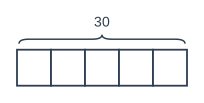
The bar model shows 30 split into 5 equal parts.

What number goes in each part?

A bar model: one bar, split into 5 equal boxes. A brace above the bar spans the whole bar and is labelled 30.

Model answer

\(30 \div 5 = 6\)

Explanation

The whole bar is 30 and it is split into 5 equal parts, so each part is \(\dfrac{1}{5}\) of 30. 30 ÷ 5 = 6. Check: 6 + 6 + 6 + 6 + 6 = 30.

Mark scheme
  1. 1 mark

    6

    Do not accept 150, 25 or 35.

Question 2

2 marks

There are 35 cars in a car park.

\(\dfrac{3}{7}\) of the cars are red.

How many red cars are there?

Model answer

\(\dfrac{1}{7}\) of 35 = \(35 \div 7 = 5\)
\(\dfrac{3}{7}\) of 35 = \(5 \times 3 = 15\) red cars

Explanation

Find one seventh first: 35 ÷ 7 = 5 cars. Three sevenths is three of those groups: 5 × 3 = 15 cars. A common mistake is to stop at 5, which is only one seventh of the cars.

Mark scheme
  1. 1 mark

    \(35 \div 7 = 5\); or the correct answer 15 with no working

    Also award this mark for 35 × 3 = 105 followed by dividing by 7.

  2. 1 mark

    15

    Do not accept 5 or 20 (the cars that are not red). A correct answer with no working scores full marks.

Question 3

2 marks

Priya says, "\(\dfrac{1}{6}\) of 30 is bigger than \(\dfrac{1}{5}\) of 30, because 6 is bigger than 5."

Is Priya right? How do you know?

Model answer

No.
\(\dfrac{1}{6}\) of 30 = \(30 \div 6 = 5\)
\(\dfrac{1}{5}\) of 30 = \(30 \div 5 = 6\)
6 is bigger than 5, so \(\dfrac{1}{5}\) of 30 is bigger.

Explanation

When you share the same amount into more equal parts, each part gets smaller. 30 shared into 6 parts gives 5 each, but 30 shared into 5 parts gives 6 each. So a bigger denominator gives a smaller unit fraction. Priya's mistake is very common: she looked at the denominators as if they were ordinary numbers.

Mark scheme
  1. 1 mark

    No, with a reason that is correct but not complete, e.g. one value worked out correctly (\(\dfrac{1}{6}\) of 30 = 5, or \(\dfrac{1}{5}\) of 30 = 6) without a comparison, or 'a bigger denominator does not mean a bigger fraction'

    'No' alone scores 0. 'Yes' scores 0.

  2. 1 mark

    No, with a complete reason, e.g. '\(\dfrac{1}{6}\) of 30 = 5 and \(\dfrac{1}{5}\) of 30 = 6, so \(\dfrac{1}{5}\) of 30 is bigger'; or 'splitting 30 into 6 equal parts makes smaller parts than splitting it into 5 equal parts'

    A complete correct reason on its own scores both marks.

Question 4

4 marks

There are 40 children at a holiday club.

\(\dfrac{3}{8}\) of the children choose football.

\(\dfrac{1}{5}\) of the children who are left choose art.

How many children choose art?

Model answer

\(\dfrac{1}{8}\) of 40 = 5, so \(\dfrac{3}{8}\) of 40 = 15 choose football.
Left: \(40 - 15 = 25\)
\(\dfrac{1}{5}\) of 25 = \(25 \div 5 = 5\) choose art.

Explanation

Take it one step at a time. Three eighths of 40 is 15, so 15 children choose football and 25 are left. The art fraction is a fraction of the 25 who are left, not of all 40 children: 25 ÷ 5 = 5. A common mistake is to find one fifth of 40 and get 8.

Mark scheme
  1. 1 mark

    A correct method for \(\dfrac{3}{8}\) of 40, e.g. \(40 \div 8 \times 3\); or the correct final answer, 5 children choose art, with no working

  2. 1 mark

    15 children choose football

  3. 1 mark

    25 children are left (\(40 - 15\))

    Follow through from a wrong number for football.

  4. 1 mark

    5 children choose art

    Follow through: one fifth of their number left, if it is a whole number. Do not accept 8 (1/5 of 40). A correct answer with no working scores full marks.

Ready to try the rest? Tap your answers and see straight away how you did.

Topic notes

Fractions of amounts

The big idea

To find a fraction of an amount, split the amount into equal parts, then take as many parts as you need. You do this all the time: half of a bag of sweets, a quarter of an hour, or three fifths of the money in a jar. The denominator (the bottom number) is the number of equal parts. The numerator (the top number) is how many of those parts you take.

Unit fractions

In a unit fraction, the numerator is 1, as in \(\dfrac{1}{6}\). For a unit fraction of something, divide it by the denominator.

\(\dfrac{1}{6}\) of 42: split 42 into 6 equal parts. \(42 \div 6 = 7\), so \(\dfrac{1}{6}\) of 42 is 7.

Your times tables help: 6 sevens are 42, and that tells you \(42 \div 6 = 7\).

Non-unit fractions

In a non-unit fraction, the numerator is more than 1, as in \(\dfrac{3}{5}\). Find one part first, then take as many parts as the numerator says:

  1. Divide by the denominator to find one part.
  2. Multiply by the numerator.
A bar model: one bar, labelled "sheep" split into 5 equal boxes; written in the boxes (counting from the left): box 1: 9, box 2: 9, box 3: 9, box 4: 9, box 5: 9; boxes 1, 2 and 3 shaded. A brace above the bar spans the whole bar and is labelled 45 sheep (drawn outside the shorter brace). A brace above the bar spans boxes 1 to 3 and is labelled top field: 27. A brace below the bar spans boxes 4 to 5 and is labelled bottom field: 18. (The brace labelled 45 sheep covers 5 units, so one unit = 9 sheep.)
45 split into 5 equal parts is 9 in each part. 3 parts are 27 sheep and the other 2 parts are 18 sheep.

A farmer has 45 sheep. \(\dfrac{3}{5}\) of them are in the top field and the rest are in the bottom field. How many sheep are in each field?

One fifth: \(45 \div 5 = 9\) sheep.

Three fifths: \(9 \times 3 = 27\) sheep in the top field.

The rest: \(45 - 27 = 18\) sheep in the bottom field.

Check: the bottom field has the other 2 fifths, and \(9 \times 2 = 18\). Also \(27 + 18 = 45\).

Money and measures

Change the amount into a smaller unit first, so that you are working with whole numbers: pounds into pence, kilograms into grams, metres into centimetres, weeks into days.

Mia's summer holiday is 3 weeks long. She spends \(\dfrac{4}{7}\) of it at her gran's house. How many days does she spend at her gran's?

Change weeks into days: \(3 \times 7 = 21\) days.

One seventh: \(21 \div 7 = 3\) days.

Four sevenths: \(3 \times 4 = 12\) days.

Mia spends 12 days at her gran's house.

Kim gets £4.50 pocket money each week. She saves \(\dfrac{1}{5}\) of it every week. How many weeks will it take her to save at least £4?

Change to pence: £4.50 is 450p.

One fifth: \(450 \div 5 = 90\)p saved each week.

Count up in 90p: 90p, 180p, 270p, 360p, 450p.

After 4 weeks she has 360p, which is £3.60: not enough yet. After 5 weeks she has 450p, which is £4.50.

It takes Kim 5 weeks.

Stretch: finding the whole

Sometimes you know what one part is worth and need the whole amount. The whole is made of as many parts as the denominator, so multiply by the denominator.

Ella is 9 years old. Her age is \(\dfrac{1}{7}\) of her grandad's age. How old is her grandad?

Ella's age is one part, and her grandad's age is 7 of those parts.

\(9 \times 7 = 63\)

Her grandad is 63 years old. Check: \(63 \div 7 = 9\).

Remember

  • Unit fraction: divide the amount by the denominator.
  • Non-unit fraction: find one part (divide by the denominator), then take as many parts as the numerator (multiply).
  • To find the whole from one part: multiply by the denominator.

Common mistakes

  • Multiplying instead of dividing. \(\dfrac{1}{6}\) of 42 is 7, not 252. A proper fraction of something is always less than the whole of it.
  • Stopping after dividing. For \(\dfrac{3}{5}\) of 45, 9 is only one fifth. Multiply by 3 to get 27.
  • Thinking a bigger denominator gives a bigger part. \(\dfrac{1}{8}\) of 24 is only 3, but \(\dfrac{1}{4}\) of 24 is 6.
  • Using the wrong number of units. A week has 7 days and an hour has 60 minutes, not 100.
  • Writing pence wrongly as pounds. 360p is £3.60, not £3.06 or £36.

Top tip

Read the question again before you answer. Does it want the part you found, or the rest? If it asks for the rest, take your part away from the whole amount.

Study Helper Hints first, answers after you try

Stuck on this one? Ask for a hint and I’ll point you in the right direction, without giving the answer away. Once you’ve checked your answer, I’ll show you how the marks are awarded.