Practise 20 questions on Volume and capacity for Year 5 Maths. Tap your answer and find out straight away if you are right, with the Study Helper on hand if you get stuck.
20 questions
1–4 marks each
Instant marking
No sign-up needed
20 questions, marked as you go
Sample questions with model answers
Here are 4 of the questions in this topic, each with a model answer, an explanation of why it earns the marks and the mark scheme.
Question 1
1 mark
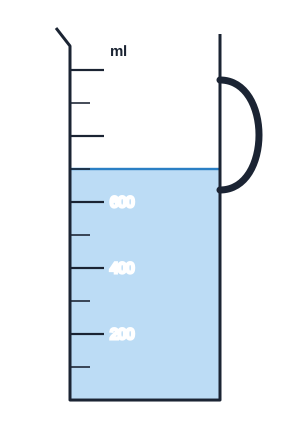
The diagram shows some water in a measuring jug.
How much water is in the jug?
Model answer
Each small mark is 100 ml. The water is one mark above 600 ml. 700 ml
Explanation
The numbered marks go up in 200s, and there is one mark between each pair, so each mark is worth 100 ml. The water is level with the mark between 600 and 800, which is 700 ml. A common mistake is to think each mark is worth 1 or 10, so always work out what a mark is worth first.
Mark scheme
1 mark
700 ml
Accept 700 with no unit, or 0.7 litres. Do not accept 650 or 750 (the scale misread), or 7.
Question 2
2 marks
A jug holds 2 litres of orange juice. Mr Okafor pours all the juice into glasses.
Each glass holds 250 ml.
How many glasses can he fill?
Model answer
2 litres = 2,000 ml 4 glasses of 250 ml make 1,000 ml (1 litre) 2 litres fill \(4 \times 2 = 8\) glasses 8 glasses
Explanation
First change the litres into millilitres: 2 litres is 2,000 ml. Four glasses of 250 ml make 1,000 ml, which is 1 litre, so 2 litres fill 8 glasses. Always put both amounts in the same unit before you compare them.
Mark scheme
1 mark
2 litres = 2,000 ml, or 4 glasses fill 1 litre (\(4 \times 250 = 1{,}000\)); or the correct answer 8 with no working
1 mark
8 (glasses)
Do not accept 125 or 0.008. A correct answer with no working scores full marks.
Question 3
3 marks
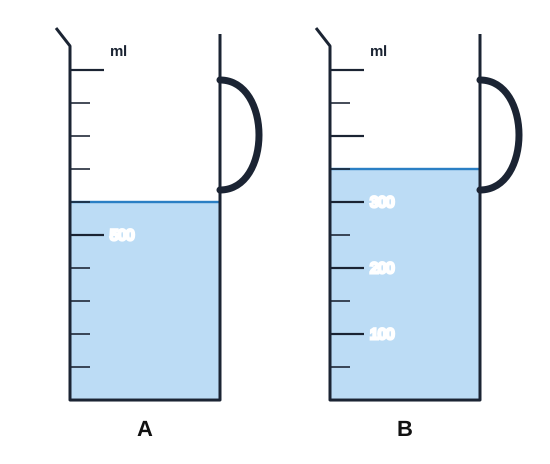
The diagram shows two measuring jugs, A and B, with some water in each.
Tom pours all the water from both jugs into an empty 1 litre bottle.
How much more water does he need to fill the bottle?
Model answer
Jug A: each mark is 100 ml, so A has 600 ml. Jug B: each mark is 50 ml, so B has 350 ml. \(600 + 350 = 950\) ml 1 litre = 1,000 ml \(1{,}000 - 950 = 50\) 50 ml
Explanation
The two jugs have different scales, so work out what each mark is worth. On jug A the marks go up in 100s, so A has 600 ml; on jug B they go up in 50s, so B has 350 ml. Together that is 950 ml, and a 1 litre bottle holds 1,000 ml, so he needs 50 ml more. A common mistake is to read both jugs as if their marks were worth the same.
Mark scheme
1 mark
One jug read correctly: A 600 ml or B 350 ml; or the correct answer 50 ml with no working
1 mark
Total water 950 ml (600 + 350)
Follow through from their readings.
1 mark
50 ml
Accept 50 with no unit. Follow through: 1,000 − their total. Do not accept 1,050 or an answer that uses 100 ml in a litre. A correct answer with no working scores full marks.
Question 4
4 marks
A fish tank holds 24 litres of water when it is full.
Ben fills the tank using a jug that holds 500 ml. He has already poured in 15 full jugs of water.
How many more full jugs does he need to fill the tank?
Model answer
500 ml is half a litre, so 2 jugs fill 1 litre. The whole tank: \(24 \times 2 = 48\) jugs \(48 - 15 = 33\) 33 more jugs
Explanation
A 500 ml jug is half a litre, so it takes 2 jugs to make 1 litre and \(24 \times 2 = 48\) jugs to fill the tank. Ben has poured 15 jugs, so he needs \(48 - 15 = 33\) more. A common mistake is to work out \(24 - 15\), mixing up litres and jugs.
Mark scheme
1 mark
24 litres = 24,000 ml, or 2 jugs fill 1 litre; or 15 jugs = 7,500 ml (7.5 litres); or the correct answer 33 with no working
1 mark
48 jugs fill the whole tank, or 16,500 ml (16.5 litres) still needed
1 mark
\(48 - 15\), or \(16{,}500 \div 500\), or 16.5 litres × 2
Follow through from their numbers.
1 mark
33 (jugs)
Do not accept 48 (the whole tank) or 9 (24 − 15). A correct answer with no working scores full marks.
Ready to try the rest? Tap your answers and see straight away how you did.
Ctrl + Enter to check
Study HelperHints first, answers after you try
Stuck on this one? Ask for a hint and I’ll point you in the right direction, without giving the answer away. Once you’ve checked your answer, I’ll show you how the marks are awarded.