Practise 20 questions on Multiplying fractions by whole numbers for Year 5 Maths. Tap your answer and find out straight away if you are right, with the Study Helper on hand if you get stuck.
20 questions
1–5 marks each
Instant marking
No sign-up needed
20 questions, marked as you go
Sample questions with model answers
Here are 4 of the questions in this topic, each with a model answer, an explanation of why it earns the marks and the mark scheme.
Question 1
1 mark
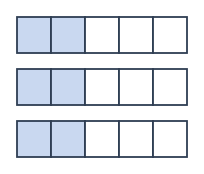
The diagram shows 3 bars that are the same size. \(\dfrac{2}{5}\) of each bar is shaded.
Work out \(3 \times \dfrac{2}{5}\)
Model answer
There are 2 fifths shaded in each bar, and 3 bars. \(3 \times 2 = 6\) fifths \(3 \times \dfrac{2}{5} = \dfrac{6}{5} = 1\dfrac{1}{5}\)
Explanation
Count the shaded fifths: 2 in each bar, in 3 bars, makes 6 fifths. Five fifths make a whole, so 6 fifths is \(1\dfrac{1}{5}\). A common mistake is to count all 15 boxes and write \(\dfrac{6}{15}\), but each box is one fifth of its own bar.
Mark scheme
1 mark
\(\dfrac{6}{5}\) or \(1\dfrac{1}{5}\)
Accept '1 1/5', '1 and 1/5' or 1.2. Do not accept 6/15.
5 lots of 2 thirds is 10 thirds. To write it as a mixed number, see how many wholes are in 10 thirds: 3 thirds make 1 whole, so 9 thirds make 3 wholes, and 1 third is left. The answer is \(3\dfrac{1}{3}\). A common mistake is to multiply both numbers in the fraction and get \(\dfrac{10}{15}\).
Mark scheme
1 mark
\(\dfrac{10}{3}\) seen; or the correct answer \(3\dfrac{1}{3}\) with no working
Accept 2/3 + 2/3 + 2/3 + 2/3 + 2/3 = 10/3.
1 mark
\(3\dfrac{1}{3}\)
Accept '3 1/3' or '3 and 1/3'. 10/3 on its own scores the first mark only. Do not accept 10/15. A correct answer with no working scores full marks.
\(4 \times \dfrac{3}{8} = \dfrac{12}{8}\) \(\dfrac{12}{8} = 1\dfrac{4}{8} = 1\dfrac{1}{2}\) So the answer is =.
Explanation
4 lots of 3 eighths is 12 eighths. 8 eighths make 1 whole, so 12 eighths is 1 whole and 4 eighths, and 4 eighths is the same as one half. So both sides are equal, and the answer is =. A common mistake is to multiply the denominator as well and get \(\dfrac{12}{32}\), which would wrongly make the left side smaller.
Mark scheme
1 mark
\(4 \times \dfrac{3}{8} = \dfrac{12}{8}\) (or \(1\dfrac{4}{8}\), or \(1\dfrac{1}{2}\)) worked out; or the correct answer = with no working
Also award this mark for changing 1 1/2 into 12/8 or 3/2.
1 mark
=
Accept 'equals' or 'they are the same'. Do not accept < or >. A correct answer with no working scores full marks.
Question 4
4 marks
Mia practises the recorder for \(\dfrac{3}{4}\) of an hour on each of 4 days.
Raj practises the recorder for \(\dfrac{2}{3}\) of an hour on each of 5 days.
How long does each child practise for altogether? Who practises for longer altogether?
Model answer
Mia: \(4 \times \dfrac{3}{4} = \dfrac{12}{4} = 3\) hours Raj: \(5 \times \dfrac{2}{3} = \dfrac{10}{3} = 3\dfrac{1}{3}\) hours \(3\dfrac{1}{3}\) hours is more than 3 hours, so Raj practises for longer.
Explanation
Work out each total by multiplying. Mia: 4 lots of 3 quarters is 12 quarters, which is exactly 3 hours. Raj: 5 lots of 2 thirds is 10 thirds, which is \(3\dfrac{1}{3}\) hours. You could also use minutes: 4 × 45 = 180 and 5 × 40 = 200. A common mistake is to think Mia wins because \(\dfrac{3}{4}\) is bigger than \(\dfrac{2}{3}\), but Raj practises on more days.
Mark scheme
1 mark
Mia: \(4 \times \dfrac{3}{4} = \dfrac{12}{4}\), or 180 minutes
Accept working in minutes: 3/4 of an hour = 45 minutes, 4 × 45 = 180.
'Raj' alone scores 0. Accept 'Raj, by 1/3 of an hour (20 minutes)' but the difference is not needed. A complete correct method with 'Raj' scores all 4 marks.
Ready to try the rest? Tap your answers and see straight away how you did.
Ctrl + Enter to check
Study HelperHints first, answers after you try
Stuck on this one? Ask for a hint and I’ll point you in the right direction, without giving the answer away. Once you’ve checked your answer, I’ll show you how the marks are awarded.