
Level:
Correct: 0
Incorrect: 0
Marks: 0/0
Exam Practice
Course:
Topics:
OCR GCSE Chemistry (Paper 4) Smart practice A mixed round aimed at your weak spots
Unit 4
Predicting and identifying reactions and products
Unit 5
Monitoring and controlling chemical reactions
Unit 6
Global challenges
Unit 7
Practical skills
Avg
score:
–
Topics
done:
0/37

Transition metals and their compounds

Practise 10 exam-style questions on Transition metals and their compounds for OCR GCSE Chemistry (Paper 4). Write your answer as you would in the exam and get it marked in seconds against the mark scheme, point by point, with the Study Helper on hand if you get stuck.

  • 10 questions
  • 1–5 marks each
  • Instant marking
  • No sign-up needed
10 questions, marked as you go

Sample questions with model answers

Here are 4 of the questions in this topic, each with a model answer, an explanation of why it earns the marks and the mark scheme an examiner would use.

Question 1

1 mark

Nickel is a transition metal. A student drops a small piece of nickel into a beaker of cold water.

What is the student most likely to see?

Choose your answer.

  • A The nickel bursts into flame.
  • B The nickel fizzes and moves around.
  • C The nickel melts into a ball.
  • D No reaction can be seen.

Model answer

D

Explanation

Transition metals are much less reactive than Group 1 metals: many, such as nickel and copper, show no reaction with cold water, and iron reacts only slowly with water and oxygen when it rusts. All three wrong options describe how Group 1 metals react with water.

Mark scheme
  1. 1 mark

    D / No reaction can be seen.

    The only correct answer is D: transition metals are much less reactive than Group 1 metals, and nickel does not react noticeably with cold water. A is not correct because bursting into flame is what potassium does in water; B is not correct because fizzing and moving around on the surface is what lithium and sodium do (nickel is dense and sinks); C is not correct because sodium melts into a ball because its reaction gives out heat and it has a low melting point, but nickel does not react and has a very high melting point (1455 °C). ALLOW the letter or the option. If more than one option is given, do not award the mark.
Question 2

2 marks

Copper(II) sulfate is a blue compound. Sodium sulfate is a white compound.

The name copper(II) sulfate contains the Roman numeral (II), but the name sodium sulfate does not contain a Roman numeral.

Explain why.

Model answer

The (II) shows that the copper ions in the compound have a 2+ charge (Cu²⁺). Copper is a transition metal and can form ions with different charges, Cu⁺ and Cu²⁺, so the name has to show which one is present. Sodium is a Group 1 metal and only ever forms Na⁺ ions, so no number is needed.

Explanation

One general property of transition metals is that they form ions with different charges, for example Cu⁺ and Cu²⁺ or Fe²⁺ and Fe³⁺, so their names give the charge as a Roman numeral. The numeral does not count atoms: copper(II) sulfate is CuSO₄, with one copper ion in each formula. Group 1 metals always form 1+ ions, so their names need no numeral.

Mark scheme
  1. 1 mark

    (II) shows that the copper ions have a charge of 2+ / the compound contains Cu²⁺ ions

    ALLOW (II) shows the oxidation state or valency of the copper is 2. DO NOT ALLOW (II) shows that there are two copper atoms or two copper ions.

  2. 1 mark

    copper (a transition metal) can form ions with different charges, such as Cu⁺ and Cu²⁺, so the name must show which ion is present (whereas sodium only forms Na⁺ ions)

    ALLOW transition metals form ions with different charges but Group 1 metals form only one ion. The idea that copper can form more than one type of ion is needed: 'sodium forms only one ion' on its own does not score. IGNORE references to colour.

Question 3

3 marks

Corundum is a natural crystal of aluminium oxide, Al₂O₃. Pure corundum is colourless.

• A ruby is corundum in which a small number of the aluminium ions have been replaced by chromium(III) ions, Cr³⁺. Rubies are red.
• A blue sapphire is corundum that contains small amounts of iron ions and titanium ions.

Explain why rubies and sapphires are coloured but pure corundum is colourless.

Suggest why rubies and sapphires are different colours.

Model answer

Aluminium is a Group 3 metal, not a transition metal, so its ions, and so aluminium oxide, are colourless. Chromium, iron and titanium are transition metals, and transition metal ions form coloured compounds, so even a small number of these ions in the crystal gives it a colour. Rubies and sapphires contain different transition metal ions - chromium(III) ions in rubies, iron and titanium ions in sapphires - and different transition metal ions give different colours.

Explanation

Forming coloured compounds is a general property of transition metals, while compounds of the metals in Groups 1, 2 and 3, such as aluminium, are white or colourless. Here the colour comes from a few transition metal ions in an otherwise colourless crystal. A common error is to say the colour comes from the oxide ions, which are present in pure corundum too.

Mark scheme
  1. 1 mark

    aluminium is not a transition metal / is in Group 3, so its ions and compounds (such as aluminium oxide) are colourless / white

    ALLOW Al³⁺ ions are not coloured. IGNORE oxide ions are colourless on its own.

  2. 1 mark

    chromium, iron and titanium are transition metals, and transition metal ions / compounds are coloured, so even a small amount of them colours the crystal

    ALLOW the colour comes from the (chromium / iron / titanium) transition metal ions. At least one of the added metals must be identified as a transition metal.

  3. 1 mark

    different transition metal ions give different colours: chromium ions in rubies, but iron and titanium ions in sapphires

    ALLOW rubies and sapphires contain different transition metals. IGNORE references to different amounts of the ions.

Question 4

3 marks

A student tests four metal oxides as catalysts for the decomposition of hydrogen peroxide solution:

2H₂O₂(aq) → 2H₂O(l) + O₂(g)

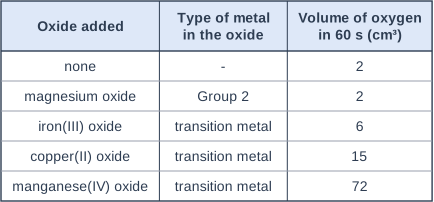
The student adds 0.20 g of each oxide powder to 20 cm³ of the same hydrogen peroxide solution and measures the volume of oxygen collected in 60 seconds. The student also does one test with no oxide. The table shows the results.

The student concludes: 'Compounds of transition metals are catalysts for this reaction, and compounds of other metals are not.'

Evaluate the student's conclusion. Use data from the table in your answer.

Table with columns "Oxide added", "Type of metal in the oxide", "Volume of oxygen in 60 s (cm³)". Oxide added: none; Type of metal in the oxide: -; Volume of oxygen in 60 s (cm³): 2 | Oxide added: magnesium oxide; Type of metal in the oxide: Group 2; Volume of oxygen in 60 s (cm³): 2 | Oxide added: iron(III) oxide; Type of metal in the oxide: transition metal; Volume of oxygen in 60 s (cm³): 6 | Oxide added: copper(II) oxide; Type of metal in the oxide: transition metal; Volume of oxygen in 60 s (cm³): 15 | Oxide added: manganese(IV) oxide; Type of metal in the oxide: transition metal; Volume of oxygen in 60 s (cm³): 72.

Model answer

The results support part of the conclusion. All three transition metal oxides speeded up the reaction: they gave 6, 15 and 72 cm³ of oxygen in 60 s, compared with only 2 cm³ with no oxide. Magnesium oxide, an oxide of a Group 2 metal, gave 2 cm³, the same as no oxide, so it is not a catalyst for this reaction.

However, the transition metal oxides were very different: manganese(IV) oxide gave 72 cm³ but iron(III) oxide only 6 cm³, so they are not all good catalysts. Only one oxide of a metal that is not a transition metal was tested, and only one reaction, so the student cannot say that compounds of other metals are never catalysts. Also, each test was done only once, and the student did not check that the mass of each oxide was unchanged at the end, which is needed to show that it is a catalyst.

Explanation

An evaluation weighs evidence for and against: here the data support the idea that these transition metal compounds speed up the reaction, but four oxides and one reaction are too few to support a conclusion about all compounds. Transition metals and their compounds are often used as catalysts, for example vanadium(V) oxide in the Contact process, but how well they work varies. Answers that only agree or only disagree with the conclusion cannot gain full marks.

Mark scheme
  1. 1 mark

    (supports) all three transition metal oxides gave more oxygen than the test with no oxide (6, 15 and 72 cm³ compared with 2 cm³), so they all speed up the reaction

    1 mark for each of marking points 1 to 6, max 3. Max 2 if no data from the table are used. Max 2 if the answer gives only one side (only evidence for or only evidence against the conclusion).

  2. 1 mark

    (supports) magnesium oxide, an oxide of a Group 2 metal, gave the same volume as no oxide (2 cm³), so it is not a catalyst for this reaction

    ALLOW magnesium oxide had no effect on the rate.

  3. 1 mark

    (against) the transition metal oxides are very different: manganese(IV) oxide gave 72 cm³ but iron(III) oxide only 6 cm³, so they are not all good catalysts

    ALLOW any correct comparison of two transition metal oxides using the data, for example copper(II) oxide 15 cm³ compared with manganese(IV) oxide 72 cm³.

  4. 1 mark

    (against) only one oxide of a metal that is not a transition metal, and only one reaction, were tested, so the conclusion cannot be applied to all compounds of other metals

    ALLOW only four oxides / too few compounds were tested to make a conclusion about all compounds.

  5. 1 mark

    (against) each oxide was tested only once, so the results may not be repeatable

    ALLOW the tests should be repeated (to check the results).

  6. 1 mark

    (against) the student did not show that the mass of each oxide was unchanged at the end, so it is not shown that the oxides are catalysts (not used up)

    ALLOW the oxides should be filtered, dried and weighed after the reaction.

Ready to try the rest? Every answer you write is marked against the mark scheme, so you can see exactly where the marks are.

Study Helper Hints first, answers after you try

Stuck on this one? Ask for a hint and I’ll point you in the right direction, without giving the answer away. Once you’ve checked your answer, I’ll show you how the marks are awarded.