
Level:
Correct: 0
Incorrect: 0
Marks: 0/0
Exam Practice
Course:
Topics:
OCR GCSE Chemistry (Paper 4) Smart practice A mixed round aimed at your weak spots
Unit 4
Predicting and identifying reactions and products
Unit 5
Monitoring and controlling chemical reactions
Unit 6
Global challenges
Unit 7
Practical skills
Avg
score:
–
Topics
done:
0/37

Molar amounts of gases and their volumes

Practise 12 exam-style questions on Molar amounts of gases and their volumes for OCR GCSE Chemistry (Paper 4). Write your answer as you would in the exam and get it marked in seconds against the mark scheme, point by point, with the Study Helper on hand if you get stuck.

  • 12 questions
  • 1–4 marks each
  • Instant marking
  • No sign-up needed
12 questions, marked as you go

Sample questions with model answers

Here are 4 of the questions in this topic, each with a model answer, an explanation of why it earns the marks and the mark scheme an examiner would use.

Question 1

1 mark

An ozone generator turns some of the oxygen that passes through it into ozone, O₃. A gas syringe contains 100 cm³ of the gas from the generator: a mixture of oxygen, O₂, and 6 cm³ of ozone. The gas is heated until all of the ozone has decomposed, and then cooled back to the starting temperature and pressure.

2O₃(g) → 3O₂(g)

What is the total volume of gas at the end?

Choose your answer.

  • A 94 cm³
  • B 98 cm³
  • C 100 cm³
  • D 103 cm³

Model answer

D

volume of ozone = 6 cm³, so volume of oxygen at the start = 100 − 6 = 94 cm³
2 volumes of O₃ form 3 volumes of O₂, so 6 cm³ of O₃ forms 9 cm³ of O₂
total volume at the end = 94 + 9 = 103 cm³

Explanation

Equal volumes of gases at the same temperature and pressure contain equal numbers of molecules, so the balanced equation gives the ratio of gas volumes directly: no conversion to moles is needed. Mass is conserved in the reaction, but the number of gas molecules is not, so the volume can change. Remember to include the gas that does not react: here most of the gas from the generator is oxygen.

Mark scheme
  1. 1 mark

    D / 103 cm³

    The only correct answer is D: at the same temperature and pressure, gas volumes are in the same ratio as moles, so 6 cm³ of ozone forms 6 × 3 ÷ 2 = 9 cm³ of oxygen; adding the 94 cm³ of oxygen already in the syringe gives 103 cm³. A is not correct because 94 cm³ is only the oxygen that was in the syringe at the start: it leaves out the 9 cm³ of oxygen formed from the ozone; B is not correct because 98 cm³ comes from using the ratio the wrong way round (6 × 2 ÷ 3 = 4 cm³ of oxygen formed, plus 94 cm³); C is not correct because the volume of a gas depends on the number of molecules, not on the mass, and the number of molecules increases from 2 to 3 for each 2O₃ that decompose. ALLOW the letter or the option. If more than one option is given, do not award the mark.
Question 2

2 marks

A student adds a piece of magnesium ribbon to an excess of dilute sulfuric acid and collects the hydrogen in a gas syringe.

Mg(s) + H₂SO₄(aq) → MgSO₄(aq) + H₂(g)

When all of the magnesium has reacted, she has collected 168 cm³ of hydrogen at room temperature and pressure.

Relative atomic mass (Ar): Mg = 24.3

Calculate the mass of the piece of magnesium ribbon. Give your answer to 3 significant figures.

Model answer

amount of H₂ = 168 ÷ 24 000 = 0.00700 mol (one mole of gas occupies 24 000 cm³ at room temperature and pressure)
The equation shows 1 mol of Mg gives 1 mol of H₂, so amount of Mg = 0.00700 mol
mass of Mg = 0.00700 × 24.3 = 0.1701 g = 0.170 g (3 significant figures)

Explanation

Change the gas volume into moles by dividing by the molar gas volume in the same unit: 24 dm³ or 24 000 cm³. Then use the 1 : 1 ratio from the equation and multiply by the Ar of magnesium, 24.3, not by 24 again, which gives 0.168 g. Dividing a volume in cm³ by 24 gives an answer a thousand times too big, which is easy to spot here because a piece of magnesium ribbon that gives less than 200 cm³ of gas cannot have a mass of 170 g.

Mark scheme
  1. 1 mark

    amount of H₂ = 168 ÷ 24 000 = 0.00700 / 7.00 × 10⁻³ (mol); or a correct final answer of 0.170 g with no working

    An answer of 0.170 g with no working scores 2 marks. ALLOW 1 mark for 0.1701 g or 0.17 g (not given to 3 significant figures). ALLOW 168 ÷ 1000 = 0.168 dm³ and 0.168 ÷ 24 = 0.00700 mol. ALLOW 1 mark for 170 g (the volume in cm³ divided by 24). An answer of 0.168 g (the amount multiplied by 24, the molar gas volume, instead of by 24.3, or 0.168 dm³ given as a mass) scores marking point 1 only if 0.00700 mol of hydrogen is shown in the working, and 0 with no working.

  2. 1 mark

    mass of Mg = 0.00700 × 24.3 = 0.170 (g)

    To 3 significant figures. The 1 : 1 ratio means the amount of magnesium is also 0.00700 mol. ALLOW ECF from a wrong amount of hydrogen if the mass is correctly calculated and given to 3 significant figures.

Question 3

3 marks

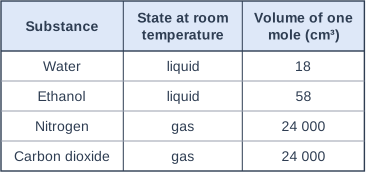
The table shows the volume of one mole of four substances at room temperature and pressure.

Use the particle model to explain why:
• one mole of a gas has a much larger volume than one mole of a liquid
• one mole of nitrogen and one mole of carbon dioxide have the same volume
• one mole of water and one mole of ethanol have different volumes.

Table with columns "Substance", "State at room temperature", "Volume of one mole (cm³)". Substance: Water; State at room temperature: liquid; Volume of one mole (cm³): 18 | Substance: Ethanol; State at room temperature: liquid; Volume of one mole (cm³): 58 | Substance: Nitrogen; State at room temperature: gas; Volume of one mole (cm³): 24 000 | Substance: Carbon dioxide; State at room temperature: gas; Volume of one mole (cm³): 24 000.

Model answer

In a gas the particles are very far apart: the spaces between them are much larger than the particles themselves. In a liquid the particles are close together and touching. So the same number of particles takes up roughly a thousand times more space as a gas than as a liquid.

Because the particles in a gas are so far apart, the size of the particles makes almost no difference to the volume. The volume depends only on the number of particles, and one mole of every gas contains 6.02 × 10²³ particles, so one mole of nitrogen and one mole of carbon dioxide both occupy 24 000 cm³.

In a liquid the particles touch, so the volume depends on how big the particles are and how they pack together. Ethanol molecules are larger than water molecules, so one mole of ethanol has a larger volume (58 cm³) than one mole of water (18 cm³).

Explanation

The molar gas volume (24 dm³ at room temperature and pressure) is the same for every gas because a gas is mostly empty space, so only the number of particles matters. This is not true for liquids and solids, where the particles are in contact, so their molar volumes depend on the size of the particles. Answers that say gas molecules are all the same size are wrong: carbon dioxide molecules are larger than nitrogen molecules.

Mark scheme
  1. 1 mark

    in a gas the particles are very far apart (the spaces between them are very large compared with the particles), but in a liquid the particles are close together / touching

    Both states must be described. ALLOW 'gas molecules are spread out, but liquid molecules are packed closely together'. IGNORE references to the movement of the particles.

  2. 1 mark

    so the volume of a gas depends (almost) only on the number of particles, not on their size or type, and one mole of every gas contains the same number of particles (6.02 × 10²³)

    ALLOW 'the size of the molecules makes almost no difference to the volume of a gas, and one mole of any gas has the same number of molecules'. DO NOT ALLOW 'nitrogen and carbon dioxide molecules are the same size'.

  3. 1 mark

    in a liquid the volume depends on the size of the particles, and ethanol molecules are larger than water molecules, so one mole of ethanol takes up more space

    ALLOW 'the molecules in liquids touch, so bigger molecules give a bigger volume for the same number of molecules'. ALLOW references to different forces between the molecules changing how closely they pack.

Question 4

4 marks

A small diesel generator burns 90.4 g of diesel fuel in 10 minutes. Diesel fuel can be thought of as hexadecane, C₁₆H₃₄, which burns in air:

2C₁₆H₃₄ + 49O₂ → 32CO₂ + 34H₂O

Air contains 21% oxygen by volume.

Relative atomic mass (Ar): H = 1.0 C = 12.0

Calculate the volume of air, in dm³ at room temperature and pressure, that contains the oxygen needed to burn this fuel completely.

Give your answer to 2 significant figures.

Model answer

Mr of C₁₆H₃₄ = (16 × 12.0) + (34 × 1.0) = 226.0
amount of hexadecane = 90.4 ÷ 226.0 = 0.400 mol
The equation shows 2 mol of hexadecane react with 49 mol of oxygen, so amount of O₂ = 0.400 × 49 ÷ 2 = 9.80 mol
volume of O₂ = 9.80 × 24 = 235.2 dm³
Air is 21% oxygen, so volume of air = 235.2 × 100 ÷ 21 = 1120 dm³ = 1100 dm³ (2 significant figures)

Explanation

This is a multistep calculation: mass to moles, the 2 : 49 ratio from the equation, moles to volume (× 24 dm³), then from oxygen to air. Only 21% of air is oxygen, so the volume of air is larger than the volume of oxygen: divide by 0.21. Stopping at the volume of oxygen, or using a 1 : 1 ratio, are common errors; and 1120 rounded to 2 significant figures is 1100, not 1120.

Mark scheme
  1. 1 mark

    amount of C₁₆H₃₄ = 90.4 ÷ 226.0 = 0.400 (mol); or a correct final answer of 1100 dm³ with no working

    An answer of 1100 dm³ (ALLOW 1.1 × 10³ dm³) with no working scores 4 marks. ALLOW 3 marks for 1120 dm³ (not given to 2 significant figures). ALLOW 2 marks for 235 or 240 dm³ (the volume of oxygen, not of air). ALLOW 3 marks for 46 dm³ (a 1 : 1 ratio of hexadecane to oxygen used).

  2. 1 mark

    amount of O₂ = 0.400 × 49 ÷ 2 = 9.80 (mol); or a correct final answer of 1100 dm³ with no working

    ALLOW ECF from a wrong amount of hexadecane.

  3. 1 mark

    volume of air = 9.80 × 24 × 100 ÷ 21 = 1120 (dm³) (volume of O₂ = 235.2 dm³); or a correct final answer of 1100 dm³ with no working

    ALLOW 235.2 ÷ 0.21. ALLOW ECF from a wrong amount of oxygen.

  4. 1 mark

    1100 (dm³)

    To 2 significant figures. ALLOW 1.1 × 10³ dm³. ALLOW ECF for the significant-figure mark from a valid calculation of a volume of air.

Ready to try the rest? Every answer you write is marked against the mark scheme, so you can see exactly where the marks are.

Study Helper Hints first, answers after you try

Stuck on this one? Ask for a hint and I’ll point you in the right direction, without giving the answer away. Once you’ve checked your answer, I’ll show you how the marks are awarded.