Level:
Correct: 0
Incorrect: 0
Marks: 0/0
Exam Practice
Course:
Topics:
OCR GCSE Chemistry (Paper 4) Smart practice A mixed round aimed at your weak spots
Unit 4
Predicting and identifying reactions and products
Unit 5
Monitoring and controlling chemical reactions
Unit 6
Global challenges
Unit 7
Practical skills
Avg
score:
–
Topics
done:
0/37

Extracting metals by electrolysis and biological methods

Practise 15 exam-style questions on Extracting metals by electrolysis and biological methods for OCR GCSE Chemistry (Paper 4). Write your answer as you would in the exam and get it marked in seconds against the mark scheme, point by point, with the Study Helper on hand if you get stuck.

  • 15 questions
  • 1–6 marks each
  • Instant marking
  • No sign-up needed
15 questions, marked as you go

Sample questions with model answers

Here are 4 of the questions in this topic, each with a model answer, an explanation of why it earns the marks and the mark scheme an examiner would use.

Question 1

1 mark

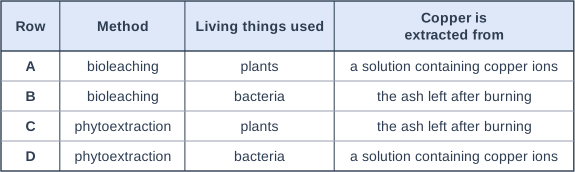
Copper can be obtained from low-grade ores by biological methods.

The table shows four possible descriptions of a biological method.

Which row is correct?

Choose your answer.

  • A row A
  • B row B
  • C row C
  • D row D
Table with columns "Row", "Method", "Living things used", "Copper is extracted from". Row: A; Method: bioleaching; Living things used: plants; Copper is extracted from: a solution containing copper ions | Row: B; Method: bioleaching; Living things used: bacteria; Copper is extracted from: the ash left after burning | Row: C; Method: phytoextraction; Living things used: plants; Copper is extracted from: the ash left after burning | Row: D; Method: phytoextraction; Living things used: bacteria; Copper is extracted from: a solution containing copper ions.

Model answer

C

Explanation

Learn the two biological methods side by side. Bioleaching uses bacteria, which release copper ions from copper sulfide ores into a solution (the leachate). Phytoextraction uses plants, which absorb copper compounds through their roots; the plants are burned and the copper is extracted from the ash. A common error is to mix up which method uses plants and which uses bacteria.

Mark scheme
  1. 1 mark

    C / row C

    The only correct answer is C: in phytoextraction, plants absorb copper compounds through their roots; the plants are harvested and burned, and the copper is extracted from the ash. A is not correct because bioleaching uses bacteria, not plants; B is not correct because bioleaching produces a solution containing copper ions (the leachate), not an ash; D is not correct because phytoextraction uses plants, not bacteria, and the copper is extracted from the ash of the plants. ALLOW the letter or the row. If more than one option is given, do not award the mark.

Question 2

2 marks

In phytoextraction, plants that have absorbed copper compounds from the soil are harvested and dried. The dried plants are burned, and copper is then extracted from the ash.

Suggest why the plants are burned before the copper is extracted.

Model answer

Burning turns most of the plant material (its carbon compounds) into carbon dioxide and water vapour, which escape. The copper compounds do not burn away, so they are left in a small mass of ash with a much higher percentage of copper than the dried plants. The ash is like a high-grade ore, so less material has to be processed to extract the copper.

Explanation

The dried plants contain only a small percentage of copper compounds; most of their mass is carbon compounds. Burning removes these as gases and concentrates the copper compounds in the ash, which is why the ash is sometimes called a 'bio-ore'. Weak answers just say 'to get the copper out' without explaining that the copper is concentrated.

Mark scheme
  1. 1 mark

    burning removes most of the mass of the plants / the carbon compounds in the plants burn and are lost as carbon dioxide and water (vapour)

    Max 2. ALLOW the plant material is turned into gases / the organic matter is removed. IGNORE 'to kill the plants'.

  2. 1 mark

    the copper compounds stay in the ash, so the ash has a much higher percentage (concentration) of copper than the dried plants / the ash is like a high-grade ore

    ALLOW a much smaller mass of material has to be processed, so less acid / energy is needed to extract the copper. ALLOW the metal compounds do not burn away / are concentrated.

  3. 1 mark

    the heat (energy) released when the plants burn can be used, for example to generate electricity

    This is an alternative to either of the other points.

Question 3

3 marks

In heap bioleaching, bacteria release copper ions, Cu²⁺, from low-grade copper ore. The solution that drains from the heap contains 1.6 g of copper ions in every dm³. Each day, 2.5 × 10⁵ dm³ of this solution is collected.

Relative atomic mass (Ar): Cu = 63.5

Calculate the mass of copper, in kg, in the solution collected each day.

Calculate the concentration of copper ions in the solution, in mol/dm³.

Model answer

Mass of copper each day = 1.6 g/dm³ × 2.5 × 10⁵ dm³ = 4.0 × 10⁵ g = 400 kg
Concentration = 1.6 g/dm³ ÷ 63.5 g/mol = 0.025 mol/dm³

Explanation

Mass of solute = concentration in g/dm³ × volume in dm³ (C3.1j), and dividing a concentration in g/dm³ by the molar mass gives the concentration in mol/dm³. The low concentration shows one disadvantage of bioleaching: very large volumes of solution must be collected and processed to obtain the copper.

Mark scheme
  1. 1 mark

    mass of copper = 1.6 × 2.5 × 10⁵ = 4.0 × 10⁵ (g); or a correct final answer of 400 kg with no working

    An answer of 400 kg with no working scores marking points 1 and 2. An answer of 0.025 mol/dm³ with no working scores marking point 3. ALLOW 1 mark (marking point 1 only) for 4.0 × 10⁵ given as the final answer (not converted to kg).

  2. 1 mark

    400 (kg)

    ALLOW 4.0 × 10² (kg). ALLOW ECF from a wrong mass in grams shown in the working.

  3. 1 mark

    concentration = 1.6 ÷ 63.5 = 0.025 (mol/dm³)

    ALLOW 0.0252 / 2.5 × 10⁻² (mol/dm³). DO NOT ALLOW 39.7 (63.5 ÷ 1.6).

Question 4

5 marks

Soil at the site of an old metal works is polluted with zinc compounds. The top layer of the soil contains 2400 kg of zinc.

The owners plan to grow plants that absorb zinc compounds (phytoextraction). They estimate that:
• each crop of plants removes 75 kg of zinc from the soil
• two crops can be grown each year
• the zinc can be extracted from the ash of the burned plants and sold.

The soil will be safe enough for building houses when 60% of the zinc has been removed.

Calculate the number of years needed to remove 60% of the zinc.

The other option is to dig up the polluted soil and take it by lorry to a landfill site. This would take about 6 months.

Evaluate the use of phytoextraction for this site, compared with digging up the soil.

Model answer

Mass of zinc to remove = 0.60 × 2400 = 1440 kg
Zinc removed each year = 2 × 75 = 150 kg
Time = 1440 ÷ 150 = 9.6 years (about 10 years)

Phytoextraction has advantages: the zinc is recovered from the ash and can be sold, instead of being wasted in landfill; no landfill space is used; and far less fuel is burned than when many lorry loads of soil are dug up and driven away, so less carbon dioxide is released.

However, it takes about 10 years instead of about 6 months, so the owners cannot build on or sell the land for a long time. It could take even longer, because the plants may remove less zinc each crop as the zinc concentration in the soil falls, or the crops may grow badly in poor weather.

Explanation

First find 60% of the zinc, then divide by the mass removed in one year (two crops of 75 kg). Common errors are to divide the whole 2400 kg (16 years) or to forget that there are two crops a year (19.2 years). In the evaluation give at least one advantage and one disadvantage, and use your answer to compare the times, because the slowness of biological methods is their main disadvantage.

Mark scheme
  1. 1 mark

    mass of zinc to remove = 0.60 × 2400 = 1440 (kg); or a correct final answer of 9.6 years with no working

    An answer of 9.6 years with no working scores marking points 1 and 2. ALLOW 10 years (rounded up to a whole number of years) for marking points 1 and 2. ALLOW 1 mark for 16 years (60% not used) or 19.2 years (only one crop a year used). Max 4 if the evaluation gives only one side (only advantages or only disadvantages of phytoextraction).

  2. 1 mark

    evaluation: 1440 ÷ (2 × 75) = 1440 ÷ 150 = 9.6 (years)

    ALLOW 1440 ÷ 75 = 19.2 crops, then 19.2 ÷ 2 = 9.6 years. ALLOW 10 (years). ALLOW ECF from a wrong mass of zinc to remove, divided by 150.

  3. 3 marks

    evaluation of phytoextraction compared with digging up the soil, any valid points from: (advantage) the zinc is recovered and can be sold / a finite resource is not wasted; (advantage) no landfill space is used / the polluted soil is not moved to another place; (advantage) less fuel or energy is used and less carbon dioxide released than digging up and transporting large masses of soil by lorry; (advantage) the soil stays on the site and is not lost / less damage, noise and traffic from lorries; (disadvantage) it takes much longer, about ten years compared with half a year, so the land cannot be built on or sold for many years; (disadvantage) the crops could fail or grow slowly (for example in bad weather), so it may take even longer; (disadvantage) the plants remove less zinc as its concentration in the soil falls, so later crops may remove less than estimated; (disadvantage) the zinc-rich plants must be kept away from animals and must be burned safely

    1 mark for each valid point, max 3. The time comparison may use the student's own calculated value. ALLOW other valid points. IGNORE 'it is better for the environment' without a reason. A judgement is not required for full marks.

Ready to try the rest? Every answer you write is marked against the mark scheme, so you can see exactly where the marks are.

Study Helper Hints first, answers after you try

Stuck on this one? Ask for a hint and I’ll point you in the right direction, without giving the answer away. Once you’ve checked your answer, I’ll show you how the marks are awarded.