Level:
Correct: 0
Incorrect: 0
Marks: 0/0
Exam Practice
Course:
Topics:
OCR GCSE Chemistry (Paper 4) Smart practice A mixed round aimed at your weak spots
Unit 4
Predicting and identifying reactions and products
Unit 5
Monitoring and controlling chemical reactions
Unit 6
Global challenges
Unit 7
Practical skills
Avg
score:
–
Topics
done:
0/37

Comparing materials and selecting them for uses

Practise 12 exam-style questions on Comparing materials and selecting them for uses for OCR GCSE Chemistry (Paper 4). Write your answer as you would in the exam and get it marked in seconds against the mark scheme, point by point, with the Study Helper on hand if you get stuck.

  • 12 questions
  • 1–6 marks each
  • Instant marking
  • No sign-up needed
12 questions, marked as you go

Sample questions with model answers

Here are 4 of the questions in this topic, each with a model answer, an explanation of why it earns the marks and the mark scheme an examiner would use.

Question 1

1 mark

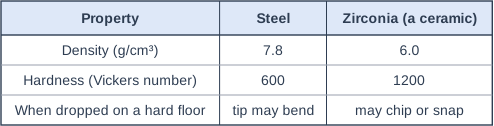
Kitchen knife blades can be made of steel or of zirconia, a ceramic. The table shows typical properties of the two materials.

Which statement correctly compares the zirconia blade with the steel blade?

Choose your answer.

  • A It is about twice as hard, and its density is about 77% of the density of steel.
  • B It is about twice as hard, and its density is about 130% of the density of steel.
  • C It is about half as hard, and its density is about 77% of the density of steel.
  • D It is about half as hard, and its density is about 130% of the density of steel.
Table with columns "Property", "Steel", "Zirconia (a ceramic)". Property: Density (g/cm³); Steel: 7.8; Zirconia (a ceramic): 6.0 | Property: Hardness (Vickers number); Steel: 600; Zirconia (a ceramic): 1200 | Property: When dropped on a hard floor; Steel: tip may bend; Zirconia (a ceramic): may chip or snap.

Model answer

A

Explanation

To compare zirconia with steel, put the zirconia value on top: hardness 1200 ÷ 600 = 2 times; density 6.0 ÷ 7.8 = 0.77, or 77%. Dividing the other way round gives the steel compared with the zirconia, which is the error in the other options. The data also show the drawback of the ceramic: it is brittle, so a dropped blade may chip or snap.

Mark scheme
  1. 1 mark

    A / It is about twice as hard, and its density is about 77% of the density of steel.

    The only correct answer is A: 1200 ÷ 600 = 2, so zirconia is about twice as hard as steel, and 6.0 ÷ 7.8 × 100 = 77%, so its density is about 77% of the density of steel. B is not correct because 130% comes from 7.8 ÷ 6.0 × 100, the density of steel as a percentage of the density of zirconia; C is not correct because zirconia is harder than steel, not half as hard (600 ÷ 1200 compares the steel with the zirconia); D is not correct because both comparisons are the wrong way round. ALLOW the letter or the option. If more than one option is given, do not award the mark.
Question 2

2 marks

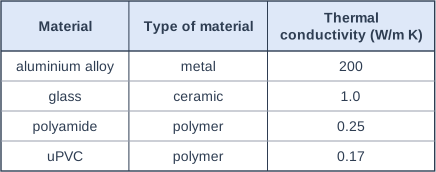
Window frames can be made of uPVC, a polymer, or of an aluminium alloy. The table shows typical values of the thermal conductivity of some materials used in windows. The higher the thermal conductivity, the faster heat is conducted through the material.

Calculate how many times greater the thermal conductivity of the aluminium alloy is than the thermal conductivity of uPVC.

Aluminium window frames often have a strip of polyamide, another polymer, joining the inside part of the frame to the outside part. Explain how this strip reduces the heat lost from a room through the frame.

Table with columns "Material", "Type of material", "Thermal conductivity (W/m K)". Material: aluminium alloy; Type of material: metal; Thermal conductivity (W/m K): 200 | Material: glass; Type of material: ceramic; Thermal conductivity (W/m K): 1.0 | Material: polyamide; Type of material: polymer; Thermal conductivity (W/m K): 0.25 | Material: uPVC; Type of material: polymer; Thermal conductivity (W/m K): 0.17.

Model answer

200 ÷ 0.17 = 1176, so the aluminium alloy conducts heat about 1200 times better than uPVC.

Polyamide has a thermal conductivity of only 0.25, about 800 times lower than the aluminium alloy. The strip separates the inside part of the frame from the outside part, so there is no continuous path of metal: heat from the room cannot easily be conducted through the frame to the outside.

Explanation

Divide the larger value by the smaller to find how many times greater it is. Metals are good thermal conductors and polymers are very poor ones, so a polymer 'thermal break' cuts off the metal path that would conduct heat out of the room. Dividing 0.17 by 200 is a common slip and gives a number less than 1.

Mark scheme
  1. 1 mark

    200 ÷ 0.17 = 1176 / about 1200 (times)

    An answer from 1170 to 1200 with no working scores marking point 1. ALLOW any value from 1170 to 1200, or 1.2 × 10³. DO NOT ALLOW 0.00085 (division the wrong way round).

  2. 1 mark

    polyamide is a very poor conductor of heat compared with aluminium alloy, so heat cannot easily be conducted from the inside part of the frame to the outside part / the strip breaks the path of metal through which heat would be conducted

    ALLOW data such as 'polyamide conducts heat 800 times less than the aluminium alloy'. ALLOW 'the strip acts as an insulator between the inside and outside parts of the frame'. IGNORE 'polyamide is an insulator' with no idea of separating the inside part from the outside part. DO NOT ALLOW 'polyamide stops cold getting in' as the only explanation.

Question 3

3 marks

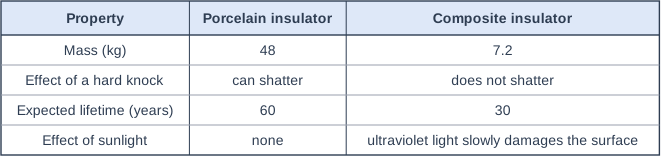
Overhead power lines hang from insulators fixed to the pylons. Insulators used to be made of porcelain, a clay ceramic. Many new insulators are composite insulators: a rod of glass-fibre-reinforced polymer inside a cover of silicone rubber, another polymer.

The table shows an electricity company's data for two insulators that can do the same job.

Calculate the percentage reduction in mass when a porcelain insulator is replaced by a composite insulator.

Use the data to give one advantage and one disadvantage of using composite insulators instead of porcelain insulators.

Table with columns "Property", "Porcelain insulator", "Composite insulator". Property: Mass (kg); Porcelain insulator: 48; Composite insulator: 7.2 | Property: Effect of a hard knock; Porcelain insulator: can shatter; Composite insulator: does not shatter | Property: Expected lifetime (years); Porcelain insulator: 60; Composite insulator: 30 | Property: Effect of sunlight; Porcelain insulator: none; Composite insulator: ultraviolet light slowly damages the surface.

Model answer

Reduction in mass = 48 − 7.2 = 40.8 kg
Percentage reduction = 40.8 ÷ 48 × 100 = 85%

Advantage: the composite insulator is much lighter, so there is less load on the pylon and it is easier and safer to lift and fit. It also does not shatter if it is hit by a stone.

Disadvantage: it lasts only 30 years instead of 60, because ultraviolet light in sunlight slowly damages its polymer surface, so it must be replaced twice as often.

Explanation

Percentage reduction = (original value − new value) ÷ original value × 100; dividing 7.2 by 48 gives the percentage that remains (15%), not the reduction. The data show a typical trade-off: the polymer composite is light and tough, while the ceramic is heavy and brittle but very unreactive and long-lasting.

Mark scheme
  1. 1 mark

    (48 − 7.2) ÷ 48 × 100 = 85 (%)

    An answer of 85% with no working scores marking point 1. DO NOT ALLOW 15% (7.2 ÷ 48 × 100: the percentage of the mass that remains) or 567% (dividing by 7.2).

  2. 1 mark

    any one advantage of the composite insulator from: it is much lighter (so there is less load on the pylon / it is easier and safer to lift and fit); it does not shatter when it is hit (for example by a thrown stone)

    ALLOW 'lighter' or 'less mass' without a consequence. IGNORE 'cheaper' (no data are given).

  3. 1 mark

    disadvantage: it has a shorter lifetime / needs replacing twice as often / sooner, because ultraviolet light (in sunlight) damages the polymer surface

    ALLOW 'it lasts only half as long as the porcelain insulator'. ALLOW 'it is damaged by sunlight / ultraviolet light'. IGNORE 'it is a polymer, so it melts'.

Question 4

4 marks

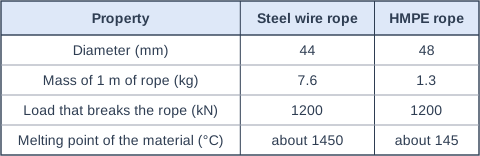
Large ships are tied up in a port with mooring ropes. A port is replacing its steel wire ropes with ropes made of HMPE, a form of poly(ethene) with extremely long chains.

The table shows a supplier's data for two ropes that break at the same load.

Each ship is tied up with 8 ropes, and each rope is 120 m long.

Calculate the total mass of rope saved for each ship by using HMPE ropes instead of steel wire ropes.

Use the data to suggest one disadvantage of HMPE ropes.

Table with columns "Property", "Steel wire rope", "HMPE rope". Property: Diameter (mm); Steel wire rope: 44; HMPE rope: 48 | Property: Mass of 1 m of rope (kg); Steel wire rope: 7.6; HMPE rope: 1.3 | Property: Load that breaks the rope (kN); Steel wire rope: 1200; HMPE rope: 1200 | Property: Melting point of the material (°C); Steel wire rope: about 1450; HMPE rope: about 145.

Model answer

Total length of rope = 8 × 120 = 960 m
Mass of steel ropes = 960 × 7.6 = 7296 kg
Mass of HMPE ropes = 960 × 1.3 = 1248 kg
Mass saved = 7296 − 1248 = 6048 kg (about 6000 kg)

Disadvantage: HMPE melts at about 145 °C, compared with about 1450 °C for steel. If the rope rubs quickly against a metal post, the heat produced by friction could melt or weaken it.

Explanation

The two ropes break at the same load, but 1 m of HMPE rope has less than one fifth of the mass of 1 m of steel rope, so for the same strength the polymer rope is far lighter and easier for the crew to handle. Remember to multiply by both the number of ropes and their length. A polymer's low melting point is a common drawback when it replaces a metal.

Mark scheme
  1. 1 mark

    mass of eight steel ropes = 8 × 120 × 7.6 = 7296 (kg); or a correct final answer of 6048 kg (6000 kg) with no working

    An answer of 6048 kg (or 6000 kg) with no working scores marking points 1, 2 and 3. Alternative method: mass saved for each metre = 7.6 − 1.3 = 6.3 (kg) scores marking point 1, total length of rope = 8 × 120 = 960 (m) scores marking point 2, and 6.3 × 960 = 6048 (kg) scores marking point 3. ALLOW 2 marks for 756 kg (one rope only). ALLOW 1 mark for 50.4 kg (the length of each rope not used).

  2. 1 mark

    mass of eight HMPE ropes = 8 × 120 × 1.3 = 1248 (kg); or a correct final answer of 6048 kg (6000 kg) with no working

    ALLOW ECF from an error in marking point 1 if the same error is made for both ropes.

  3. 1 mark

    evaluation: 7296 − 1248 = 6048 (kg) / 6000 (kg)

    ALLOW 6.0 × 10³ kg, 6.05 tonnes or 6.0 tonnes.

  4. 1 mark

    HMPE has a much lower melting point than steel, so the rope could melt / be weakened by heat, for example from friction when it rubs against a metal post (or in a fire)

    ALLOW 'the HMPE rope is thicker, so it needs larger fittings / takes up more space'. IGNORE cost (no data are given). IGNORE 'polymer ropes are weaker' (both ropes break at the same load).

Ready to try the rest? Every answer you write is marked against the mark scheme, so you can see exactly where the marks are.

Study Helper Hints first, answers after you try

Stuck on this one? Ask for a hint and I’ll point you in the right direction, without giving the answer away. Once you’ve checked your answer, I’ll show you how the marks are awarded.