Level:
Correct: 0
Incorrect: 0
Marks: 0/0
Exam Practice
Course:
Topics:
OCR GCSE Chemistry (Paper 4) Smart practice A mixed round aimed at your weak spots
Unit 4
Predicting and identifying reactions and products
Unit 5
Monitoring and controlling chemical reactions
Unit 6
Global challenges
Unit 7
Practical skills
Avg
score:
–
Topics
done:
0/37

Instrumental methods of analysis

Practise 12 exam-style questions on Instrumental methods of analysis for OCR GCSE Chemistry (Paper 4). Write your answer as you would in the exam and get it marked in seconds against the mark scheme, point by point, with the Study Helper on hand if you get stuck.

  • 12 questions
  • 1–6 marks each
  • Instant marking
  • No sign-up needed
12 questions, marked as you go

Sample questions with model answers

Here are 4 of the questions in this topic, each with a model answer, an explanation of why it earns the marks and the mark scheme an examiner would use.

Question 1

1 mark

Propanoic acid, CH₃CH₂COOH, is used as a preservative in bread. The main peaks in its mass spectrum are at m/z = 27, 28, 29, 45, 57, 73 and 74.

Relative atomic mass (Ar): H = 1.0 C = 12.0 O = 16.0

Which ion produces the peak at m/z = 57?

Choose your answer.

  • A CH₃CH₂⁺
  • B COOH⁺
  • C CH₃CH₂CO⁺
  • D CH₃CH₂COOH⁺

Model answer

C

Explanation

The peaks below the molecular ion are fragment ions, formed when molecules break apart in the mass spectrometer. Each fragment ion has a charge of 1+, so its m/z value equals its relative mass: add up the relative atomic masses of the atoms in each option and find the one that totals 57. CH₃CH₂CO⁺ is 36 + 5 + 16 = 57; the molecular ion, CH₃CH₂COOH⁺, gives the peak at 74.

Mark scheme
  1. 1 mark

    C / CH₃CH₂CO⁺

    The only correct answer is C: the relative mass of CH₃CH₂CO⁺ is (3 × 12.0) + (5 × 1.0) + 16.0 = 57, and the ion has a charge of 1+, so its m/z is 57. It forms when the molecule breaks and loses its OH group. A is not correct because CH₃CH₂⁺ has m/z = 29; B is not correct because COOH⁺ has m/z = 45; D is not correct because CH₃CH₂COOH⁺ is the molecular ion, with m/z = 74. ALLOW the letter or the ion. If more than one option is given, do not award the mark.
Question 2

2 marks

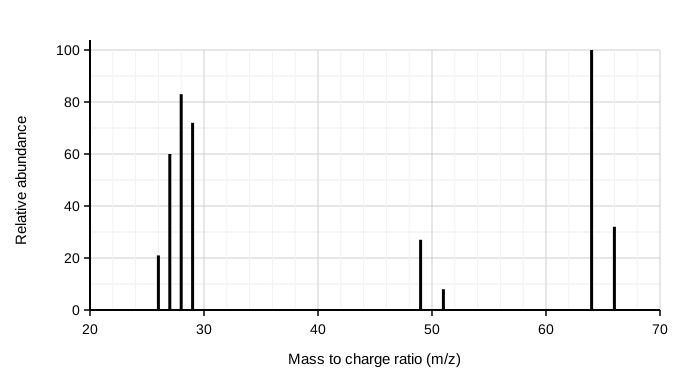
Chloroethane, C₂H₅Cl, is used in sprays that cool and numb the skin. The chart shows the mass spectrum of chloroethane.

Chlorine atoms exist as two isotopes, ³⁵Cl and ³⁷Cl.

Relative atomic mass (Ar): H = 1.0 C = 12.0

The peaks at m/z = 64 and m/z = 66 are both produced by C₂H₅Cl⁺ ions.

Explain why there are two peaks for C₂H₅Cl⁺ ions, and what the heights of these two peaks show about chlorine.

A mass spectrum drawn as vertical lines. The horizontal axis is mass to charge ratio (m/z) from 20 to 70; the vertical axis is relative abundance from 0 to 100. There are lines at m/z 26, 27, 28, 29, 49, 51, 64 and 66. The line at 64 is the tallest, reaching 100; the line at 66 reaches 32.

Model answer

Chlorine has two isotopes. ³⁷Cl atoms have two more neutrons than ³⁵Cl atoms, so a C₂H₅Cl⁺ ion containing ³⁵Cl has m/z = 24 + 5 + 35 = 64, and one containing ³⁷Cl has m/z = 24 + 5 + 37 = 66.

The peak at 64 has a relative abundance of 100 and the peak at 66 has 32, so the peak at 64 is about three times as tall. This shows that about three times as many chlorine atoms are ³⁵Cl as ³⁷Cl (about 75% and 25%).

Explanation

Isotopes of an element have the same number of protons but different numbers of neutrons, so molecules containing different isotopes have different masses and give separate peaks. The height of each peak shows how many ions have that mass, so the ratio of the heights gives the ratio of the isotopes. The same pattern, a pair of peaks 2 apart in a 3 : 1 ratio, appears at m/z = 49 and 51 for the CH₂Cl⁺ fragment.

Mark scheme
  1. 1 mark

    an ion containing ³⁵Cl has m/z (24 + 5 + 35 =) 64 and an ion containing ³⁷Cl has m/z (24 + 5 + 37 =) 66 / ³⁷Cl atoms have two more neutrons than ³⁵Cl atoms, so ions containing ³⁷Cl are 2 heavier

    The idea is that the two peaks come from ions containing the two different isotopes. ALLOW chlorine-35 and chlorine-37, Cl-35 and Cl-37. ALLOW 'the isotopes have different numbers of neutrons (but the same number of protons), so the ions have different masses'. DO NOT ALLOW different numbers of protons or electrons. IGNORE references to the other peaks.

  2. 1 mark

    the peak at m/z 64 is about three times as tall as the peak at m/z 66 (100 : 32), so there are about three times as many ³⁵Cl atoms as ³⁷Cl atoms

    ALLOW about 75% (or 76%) of chlorine atoms are ³⁵Cl and about 25% (or 24%) are ³⁷Cl. ALLOW ratios from 3 : 1 to 3.2 : 1. ALLOW ³⁵Cl is (about three times) more common / more abundant. A statement that ³⁵Cl is more common with no link to the peak heights scores this mark only if the heights are used somewhere in the answer. DO NOT ALLOW ³⁷Cl is more common.

Question 3

3 marks

A gas cylinder is labelled 'C₄H₁₀'. Two compounds have this formula: butane and methylpropane. A scientist records the mass spectrum of the gas.

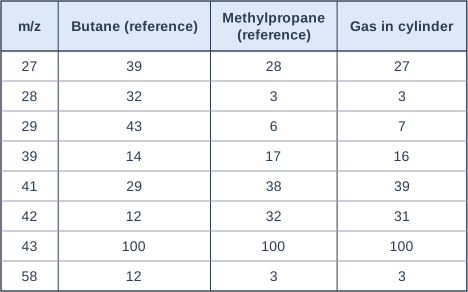
The table shows the main peaks in reference spectra of the two compounds, and in the spectrum of the gas. Each number is the relative abundance of a peak.

Identify the gas. Explain how the data show this, and why the molecular ion peak alone cannot be used to identify the gas.

Table with columns "m/z", "Butane (reference)", "Methylpropane (reference)", "Gas in cylinder". m/z: 27; Butane (reference): 39; Methylpropane (reference): 28; Gas in cylinder: 27 | m/z: 28; Butane (reference): 32; Methylpropane (reference): 3; Gas in cylinder: 3 | m/z: 29; Butane (reference): 43; Methylpropane (reference): 6; Gas in cylinder: 7 | m/z: 39; Butane (reference): 14; Methylpropane (reference): 17; Gas in cylinder: 16 | m/z: 41; Butane (reference): 29; Methylpropane (reference): 38; Gas in cylinder: 39 | m/z: 42; Butane (reference): 12; Methylpropane (reference): 32; Gas in cylinder: 31 | m/z: 43; Butane (reference): 100; Methylpropane (reference): 100; Gas in cylinder: 100 | m/z: 58; Butane (reference): 12; Methylpropane (reference): 3; Gas in cylinder: 3.

Model answer

The gas is methylpropane.

The gas has very small peaks at m/z 28 and 29 (3 and 7), like methylpropane (3 and 6), whereas butane has large peaks there (32 and 43). The gas also has a peak of 31 at m/z 42, matching methylpropane's 32, but butane's is only 12.

Butane and methylpropane are isomers with the same formula, C₄H₁₀, so both have a relative molecular mass of 58 and both give a molecular ion peak at m/z 58. The molecular ion alone cannot tell them apart; the pattern of fragment peaks can.

Explanation

Isomers have the same relative molecular mass, so their molecular ion peaks are at the same m/z value. Their molecules break up in different ways, so the heights of their fragment peaks differ, and comparing the whole pattern with reference spectra identifies the compound. Look for the m/z values where the two reference spectra differ most (28, 29, 42 and 58) and see which reference the sample matches.

Mark scheme
  1. 1 mark

    methylpropane

    ALLOW 2-methylpropane / isobutane.

  2. 1 mark

    a comparison of at least one peak that matches methylpropane but not butane: the peaks at m/z 28 and 29 are small (3 and 7), like methylpropane's (3 and 6) but not butane's (32 and 43) / the peak at m/z 42 is 31, like methylpropane's 32 but not butane's 12 / the peak at m/z 58 is 3, like methylpropane's 3 but not butane's 12

    Data for the gas and at least one reference must be used. ALLOW 'all the peaks match methylpropane' only if at least one m/z value that differs between the references is quoted. IGNORE the peak at 43 (it is the tallest peak in all three spectra).

  3. 1 mark

    both compounds have the same molecular formula / the same relative molecular mass of 58 (they are isomers), so both have a molecular ion peak at m/z 58

    ALLOW both have Mr = 58 / both molecules have the same mass. IGNORE both have their tallest peak at 43.

Question 4

4 marks

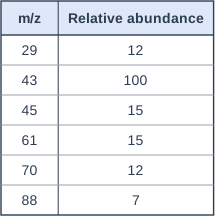
Compound E is a solvent used to remove caffeine from coffee beans. It contains carbon, hydrogen and oxygen only. By mass, it contains 54.5% carbon, 9.1% hydrogen and 36.4% oxygen.

The table shows the main peaks in the mass spectrum of compound E.

Relative atomic mass (Ar): H = 1.0 C = 12.0 O = 16.0

Determine the empirical formula and the molecular formula of compound E.

Table with columns "m/z", "Relative abundance". m/z: 29; Relative abundance: 12 | m/z: 43; Relative abundance: 100 | m/z: 45; Relative abundance: 15 | m/z: 61; Relative abundance: 15 | m/z: 70; Relative abundance: 12 | m/z: 88; Relative abundance: 7.

Model answer

Amount of C = 54.5 ÷ 12.0 = 4.54 mol
Amount of H = 9.1 ÷ 1.0 = 9.1 mol
Amount of O = 36.4 ÷ 16.0 = 2.275 mol
Divide by the smallest (2.275): C = 2.0, H = 4.0, O = 1.0
Empirical formula = C₂H₄O

The molecular ion peak is the peak with the highest m/z, at 88, so the relative molecular mass of E is 88.
Empirical formula mass = (2 × 12.0) + (4 × 1.0) + 16.0 = 44
88 ÷ 44 = 2, so the molecular formula = C₄H₈O₂

Explanation

Treat the percentages as masses in 100 g, divide each by its relative atomic mass, then divide by the smallest amount to get the simplest whole-number ratio. The mass spectrum supplies the relative molecular mass: it is the m/z of the molecular ion, the peak furthest to the right, not the tallest peak at 43, which is a fragment. Dividing 88 by the empirical formula mass shows how many empirical units are in one molecule.

Mark scheme
  1. 1 mark

    amounts in 100 g: C = 54.5 ÷ 12.0 = 4.54, H = 9.1 ÷ 1.0 = 9.1, O = 36.4 ÷ 16.0 = 2.275 (mol); or a correct final answer of C₂H₄O and C₄H₈O₂ with no working

    Correct formulae (empirical formula C₂H₄O and molecular formula C₄H₈O₂) with no working score 4 marks. A correct molecular formula, C₄H₈O₂, on its own with no working scores marking points 3 and 4. ALLOW 4.5 for carbon and 2.3 or 2.28 for oxygen.

  2. 1 mark

    ratio C : H : O = 4.54 ÷ 2.275 : 9.1 ÷ 2.275 : 2.275 ÷ 2.275 = 2 : 4 : 1, so the empirical formula is C₂H₄O; or a correct final answer of C₂H₄O and C₄H₈O₂ with no working

    ALLOW the elements in any order. ALLOW C2H4O.

  3. 1 mark

    the molecular ion peak is at m/z = 88 (the peak with the highest m/z), so the relative molecular mass of E is 88; or a correct final answer of C₂H₄O and C₄H₈O₂ with no working

    DO NOT ALLOW 43 (the tallest peak, not the molecular ion). A student who uses 43 and gives C₂H₄O as the molecular formula scores marking points 1 and 2 only.

  4. 1 mark

    (empirical formula mass = 44, and 88 ÷ 44 = 2, so) molecular formula = C₄H₈O₂

    ALLOW C4H8O2 and the elements in any order. ALLOW ECF from a wrong empirical formula, if it is correctly scaled up to a relative formula mass of 88.

Ready to try the rest? Every answer you write is marked against the mark scheme, so you can see exactly where the marks are.

Study Helper Hints first, answers after you try

Stuck on this one? Ask for a hint and I’ll point you in the right direction, without giving the answer away. Once you’ve checked your answer, I’ll show you how the marks are awarded.