
Level:
Correct: 0
Incorrect: 0
Marks: 0/0
Exam Practice
Course:
Topics:
OCR GCSE Chemistry (Paper 4) Smart practice A mixed round aimed at your weak spots
Unit 4
Predicting and identifying reactions and products
Unit 5
Monitoring and controlling chemical reactions
Unit 6
Global challenges
Unit 7
Practical skills
Avg
score:
–
Topics
done:
0/37

Hydrocarbons, a finite resource, and cracking

Practise 16 exam-style questions on Hydrocarbons, a finite resource, and cracking for OCR GCSE Chemistry (Paper 4). Write your answer as you would in the exam and get it marked in seconds against the mark scheme, point by point, with the Study Helper on hand if you get stuck.

  • 16 questions
  • 1–6 marks each
  • Instant marking
  • No sign-up needed
16 questions, marked as you go

Sample questions with model answers

Here are 4 of the questions in this topic, each with a model answer, an explanation of why it earns the marks and the mark scheme an examiner would use.

Question 1

1 mark

In a catalytic cracker, the hot zeolite catalyst slowly becomes coated with a layer of solid carbon.

What effect does the layer of carbon have?

Choose your answer.

  • A The carbon lowers the activation energy further, so cracking speeds up.
  • B The carbon reacts with the alkanes, so more alkenes are made.
  • C The catalyst is used up by the carbon, so it must be thrown away.
  • D The surface of the catalyst is covered, so cracking slows down.

Model answer

D

Explanation

Catalytic cracking happens on the surface of the solid catalyst, which is why the catalyst is used as a fine powder with a large surface area. A layer of carbon blocks the surface, so fewer alkane molecules can reach it and the reaction slows down. In refineries the carbon is burned off in air and the catalyst is reused, because a catalyst is not used up.

Mark scheme
  1. 1 mark

    D / the surface of the catalyst is covered, so cracking slows down

    The only correct answer is D: the reaction happens on the surface of the solid catalyst, so carbon covering the surface leaves less of the catalyst surface available to the alkane molecules, and the rate of cracking falls. A is not correct because the carbon is not a catalyst for cracking and does not lower the activation energy; B is not correct because the solid carbon does not react with the alkanes to make alkenes; C is not correct because a catalyst is not used up in the reaction: the carbon can be burned off in air and the catalyst used again. ALLOW the letter or the statement. If more than one option is given, do not award the mark.
Question 2

2 marks

A new hospital gets all its electricity from wind turbines and heats its buildings with electric heat pumps, so it burns no fuel.

The hospital manager says: 'Our hospital no longer depends on crude oil.'

Give two different ways in which the hospital still depends on substances made from crude oil.

Model answer

The hospital uses many plastic items made from crude oil, such as syringes, gloves and drip bags. Many of its medicines are also made from chemicals obtained from crude oil, and its ambulances run on diesel.

Explanation

Modern life depends on hydrocarbons from crude oil both as fuels and as a feedstock for materials. Even when electricity and heating come from other sources, plastics, medicines, lubricants, solvents and transport fuels all still come from crude oil. Two answers of the same type, such as two plastic items, count as only one way.

Mark scheme
  1. 2 marks

    any two different ways from: plastics / polymers (for example syringes, gloves, tubing, drip bags or packaging); medicines (many are made from chemicals obtained from crude oil); fuel for ambulances or delivery vehicles; lubricants for machines (for example lifts or scanners); solvents, detergents or disinfectants; dyes or adhesives

    1 mark for each different way, max 2. Two items of the same type (for example two plastic items) score only 1 mark. Max 1 if more than two answers are given and one of them is wrong. IGNORE electricity or heating (the question says these do not use fuel). IGNORE 'petrol' on its own unless linked to a vehicle that the hospital uses.

Question 3

3 marks

Crude oil is a finite resource.

At the end of 2020, the world's proved reserves of oil were about 1.7 × 10¹² barrels. In 2020, the world produced about 3.2 × 10¹⁰ barrels of oil.
(Data: Energy Institute, Statistical Review of World Energy; values rounded)

Calculate how many years the proved reserves would last if oil continued to be produced at the 2020 rate.

Suggest one reason why the oil might last longer than your answer.

Model answer

Number of years = reserves ÷ production per year = 1.7 × 10¹² ÷ 3.2 × 10¹⁰ = 53 years
The oil might last longer because new reserves may be discovered, or people may use less oil in future, for example by using more renewable energy and electric vehicles.

Explanation

Divide the reserves by the amount used each year to find how many years they would last; with standard form, 10¹² ÷ 10¹⁰ = 10². The calculation assumes that no new oil is found and that use stays the same, so it is only an estimate. Crude oil is finite because it forms over millions of years, far more slowly than it is used, so new crude oil forming is not a reason it will last longer.

Mark scheme
  1. 1 mark

    1.7 × 10¹² ÷ 3.2 × 10¹⁰; or a correct final answer of 53 years (or 50 years) with no working

    An answer of 53 years (or 53.1 or 50 years) with no working scores marking points 1 and 2. ALLOW 53.1 or 53.125. DO NOT ALLOW 0.019 (3.2 × 10¹⁰ ÷ 1.7 × 10¹², the division the wrong way round).

  2. 1 mark

    53 (years)

    ALLOW 53.1, 53.125 or 50 (years). IGNORE units.

  3. 1 mark

    new reserves may be discovered / new technology may allow more oil to be extracted from known oil fields / people may use less oil in future (for example by switching to renewable energy, electric vehicles or recycling plastics)

    ALLOW oil companies may find more oil. ALLOW the price may rise so that oil which is too expensive to extract now becomes worth extracting. IGNORE 'more oil will form' (oil forms over millions of years). DO NOT ALLOW reasons why the oil would run out sooner.

Question 4

5 marks

Decane, C₁₀H₂₂, can be cracked to make octane and ethene:

C₁₀H₂₂ → C₈H₁₈ + C₂H₄

A molecule of decane has 9 C–C bonds and 22 C–H bonds. A molecule of ethene has one C=C bond and 4 C–H bonds.

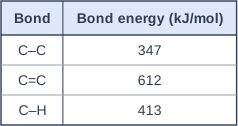
The table shows some bond energies.

Calculate the energy change for the reaction.

Hexadecane, C₁₆H₃₄, can be cracked in a similar way: C₁₆H₃₄ → C₁₄H₃₀ + C₂H₄

Explain why the energy change for this reaction is the same as the energy change for cracking decane.

Table with columns "Bond", "Bond energy (kJ/mol)". Bond: C–C; Bond energy (kJ/mol): 347 | Bond: C=C; Bond energy (kJ/mol): 612 | Bond: C–H; Bond energy (kJ/mol): 413.

Model answer

Bonds broken in decane: (9 × 347) + (22 × 413) = 3123 + 9086 = 12 209 kJ/mol
Bonds made in octane (7 C–C, 18 C–H) and ethene (1 C=C, 4 C–H): (7 × 347) + (18 × 413) + 612 + (4 × 413) = 2429 + 7434 + 612 + 1652 = 12 127 kJ/mol
Energy change = 12 209 − 12 127 = +82 kJ/mol (endothermic)
In the hexadecane reaction there are 34 C–H bonds before and 30 + 4 = 34 after, so the C–H bonds cancel out, as they do for decane. Hexadecane has 15 C–C bonds and tetradecane has 13, so overall two C–C bonds are broken and one C=C bond is made, exactly as in cracking decane. So the energy change is the same, +82 kJ/mol.

Explanation

Energy change = energy needed to break bonds − energy released when bonds are made; a positive value means the reaction is endothermic, so cracking needs a continuous supply of heat. An alkane with n carbon atoms in a straight chain has (n − 1) C–C bonds and (2n + 2) C–H bonds, which gives 7 C–C and 18 C–H bonds for octane. Whenever an alkane cracks into a shorter alkane and ethene, the net change is two C–C bonds broken and one C=C bond made.

Mark scheme
  1. 1 mark

    energy to break bonds in decane = (9 × 347) + (22 × 413) = 12 209 (kJ/mol); or a correct final answer of +82 kJ/mol with no working

    An answer of +82 kJ/mol with no working scores marking points 1, 2 and 3. ALLOW the shorter method: the C–H bonds cancel out, so the energy change = (2 × 347) − 612; 694 (kJ) for breaking two C–C bonds scores this mark.

  2. 1 mark

    energy released making bonds in octane and ethene = (7 × 347) + (18 × 413) + 612 + (4 × 413) = 12 127 (kJ/mol); or a correct final answer of +82 kJ/mol with no working

    Octane has 7 C–C bonds and 18 C–H bonds. ALLOW 612 (kJ) for making one C=C bond in the shorter method. ALLOW ECF for one wrong bond count in octane.

  3. 1 mark

    (12 209 − 12 127 =) +82 (kJ/mol)

    ALLOW 82 without a sign. DO NOT ALLOW −82. ALLOW ECF from the student's two totals. IGNORE units.

  4. 1 mark

    in both reactions the number of C–H bonds is the same before and after the reaction, so their energies cancel out

    Hexadecane has 34 C–H bonds; tetradecane has 30 and ethene has 4. ALLOW a correct count of the bonds in hexadecane and its products.

  5. 1 mark

    in both reactions, overall two C–C bonds are broken and one C=C bond is made, so the energy change is the same

    Hexadecane has 15 C–C bonds and tetradecane has 13. ALLOW 'each reaction loses two C–C bonds and gains one C=C bond'.

Ready to try the rest? Every answer you write is marked against the mark scheme, so you can see exactly where the marks are.

Study Helper Hints first, answers after you try

Stuck on this one? Ask for a hint and I’ll point you in the right direction, without giving the answer away. Once you’ve checked your answer, I’ll show you how the marks are awarded.