
Level:
Correct: 0
Incorrect: 0
Marks: 0/0
Exam Practice
Course:
Topics:
OCR GCSE Chemistry (Paper 4) Smart practice A mixed round aimed at your weak spots
Unit 4
Predicting and identifying reactions and products
Unit 5
Monitoring and controlling chemical reactions
Unit 6
Global challenges
Unit 7
Practical skills
Avg
score:
–
Topics
done:
0/37

Alloys and corrosion

Practise 14 exam-style questions on Alloys and corrosion for OCR GCSE Chemistry (Paper 4). Write your answer as you would in the exam and get it marked in seconds against the mark scheme, point by point, with the Study Helper on hand if you get stuck.

  • 14 questions
  • 1–6 marks each
  • Instant marking
  • No sign-up needed
14 questions, marked as you go

Sample questions with model answers

Here are 4 of the questions in this topic, each with a model answer, an explanation of why it earns the marks and the mark scheme an examiner would use.

Question 1

1 mark

Many outdoor statues are cast from an alloy that is about 88% copper and 12% tin by mass. The alloy is harder than pure copper and corrodes only very slowly in air.

Which alloy is this?

Choose your answer.

  • A brass
  • B bronze
  • C solder
  • D steel

Model answer

B

Explanation

Bronze is copper alloyed with tin, usually about 10-12% tin. It is harder than copper, resists corrosion and can be poured into moulds, so it is used for statues, bells and bearings. The commonest error is to confuse bronze (copper and tin) with brass (copper and zinc).

Mark scheme
  1. 1 mark

    B / bronze

    The only correct answer is B: bronze is an alloy of copper and tin, mainly copper. A is not correct because brass is an alloy of copper and zinc; C is not correct because solder is mainly tin (traditionally mixed with lead, or with small amounts of copper or silver in lead-free solder), and it has a low melting point so that it can be used to join metals; D is not correct because steel is mainly iron with a small percentage of carbon (and sometimes other metals such as chromium and nickel). ALLOW the letter or the option. If more than one option is given, do not award the mark.
Question 2

2 marks

The steel hull of a boat is protected from rusting by zinc blocks. The blocks are normally bolted directly onto the steel below the water line.

A boat owner replaces a worn zinc block. She fixes the new block to the hull with a thick layer of plastic glue, which does not conduct electricity, so the block does not touch the steel. A few months later the steel next to the new block has started to rust, even though the zinc block is also slowly corroding.

Suggest why the new block is not protecting the steel.

Model answer

Zinc is more reactive than iron, so it loses electrons more readily. When the zinc is bolted to the hull, the zinc is oxidised instead of the iron, and the electrons it loses flow through the metal into the steel, so the iron does not lose electrons.

The glue does not conduct electricity, so there is no electrical connection between the zinc and the steel. The electrons from the zinc cannot reach the steel, so the zinc corrodes on its own while the iron next to it still loses electrons, is oxidised and rusts.

Explanation

Sacrificial protection needs the more reactive metal to be in electrical contact with the iron, either touching it or joined by a conducting wire, so that it supplies electrons to the iron. Insulating the block leaves two separate pieces of metal that each corrode. Use 'corrode' or 'is oxidised' for zinc: only iron and its alloys rust.

Mark scheme
  1. 1 mark

    (sacrificial protection works because) zinc is more reactive than iron / loses electrons more readily than iron, so the zinc is oxidised instead of the iron

    ALLOW 'the zinc corrodes instead of the steel'. DO NOT ALLOW 'the zinc rusts' (only iron and its alloys rust). IGNORE 'zinc is a barrier'.

  2. 1 mark

    the glue does not conduct, so electrons (lost by the zinc) cannot flow to the steel / there is no electrical connection between the zinc and the steel, so the iron loses electrons itself / is oxidised (and rusts)

    The idea that electrons cannot pass from the zinc to the steel, or that there is no electrical connection (conducting path), is needed. IGNORE 'the block is not touching the steel' on its own (it repeats the question). DO NOT ALLOW 'the glue stops the zinc reacting' (the zinc is corroding).

Question 3

3 marks

Bronze is an alloy of copper and tin. Tin atoms are larger than copper atoms.

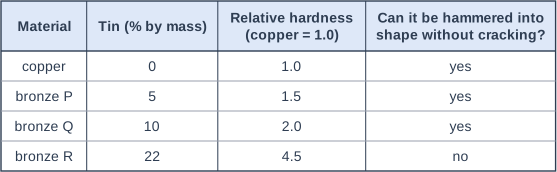
The table shows typical values for copper and for three bronzes.

Describe and explain how the percentage of tin affects the hardness of bronze. Use data from the table.

Church bells are made of bronze containing about 22% tin. Bells are made by casting: molten bronze is poured into a mould. Use the table to suggest why bells are cast rather than hammered into shape.

Table with columns "Material", "Tin (% by mass)", "Relative hardness (copper = 1.0)", "Can it be hammered into shape without cracking?". Material: copper; Tin (% by mass): 0; Relative hardness (copper = 1.0): 1.0; Can it be hammered into shape without cracking?: yes | Material: bronze P; Tin (% by mass): 5; Relative hardness (copper = 1.0): 1.5; Can it be hammered into shape without cracking?: yes | Material: bronze Q; Tin (% by mass): 10; Relative hardness (copper = 1.0): 2.0; Can it be hammered into shape without cracking?: yes | Material: bronze R; Tin (% by mass): 22; Relative hardness (copper = 1.0): 4.5; Can it be hammered into shape without cracking?: no.

Model answer

As the percentage of tin increases, the bronze gets harder: copper has a relative hardness of 1.0, bronze with 10% tin is twice as hard (2.0) and bronze with 22% tin is 4.5 times as hard.

Tin atoms are larger than copper atoms, so they distort the regular layers of copper atoms. The layers can no longer slide over each other easily, so more force is needed to change the shape of the metal.

The table shows that bronze with 22% tin cracks when it is hammered, so it is too brittle to be hammered into shape. A bell has to be cast in a mould instead.

Explanation

Adding atoms of a different size to a metal disrupts its regular layers, so the layers slide past each other less easily and the alloy is harder than the pure metal. The table also shows the cost of this: high-tin bronze is hard but brittle. A common error is to say the alloy is harder because tin itself is harder than copper; pure tin is a soft metal.

Mark scheme
  1. 1 mark

    the greater the percentage of tin, the harder the bronze, with data (for example, relative hardness rises from 1.0 for copper to 4.5 for 22% tin / bronze R is 4.5 times as hard as copper)

    Data must be quoted for the mark: any correct pair of values from the table, or a correct comparison such as 'twice as hard with 10% tin'. ORA (allow the reverse argument).

  2. 1 mark

    the (larger) tin atoms distort / disrupt the regular layers of copper atoms (ions), so the layers cannot slide over each other as easily

    Both ideas are needed: the different-sized atoms disrupt the layers, AND the layers slide less easily. ALLOW 'the rows of atoms are no longer regular, so it is harder for them to move past each other'. DO NOT ALLOW 'tin is harder than copper' or 'tin and copper atoms form strong (covalent / ionic) bonds' as the explanation. DO NOT ALLOW 'molecules' for atoms.

  3. 1 mark

    bronze with 22% tin cracks when it is hammered / is too brittle to be hammered into shape, so the bell must be shaped by casting

    The idea that the high-tin bronze cracks (is brittle) when hammered is needed. ALLOW 'only the bronzes with 10% tin or less can be hammered'. IGNORE 'it is too hard to hammer' unless cracking or brittleness is stated.

Question 4

4 marks

Brass is an alloy of copper and zinc. A student finds the percentage of zinc in a sample of powdered brass.

• She adds 4.00 g of the brass to an excess of dilute hydrochloric acid in a conical flask standing on a balance.
• All the zinc reacts and the hydrogen formed escapes from the flask. The copper does not react.
• When the reaction has stopped, the total mass has decreased by 0.044 g.

Zn + 2HCl → ZnCl₂ + H₂

Relative atomic mass (Ar): H = 1.0 Zn = 65.4

Calculate the percentage by mass of zinc in the brass. Give your answer to 2 significant figures.

Explain why the copper in the brass does not react with the acid.

Model answer

Mass of hydrogen = 0.044 g, and Mr of H₂ = 2.0
Amount of hydrogen = 0.044 ÷ 2.0 = 0.022 mol
From the equation, 1 mol Zn gives 1 mol H₂, so amount of zinc = 0.022 mol
Mass of zinc = 0.022 × 65.4 = 1.4388 g
Percentage of zinc = 1.4388 ÷ 4.00 × 100 = 35.97% = 36% (2 significant figures)

Copper is below hydrogen in the reactivity series, so it is not reactive enough to displace hydrogen from the acid.

Explanation

The loss in mass is the mass of hydrogen that escaped; dividing by 2.0 (the Mr of H₂, not the Ar of H) gives the amount in moles, and the 1 : 1 ratio in the equation gives the amount of zinc. Common errors are using 1.0 for hydrogen, which doubles the answer to 72%, and giving the percentage of copper (64%) instead of zinc. Metals below hydrogen in the reactivity series, such as copper, do not react with dilute acids.

Mark scheme
  1. 1 mark

    amount of hydrogen = 0.044 ÷ 2.0 = 0.022 (mol), so amount of zinc = 0.022 (mol); or a correct final answer of 36% with no working

    An answer of 36% with no working scores marking points 1, 2 and 3. ALLOW 2 marks for 72% (hydrogen taken as 1.0 instead of 2.0 for H₂, giving 0.044 mol). ALLOW 2 marks for 64% (the percentage of copper given instead of zinc). ALLOW ECF for marking points 2 and 3 from a wrong amount of hydrogen shown in the working.

  2. 1 mark

    mass of zinc = 0.022 × 65.4 = 1.44 (g) / 1.4388 (g); or a correct final answer of 36% with no working

    ALLOW 1.4 g. ALLOW ECF from marking point 1. ALLOW the mass-ratio method: 65.4 g of zinc gives 2.0 g of hydrogen, so mass of zinc = 0.044 × 65.4 ÷ 2.0 = 1.44 g (scores marking points 1 and 2).

  3. 1 mark

    evaluation: (1.4388 ÷ 4.00) × 100 = 36 (%)

    The answer must be given to 2 significant figures for this mark. ALLOW 2 marks in total for a correct value not given to 2 significant figures, such as 35.97% or 36.0%. An answer of 35% from rounding the mass of zinc to 1.4 g too early scores marking points 1 and 2 only. ALLOW ECF for the significant-figure mark from a valid calculation with an earlier error.

  4. 1 mark

    copper is less reactive than hydrogen / is below hydrogen in the reactivity series, so it cannot displace hydrogen from the acid

    ALLOW 'copper has less tendency than hydrogen to form positive ions'. IGNORE 'copper is less reactive than zinc' on its own (it does not explain why copper does not react with the acid). IGNORE 'copper is unreactive' with no reference to hydrogen.

Ready to try the rest? Every answer you write is marked against the mark scheme, so you can see exactly where the marks are.

Study Helper Hints first, answers after you try

Stuck on this one? Ask for a hint and I’ll point you in the right direction, without giving the answer away. Once you’ve checked your answer, I’ll show you how the marks are awarded.