Level:
Correct: 0
Incorrect: 0
Marks: 0/0
Exam Practice
Course:
Topics:
OCR GCSE Chemistry (Paper 4) Smart practice A mixed round aimed at your weak spots
Unit 4
Predicting and identifying reactions and products
Unit 5
Monitoring and controlling chemical reactions
Unit 6
Global challenges
Unit 7
Practical skills
Avg
score:
–
Topics
done:
0/37

Interpreting rate of reaction graphs

Practise 15 exam-style questions on Interpreting rate of reaction graphs for OCR GCSE Chemistry (Paper 4). Write your answer as you would in the exam and get it marked in seconds against the mark scheme, point by point, with the Study Helper on hand if you get stuck.

  • 15 questions
  • 1–6 marks each
  • Instant marking
  • No sign-up needed
15 questions, marked as you go

Sample questions with model answers

Here are 4 of the questions in this topic, each with a model answer, an explanation of why it earns the marks and the mark scheme an examiner would use.

Question 1

1 mark

A student adds limestone chips to an excess of dilute hydrochloric acid in an open flask on a balance. She records the mass of the flask and its contents every 30 seconds until the reaction stops.

Which statement describes the gradient of a graph of the mass of the flask and its contents against time?

Choose your answer.

  • A It is positive and gets less steep, then becomes zero.
  • B It is negative and gets less steep, then becomes zero.
  • C It is negative and gets steeper, then becomes zero.
  • D It is zero at first, then becomes negative.

Model answer

B. The mass goes down, so the gradient is negative. The reaction is fastest at the start and slows down, so the graph gets less steep, and when the reaction stops the line is horizontal (gradient zero).

Explanation

The gradient of a graph of amount against time gives the rate. When the quantity plotted is the mass of the flask, it falls as gas escapes, so the gradient is negative and its size gives the rate. Choosing A comes from thinking of a graph of the mass of carbon dioxide made, which rises.

Mark scheme
  1. 1 mark

    B / it is negative and gets less steep, then becomes zero

    The only correct answer is B: the mass falls as carbon dioxide escapes, so the gradient is negative; the rate is greatest at the start and decreases, so the graph gets less steep, and the gradient is zero when the reaction stops. A is not correct because the mass decreases, so the gradient cannot be positive (a graph of mass of carbon dioxide given off would have a positive gradient); C is not correct because the reaction slows down, so the graph becomes less steep, not steeper; D is not correct because the reaction is fastest at the start, so the gradient is not zero at first. ALLOW the letter or the option. If more than one option is given, do not award the mark.
Question 2

2 marks

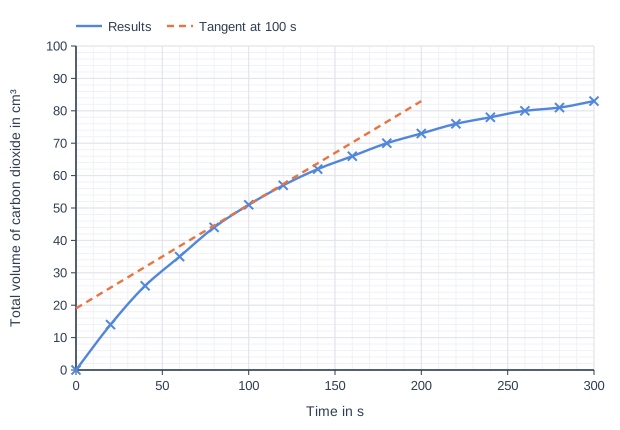
A student adds marble chips (an excess) to dilute nitric acid and measures the total volume of carbon dioxide given off every 20 seconds.

The graph shows the results. The dashed line is a tangent to the curve at 100 s.

Use the tangent to calculate the rate of reaction at 100 s. Give your answer in cm³/s.

Line graph of total volume of carbon dioxide in cm³ (y-axis, 0 to 100) against time in s (x-axis, 0 to 300). "Results" is a smooth curve through (0, 0), (20, 14), (40, 26), (60, 35), (80, 44), (100, 51), (120, 57), (140, 62), (160, 66), (180, 70), (200, 73), (220, 76), (240, 78), (260, 80), (280, 81), (300, 83). "Tangent at 100 s" (dashed) joins the points (0, 19), (200, 83).

Model answer

The tangent passes through (0 s, 19 cm³) and (200 s, 83 cm³).
Gradient = (83 − 19) ÷ (200 − 0) = 64 ÷ 200 = 0.32 cm³/s.
Rate of reaction at 100 s = 0.32 cm³/s.

Explanation

The rate at one moment is the gradient of the tangent at that time: choose two points far apart on the tangent and divide the change in volume by the change in time. A common error is to divide the volume on the curve at 100 s by 100 s, which gives the mean rate from the start (0.51 cm³/s) and is too high because the reaction was faster earlier.

Mark scheme
  1. 1 mark

    gradient of the tangent = change in volume ÷ change in time, for example (83 − 19) ÷ (200 − 0) = 64 ÷ 200; or a correct final answer of 0.32 cm³/s with no working

    An answer of 0.32 cm³/s (or any answer from 0.30 to 0.34 cm³/s) with no working scores 2 marks. ALLOW any two points read from the tangent, for example (100, 51) and (200, 83). ALLOW 1 mark for a correct method using a misread value. An answer of 0.51 cm³/s (51 ÷ 100: the reading on the curve divided by the time, which is the mean rate over the first 100 s, not the tangent) scores 0.

  2. 1 mark

    0.32 (cm³/s)

    ALLOW 0.30 to 0.34 cm³/s.

Question 3

3 marks

Iron powder (an excess) reacts with copper(II) sulfate solution:

Fe(s) + CuSO₄(aq) → FeSO₄(aq) + Cu(s)

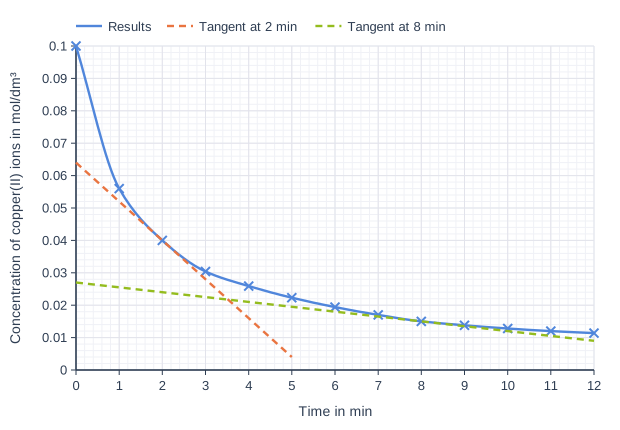
A scientist uses a colorimeter to find the concentration of copper(II) ions in the mixture every minute.

The graph shows the results. Tangents (dashed lines) have been drawn to the curve at 2 minutes and at 8 minutes.

Calculate how many times faster the reaction is at 2 minutes than at 8 minutes.

Line graph of concentration of copper(II) ions in mol/dm³ (y-axis, 0 to 0.1) against time in min (x-axis, 0 to 12). "Results" is a smooth curve through (0, 0.1), (1, 0.056), (2, 0.04), (3, 0.0304), (4, 0.0259), (5, 0.0223), (6, 0.0194), (7, 0.017), (8, 0.015), (9, 0.0138), (10, 0.0128), (11, 0.012), (12, 0.0114). "Tangent at 2 min" (dashed) joins the points (0, 0.064), (5, 0.004). "Tangent at 8 min" (dashed) joins the points (0, 0.027), (12, 0.009).

Model answer

Tangent at 2 min passes through (0, 0.064) and (5, 0.004): gradient = (0.064 − 0.004) ÷ 5 = 0.012 mol/dm³ per minute.
Tangent at 8 min passes through (0, 0.027) and (12, 0.009): gradient = (0.027 − 0.009) ÷ 12 = 0.0015 mol/dm³ per minute.
0.012 ÷ 0.0015 = 8, so the reaction is 8 times faster at 2 minutes than at 8 minutes.

Explanation

The rate at a given time is the gradient of the tangent at that time. On a graph of the concentration of a reactant the gradients are negative, because the reactant is used up, so use their sizes. A common mistake is to compare the concentrations at the two times (0.040 ÷ 0.015 = 2.7) instead of the gradients: the rate depends on how steep the curve is, not on how high it is.

Mark scheme
  1. 1 mark

    rate at 2 minutes = gradient of the tangent = (0.064 − 0.004) ÷ (5 − 0) = 0.012 (mol/dm³ per minute); or a correct final answer of 8 with no working

    An answer of 8 (or any answer from 7 to 9) with no working scores 3 marks. ALLOW 0.011 to 0.013. ALLOW any two points read from each tangent. IGNORE minus signs (the gradients are negative because a reactant is used up). An answer of 2.7 (0.040 ÷ 0.015: the ratio of the concentrations, not of the gradients) scores 0.

  2. 1 mark

    rate at 8 minutes = (0.027 − 0.009) ÷ (12 − 0) = 0.0015 (mol/dm³ per minute); or a correct final answer of 8 with no working

    ALLOW 0.0013 to 0.0017. ALLOW 1.5 × 10⁻³.

  3. 1 mark

    0.012 ÷ 0.0015 = 8 (times faster)

    ALLOW 7 to 9. ALLOW ECF from the student's two gradients. ALLOW 2 marks for 0.125 (the ratio the wrong way round) when both gradients are correct.

Question 4

4 marks

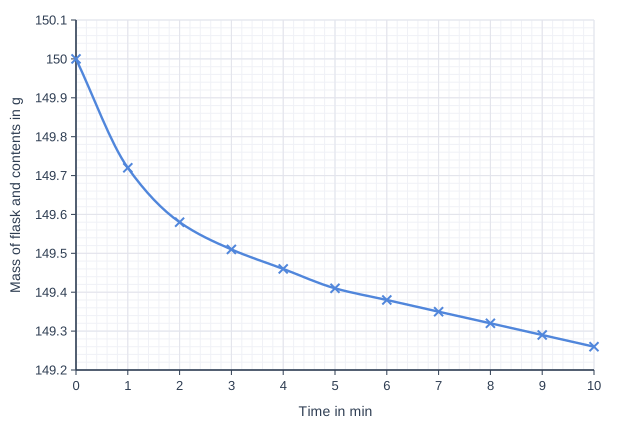
A student adds 1.00 g of calcium carbonate powder to an excess of dilute hydrochloric acid at 60 °C. The open flask stands on a balance, and she records the mass of the flask and its contents every minute.

The graph shows her results. From 5 minutes onwards, the points lie on a straight line.

The student says: 'The reaction never stops, because the mass keeps going down.'

Explain why the mass keeps going down after 5 minutes. Use the straight part of the graph to determine the mass of carbon dioxide given off by the reaction.

Line graph of mass of flask and contents in g (y-axis, 149.2 to 150.1) against time in min (x-axis, 0 to 10). The line is a smooth curve through (0, 150), (1, 149.72), (2, 149.58), (3, 149.51), (4, 149.46), (5, 149.41), (6, 149.38), (7, 149.35), (8, 149.32), (9, 149.29), (10, 149.26).

Model answer

The straight part has a gradient of (149.41 − 149.26) ÷ (10 − 5) = 0.15 ÷ 5 = 0.03 g per minute.
Extending this line back to 0 minutes: 149.41 + (5 × 0.03) = 149.56 g.
Mass of carbon dioxide = 150.00 − 149.56 = 0.44 g.
(This agrees with the 0.44 g expected from 1.00 g of calcium carbonate.)

The reaction has stopped by 5 minutes because all the calcium carbonate has been used up. The mass keeps going down because water evaporates from the hot mixture: water molecules at the surface that have enough energy escape from the liquid as a gas and leave the open flask. Evaporation happens at a steady rate at 60 °C, so the line is straight, and the same loss was happening during the reaction too.

Explanation

When a graph ends in a straight sloping line instead of becoming horizontal, something other than the reaction is still changing the reading. Here water evaporates at a steady rate from the warm, open flask. Extending the straight part back to time zero (its intercept) removes the evaporation, so the difference between the starting mass and the intercept is the mass of carbon dioxide. A common error is to take the whole fall in mass, 0.74 g, as the mass of carbon dioxide.

Mark scheme
  1. 1 mark

    the straight part of the line has a gradient of (149.41 − 149.26) ÷ (10 − 5) = 0.03 g per minute / extending the straight part back to 0 minutes gives (149.41 + 5 × 0.03 =) 149.56 g / mass lost by evaporation in 10 minutes = 10 × 0.03 = 0.30 g; or a correct final answer of 0.44 g with no working

    An answer of 0.44 g (or any answer from 0.41 to 0.47 g) with no working scores marking points 1 and 2. ALLOW a gradient of 0.026 to 0.034 g per minute and an intercept of 149.53 to 149.59 g. An answer of 0.74 g (150.00 − 149.26, which includes the water that evaporated) scores 0 for points 1 and 2. ALLOW 0.15 g lost by evaporation from 0 to 5 minutes, so 0.59 − 0.15 = 0.44 g.

  2. 1 mark

    mass of carbon dioxide = 150.00 − 149.56 = 0.44 (g) / 0.74 − 0.30 = 0.44 (g)

    ALLOW 0.41 to 0.47 g. ALLOW ECF from the student's gradient or intercept.

  3. 1 mark

    the reaction has stopped (all the calcium carbonate has been used up); the mass keeps falling because water evaporates from the hot mixture, at a constant rate, which gives the straight line

    ALLOW 'water vapour (steam) escapes from the flask'. DO NOT ALLOW 'carbon dioxide is still being given off' or 'the acid evaporates' unless water is also mentioned. ALLOW 'hydrogen chloride and water evaporate'.

  4. 1 mark

    (particle model) water molecules at the surface with enough (kinetic) energy escape from the liquid into the air / change from liquid to gas, and leave the open flask, so mass is lost even though no carbon dioxide is made

    ALLOW 'at 60 °C more of the water molecules have enough energy to overcome the forces between them and escape'. DO NOT ALLOW 'the water boils' on its own (60 °C is below the boiling point of water).

Ready to try the rest? Every answer you write is marked against the mark scheme, so you can see exactly where the marks are.

Study Helper Hints first, answers after you try

Stuck on this one? Ask for a hint and I’ll point you in the right direction, without giving the answer away. Once you’ve checked your answer, I’ll show you how the marks are awarded.