
Level:
Correct: 0
Incorrect: 0
Marks: 0/0
Exam Practice
Course:
Topics:
OCR GCSE Chemistry (Paper 4) Smart practice A mixed round aimed at your weak spots
Unit 4
Predicting and identifying reactions and products
Unit 5
Monitoring and controlling chemical reactions
Unit 6
Global challenges
Unit 7
Practical skills
Avg
score:
–
Topics
done:
0/37

Industrial processes: rate, equilibrium and conditions

Practise 14 exam-style questions on Industrial processes: rate, equilibrium and conditions for OCR GCSE Chemistry (Paper 4). Write your answer as you would in the exam and get it marked in seconds against the mark scheme, point by point, with the Study Helper on hand if you get stuck.

  • 14 questions
  • 1–5 marks each
  • Instant marking
  • No sign-up needed
14 questions, marked as you go

Sample questions with model answers

Here are 4 of the questions in this topic, each with a model answer, an explanation of why it earns the marks and the mark scheme an examiner would use.

Question 1

1 mark

The Haber process makes ammonia from nitrogen and hydrogen:

N₂(g) + 3H₂(g) ⇌ 2NH₃(g)

The forward reaction is exothermic.

Which condition is chosen as a compromise between a fast rate of reaction and a high equilibrium yield of ammonia?

Choose your answer.

  • A a catalyst of iron
  • B a pressure of about 200 atmospheres
  • C a temperature of about 450 °C
  • D removing the ammonia by cooling it

Model answer

C

Explanation

A compromise is needed only when a change helps one thing and harms another. For an exothermic reaction, raising the temperature speeds up the reaction but lowers the equilibrium yield, so the temperature is the compromise condition. Pressure is a different kind of choice: a higher pressure helps both rate and yield, and the limit is set by cost and safety.

Mark scheme
  1. 1 mark

    C / a temperature of about 450 °C

    The only correct answer is C: the forward reaction is exothermic, so a lower temperature would give a higher equilibrium yield of ammonia but a slower rate; about 450 °C gives an acceptable rate with an acceptable yield. A is not correct because the iron catalyst increases the rate without changing the equilibrium yield, so there is no conflict to balance; B is not correct because a higher pressure increases both the rate and the equilibrium yield (4 molecules of gas become 2), so the pressure is limited by the cost of energy and equipment, not by a conflict between rate and yield; D is not correct because removing ammonia moves the position of equilibrium to the right without slowing the reaction. ALLOW the letter or the option. If more than one option is given, do not award the mark.
Question 2

2 marks

In a modern sulfuric acid plant, the gas mixture passes through four beds of catalyst:

2SO₂(g) + O₂(g) ⇌ 2SO₃(g)

After the third bed, about 95% of the sulfur dioxide has been converted. The sulfur trioxide is then removed from the gas mixture by absorbing it in concentrated sulfuric acid. The remaining gases pass through the fourth bed. By the end, more than 99.7% of the sulfur dioxide has been converted.

Explain why removing the sulfur trioxide before the fourth bed increases the percentage of sulfur dioxide that is converted. Give one benefit of converting so much of the sulfur dioxide.

Model answer

Sulfur trioxide is a product, so absorbing it lowers its concentration and the position of equilibrium moves to the right to replace it. More of the remaining sulfur dioxide therefore reacts in the fourth bed. This means less sulfur dioxide escapes into the air, where it would cause acid rain.

Explanation

Removing a product is a cheap way to move an equilibrium to the right, because it needs no change in temperature or pressure. In the Contact process this almost completely converts the sulfur dioxide, which saves raw material and keeps a toxic, acidic gas out of the atmosphere. Saying only that the reaction 'goes faster' does not explain the higher conversion.

Mark scheme
  1. 1 mark

    removing the sulfur trioxide (a product) lowers its concentration, so the position of equilibrium moves to the right (to replace it) / more sulfur dioxide reacts (in the fourth bed)

    ALLOW the system opposes the removal of the product, so more product forms (Le Chatelier's principle applied). DO NOT ALLOW the catalyst moves the equilibrium. IGNORE the reaction goes faster.

  2. 1 mark

    less sulfur dioxide is released into the air, so less acid rain / less toxic gas / fewer breathing problems / less sulfur (raw material) is wasted, so it costs less (to make each tonne of acid)

    ALLOW meets the legal limits for sulfur dioxide emissions. ALLOW more sulfuric acid is made from the same mass of sulfur. IGNORE 'less pollution' unless the pollutant or its effect is named.

Question 3

3 marks

An engineer uses a computer model of a converter in an ammonia plant:

N₂(g) + 3H₂(g) ⇌ 2NH₃(g)   The forward reaction is exothermic.

In the model, the pressure is 200 atmospheres and the same mass of nitrogen and hydrogen enters the converter every hour. Only the temperature is changed. The gases spend only a short time in the converter.

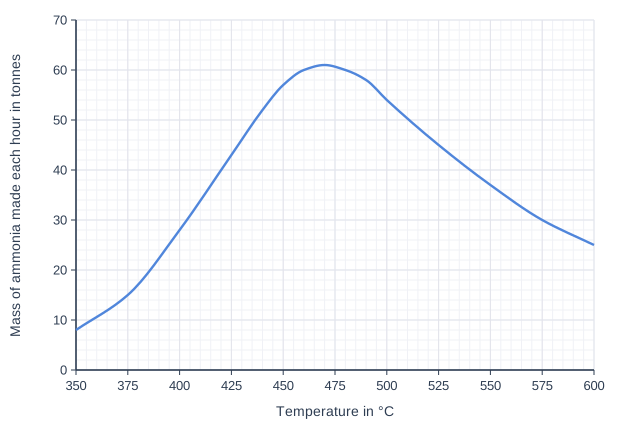
The graph shows the mass of ammonia made each hour at different temperatures.

Explain the shape of the graph. Use ideas about rate and equilibrium.

Line graph of mass of ammonia made each hour in tonnes (y-axis, 0 to 70) against temperature in °C (x-axis, 350 to 600). The line is a smooth curve through (350, 8), (375, 15), (400, 28), (425, 43), (440, 52), (450, 57), (460, 60), (470, 61), (480, 60), (490, 58), (500, 54), (525, 45), (550, 37), (575, 30), (600, 25).

Model answer

Up to about 470 °C the mass of ammonia made each hour rises, because a higher temperature makes the reaction faster: the particles collide more often and more of them have energy greater than the activation energy, so more ammonia forms in the short time the gases spend in the converter. At low temperatures the mixture is nowhere near equilibrium, so the rate limits the mass made.

Above about 470 °C the mass falls. The reaction is now fast, so the mixture gets close to equilibrium, but the forward reaction is exothermic, so at higher temperatures the position of equilibrium is further to the left and there is less ammonia in the equilibrium mixture. The highest point is the best balance between rate and yield.

Explanation

In a real converter the gases do not stay long enough to reach equilibrium, so the output depends on both the rate and the equilibrium position. At low temperatures the rate is the limit; at high temperatures the equilibrium position is. Do not say that the rate falls at high temperatures: the rate always increases with temperature, but the equilibrium yield falls.

Mark scheme
  1. 1 mark

    up to about 470 °C, the mass increases because the rate of reaction increases with temperature (particles collide more often / more particles have energy greater than the activation energy), so more ammonia forms in the short time the gases are in the converter

    ALLOW any temperature from 450 °C to 500 °C for the highest point. The idea of a faster rate is needed for this mark.

  2. 1 mark

    above about 470 °C, the mass decreases because the forward reaction is exothermic, so at a higher temperature the position of equilibrium is further to the left / the equilibrium percentage of ammonia is lower

    ALLOW the reverse (endothermic) reaction is favoured at higher temperatures. DO NOT ALLOW the rate decreases at higher temperatures.

  3. 1 mark

    at high temperatures the mixture gets close to equilibrium quickly, so the mass made is limited by the (lower) equilibrium yield / at low temperatures the reaction is too slow to get close to equilibrium, so the mass made is limited by the rate

    ALLOW the highest point is the best balance (compromise) between rate and equilibrium yield. ALLOW 'the yield is limited by rate at low temperatures and by equilibrium at high temperatures' AW.

Question 4

4 marks

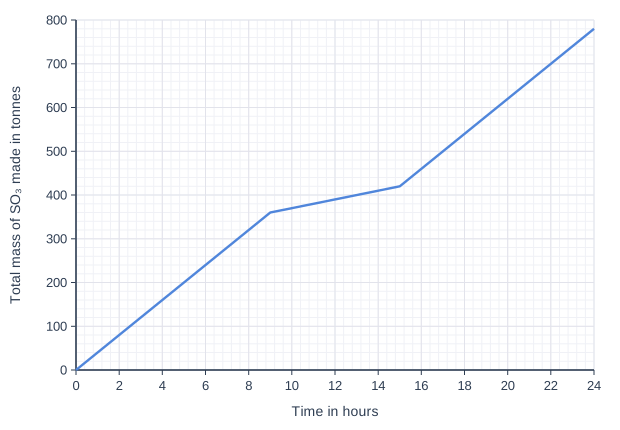
A sulfuric acid plant runs continuously. An engineer recorded the total mass of sulfur trioxide made by the plant during one day. The graph shows the engineer's data.

Between 9 hours and 15 hours, a fault meant that the gases entered the first catalyst bed at 370 °C instead of 420 °C. The catalyst works well only above about 400 °C.

Use the graph to calculate the rate of production of sulfur trioxide between 0 and 9 hours, in moles per second. Give your answer to 3 significant figures.

Relative formula mass (Mr): SO₃ = 80.1   1 tonne = 1 000 000 g

Explain why the rate of production was lower between 9 hours and 15 hours, even though the forward reaction is exothermic.

Line graph of Total mass of SO₃ made in tonnes (y-axis, 0 to 800) against time in hours (x-axis, 0 to 24). The line joins the points (0, 0), (9, 360), (15, 420), (24, 780).

Model answer

Gradient between 0 and 9 hours = 360 tonnes ÷ 9 hours = 40 tonnes per hour
40 tonnes = 4.0 × 10⁷ g
Moles per hour = 4.0 × 10⁷ ÷ 80.1 = 4.99 × 10⁵ mol
Moles per second = 4.99 × 10⁵ ÷ 3600 = 138.7 = 139 mol/s (3 significant figures)

At 370 °C the catalyst does not work well and the particles have less energy, so far fewer collisions have energy greater than the activation energy and the reaction is much slower. The gases leave the converter long before they get near equilibrium, so much less sulfur trioxide is made each hour, even though a lower temperature would give a higher equilibrium yield.

Explanation

The gradient of a total-mass against time graph is the rate of production. Convert tonnes to grams, grams to moles with the Mr, and hours to seconds (÷ 3600). A lower temperature favours the exothermic forward reaction only if the mixture can reach equilibrium; when the catalyst is too cold, the rate becomes the limit, which is why industrial temperatures cannot be set too low.

Mark scheme
  1. 1 mark

    gradient = 360 ÷ 9 = 40 (tonnes per hour); or a correct final answer of 139 mol/s with no working

    An answer of 139 mol/s with no working scores marking points 1, 2 and 3. ALLOW the gradient from any two points on the straight line between 0 and 9 hours. ALLOW 2 marks for 4.99 × 10⁵ (mol per hour, time not converted to seconds) or 8320 (mol per minute). ALLOW 2 marks for 0.139 (tonnes converted to kilograms instead of grams). ALLOW 2 marks for 138.7 / 138.72 (not rounded to 3 significant figures). ALLOW ECF for marking point 3 from a wrong gradient shown in the working.

  2. 1 mark

    40 tonnes = 4.0 × 10⁷ g, and 4.0 × 10⁷ ÷ 80.1 = 4.99 × 10⁵ (mol per hour); or a correct final answer of 139 mol/s with no working

    ALLOW 499 376 / 499 000 (mol per hour). ALLOW changing to seconds first: 4.0 × 10⁷ ÷ 3600 = 11 111 g per second.

  3. 1 mark

    evaluation: 139 (mol/s), given to 3 significant figures

    The answer must be given to 3 significant figures for this mark. ALLOW ECF for the significant-figure mark from a valid calculation with a wrong gradient. ALLOW 1.39 × 10² (mol/s). IGNORE units.

  4. 1 mark

    at 370 °C (below the temperature at which the catalyst works well) the rate of reaction is much slower, so much less sulfur dioxide is converted in the time the gases are in the converter (even though a lower temperature would favour a higher equilibrium yield)

    The idea of a slower rate is needed. ALLOW fewer particles have energy greater than the activation energy / fewer successful collisions per second. ALLOW the mixture does not get close to equilibrium. DO NOT ALLOW the lower temperature moves the equilibrium to the left.

Ready to try the rest? Every answer you write is marked against the mark scheme, so you can see exactly where the marks are.

Study Helper Hints first, answers after you try

Stuck on this one? Ask for a hint and I’ll point you in the right direction, without giving the answer away. Once you’ve checked your answer, I’ll show you how the marks are awarded.