
Level:
Correct: 0
Incorrect: 0
Marks: 0/0
Exam Practice
Course:
Topics:
OCR GCSE Chemistry (Paper 4) Smart practice A mixed round aimed at your weak spots
Unit 4
Predicting and identifying reactions and products
Unit 5
Monitoring and controlling chemical reactions
Unit 6
Global challenges
Unit 7
Practical skills
Avg
score:
–
Topics
done:
0/37

Potable water

Practise 16 exam-style questions on Potable water for OCR GCSE Chemistry (Paper 4). Write your answer as you would in the exam and get it marked in seconds against the mark scheme, point by point, with the Study Helper on hand if you get stuck.

  • 16 questions
  • 1–6 marks each
  • Instant marking
  • No sign-up needed
16 questions, marked as you go

Sample questions with model answers

Here are 4 of the questions in this topic, each with a model answer, an explanation of why it earns the marks and the mark scheme an examiner would use.

Question 1

1 mark

Which method removes both dissolved salts and microorganisms from water?

Choose your answer.

  • A chlorination
  • B distillation
  • C filtration
  • D sedimentation

Model answer

B

Explanation

Sedimentation and filtration remove insoluble particles, and chlorination kills microorganisms, but none of these removes dissolved salts. Distillation and reverse osmosis are the methods that remove dissolved salts, which is why they are needed to make sea water potable.

Mark scheme
  1. 1 mark

    B / distillation

    The only correct answer is B: in distillation only the water evaporates and is condensed, so the dissolved salts are left behind, and the microorganisms are left behind and killed by the boiling, so the water collected contains neither. A is not correct because chlorine kills microorganisms but does not remove dissolved salts; C is not correct because dissolved salts pass through a filter with the water, and filtration does not remove all microorganisms; D is not correct because only particles that sink are removed: dissolved salts and most microorganisms stay in the water. ALLOW the letter or the method. If more than one option is given, do not award the mark.
Question 2

2 marks

At a water treatment works, river water flows very slowly through large sedimentation tanks. The water stays in the tanks for several hours.

Explain why.

Model answer

Insoluble solid particles can only sink to the bottom when the water is almost still; if the water flowed quickly, it would keep the particles suspended and carry them out of the tank. Small particles sink very slowly, so the water must stay in the tank for several hours for most of the solid to settle out before the water is filtered.

Explanation

Sedimentation removes insoluble particles by letting them sink under their own weight, so it needs still water and time. It cannot remove dissolved substances, and the finest particles are removed later by filtration.

Mark scheme
  1. 1 mark

    insoluble / solid particles settle / sink to the bottom only when the water is still or moving very slowly (fast-moving water keeps them suspended / carries them out of the tank)

    ALLOW the slow flow lets the mud / sand / solids fall to the bottom. DO NOT ALLOW dissolved salts / dissolved substances settle. IGNORE 'to let the water settle'.

  2. 1 mark

    small particles sink very slowly, so they need a long time to reach the bottom of the tank (so that most of the solid is removed before the water is filtered)

    ALLOW the longer the water stays in the tank, the more of the solid settles out. ALLOW so that less solid reaches / blocks the filters.

Question 3

3 marks

A student investigates how the depth of sand in a filter affects how well it removes mud from water.

She pours 200 cm³ of the same muddy water through filters with different depths of sand. She measures the cloudiness of each filtered sample with a turbidity meter. A higher reading means cloudier water.

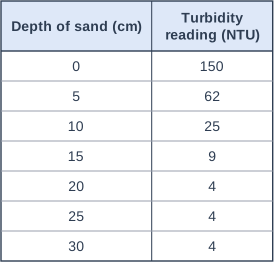
The table shows her results.

Describe the pattern in the results. Use the results to suggest the most suitable depth of sand for this filter, and give a reason for your choice.

Table with columns "Depth of sand (cm)", "Turbidity reading (NTU)". Depth of sand (cm): 0; Turbidity reading (NTU): 150 | Depth of sand (cm): 5; Turbidity reading (NTU): 62 | Depth of sand (cm): 10; Turbidity reading (NTU): 25 | Depth of sand (cm): 15; Turbidity reading (NTU): 9 | Depth of sand (cm): 20; Turbidity reading (NTU): 4 | Depth of sand (cm): 25; Turbidity reading (NTU): 4 | Depth of sand (cm): 30; Turbidity reading (NTU): 4.

Model answer

As the depth of sand increases, the turbidity reading decreases, so the water is clearer: it falls from 150 NTU with no sand to 9 NTU with 15 cm of sand. From 20 cm the reading stays at 4 NTU, so deeper sand makes no further difference.

The most suitable depth is 20 cm, because it is the smallest depth that gives the clearest water. Deeper sand would not make the water any clearer but would use more sand and slow down the flow.

Explanation

Describe a pattern by giving the overall trend and then any change in it, quoting values. The best choice is where the results level off: beyond that point extra sand adds cost and slows the flow without improving the water. Remember that clear water is not necessarily potable: filtration does not kill microorganisms.

Mark scheme
  1. 1 mark

    as the depth of sand increases, the turbidity reading / cloudiness decreases

    Max 2 if no data from the table are used. ALLOW the deeper the sand, the clearer the water / ORA (allow the reverse argument).

  2. 1 mark

    the reading levels off / stops decreasing at 4 NTU from a depth of 20 cm (sand deeper than 20 cm makes no further difference)

    ALLOW the readings fall by less and less as the depth increases, if supported by data (for example a fall of 88 NTU from 0 to 5 cm but only 5 NTU from 15 to 20 cm).

  3. 1 mark

    20 cm, because it is the smallest depth that gives the lowest reading / deeper sand gives no clearer water but uses more sand / makes the water flow through more slowly

    The depth and a reason are both needed. ALLOW 20 cm because it gives the clearest water (4 NTU) and is the smallest depth to do so. ALLOW 25 cm if the reason is a safety margin (for example in case the water is muddier) and the answer recognises that 25 cm gives no lower reading than 20 cm. DO NOT ALLOW 25 cm / 30 cm 'because it gives the clearest water' (20 cm gives the same reading).

Question 4

4 marks

Ground water from a borehole in a farming area contains 70 mg/dm³ of nitrate ions, NO₃⁻, which come from fertilisers. In the UK, the legal limit for nitrate ions in drinking water is 50 mg/dm³.

The water company treats the ground water by filtration and chlorination. This does not change the concentration of nitrate ions.

The company mixes the treated ground water with treated reservoir water that contains 10 mg/dm³ of nitrate ions.

Calculate the largest percentage of ground water that the mixture can contain, so that the concentration of nitrate ions is no higher than the legal limit.

Reverse osmosis could remove the nitrate ions from the ground water. Suggest two reasons why the company mixes the two waters instead.

Model answer

Let x be the percentage of ground water in the mixture.
70x + 10(100 − x) = 50 × 100
60x = 4000
x = 66.7, so the mixture can contain at most 66.7% (about 67%, two thirds) ground water.
(Check: 0.667 × 70 + 0.333 × 10 = 46.7 + 3.3 = 50 mg/dm³.)

Reverse osmosis needs a lot of energy to pump the water through the membranes at high pressure, so it is expensive to run. It also produces a waste solution with a high concentration of nitrate that has to be disposed of. Mixing uses water that the company has already treated, so no new plant is needed.

Explanation

Mixing two waters gives a concentration between their two values, so set up an equation for the mixture and solve it. Dividing 50 by 70 (71%) ignores the nitrate already in the reservoir water. Dissolved ions pass through sand filters and are not removed by chlorine; reverse osmosis can remove them, but it uses much more energy and produces a waste stream, so blending is often the cheaper choice.

Mark scheme
  1. 1 mark

    70x + 10(100 − x) = 50 × 100, where x is the percentage of ground water / volumes of ground water and reservoir water in the ratio (50 − 10) : (70 − 50) = 40 : 20 = 2 : 1; or a correct final answer of 67% with no working

    An answer of 67% with no working scores marking points 1 and 2. ALLOW any correct method, for example 70f + 10(1 − f) = 50 with f as a fraction, or trial of percentages that reaches 2/3. ALLOW 1 mark for 33% (the percentage of reservoir water). DO NOT ALLOW 71% (50 ÷ 70, which ignores the nitrate ions in the reservoir water).

  2. 1 mark

    evaluation: 67 (%) / 66.7 (%)

    ALLOW 66.6 / 66 / two thirds / 0.67 as a fraction of the mixture.

  3. 2 marks

    reasons: reverse osmosis uses a lot of energy (to pump the water through membranes at high pressure), so it costs more / it needs an expensive plant and membranes that must be cleaned or replaced / it produces waste brine (a concentrated nitrate solution) that must be disposed of / mixing needs no new treatment plant, because both waters are already treated / reverse osmosis removes all the dissolved salts, so some water is wasted and minerals may need adding back

    1 mark for each of these reasons, max 2. Max 1 if both reasons are about cost and give no different detail. IGNORE reverse osmosis is slow, on its own.

Ready to try the rest? Every answer you write is marked against the mark scheme, so you can see exactly where the marks are.

Study Helper Hints first, answers after you try

Stuck on this one? Ask for a hint and I’ll point you in the right direction, without giving the answer away. Once you’ve checked your answer, I’ll show you how the marks are awarded.