
Level:
Correct: 0
Incorrect: 0
Marks: 0/0
Exam Practice
Course:
Topics:
OCR GCSE Chemistry (Paper 4) Smart practice A mixed round aimed at your weak spots
Unit 4
Predicting and identifying reactions and products
Unit 5
Monitoring and controlling chemical reactions
Unit 6
Global challenges
Unit 7
Practical skills
Avg
score:
–
Topics
done:
0/37

The reactivity of metals

Practise 16 exam-style questions on The reactivity of metals for OCR GCSE Chemistry (Paper 4). Write your answer as you would in the exam and get it marked in seconds against the mark scheme, point by point, with the Study Helper on hand if you get stuck.

  • 16 questions
  • 1–6 marks each
  • Instant marking
  • No sign-up needed
16 questions, marked as you go

Sample questions with model answers

Here are 4 of the questions in this topic, each with a model answer, an explanation of why it earns the marks and the mark scheme an examiner would use.

Question 1

1 mark

Part of the reactivity series is shown, from the most reactive to the least reactive:

calcium, magnesium, zinc, iron, lead, hydrogen, copper, silver

A technician wants to recover lead metal from a solution of lead(II) nitrate by a displacement reaction.

Which metal would displace lead from the solution without also reacting with the water?

Choose your answer.

  • A calcium
  • B copper
  • C silver
  • D zinc

Model answer

D

Explanation

Two conditions must be met: the metal must be above lead, so that it can displace lead, and it must not react with the water in the solution. Calcium is above lead but reacts with cold water, while copper and silver are below lead. Only zinc meets both conditions.

Mark scheme
  1. 1 mark

    D / zinc

    The only correct answer is D: zinc is above lead, so zinc atoms form positive ions more readily than lead atoms and give electrons to the lead ions, displacing lead; zinc does not react with cold water. A is not correct because calcium reacts with cold water to form hydrogen and calcium hydroxide, so much of the calcium would be used up by the water; B is not correct because copper is below lead, so it cannot displace lead; C is not correct because silver is also below lead. ALLOW the letter or the option. If more than one option is given, do not award the mark.
Question 2

2 marks

Magnesium reacts with dilute phosphoric acid, H₃PO₄, to form magnesium phosphate and hydrogen.

Magnesium ions are Mg²⁺ and phosphate ions are PO₄³⁻.

Write the balanced symbol equation for this reaction.

Model answer

3Mg + 2H₃PO₄ → Mg₃(PO₄)₂ + 3H₂

Explanation

First work out the formula of magnesium phosphate from the charges: three Mg²⁺ ions (6+) balance two PO₄³⁻ ions (6−), so it is Mg₃(PO₄)₂. Then balance the phosphate groups (2H₃PO₄), the magnesium (3Mg) and finally the hydrogen: the 6 hydrogen atoms form 3H₂. Writing MgPO₄, or writing hydrogen as H, are the most common errors.

Mark scheme
  1. 1 mark

    correct formulae: Mg + H₃PO₄ → Mg₃(PO₄)₂ + H₂

    ALLOW formulae typed without subscripts, for example Mg3(PO4)2. IGNORE state symbols. DO NOT ALLOW MgPO₄, Mg₂(PO₄)₃, Mg₃PO₄₂ or H as the formula of hydrogen.

  2. 1 mark

    balancing: 3Mg + 2H₃PO₄ → Mg₃(PO₄)₂ + 3H₂

    The balancing mark depends on the correct formulae. ALLOW any correct multiple, including fractions (1.5Mg + H₃PO₄ → 0.5Mg₃(PO₄)₂ + 1.5H₂). ALLOW = instead of →. DO NOT ALLOW 'and' or '&' instead of +.

Question 3

3 marks

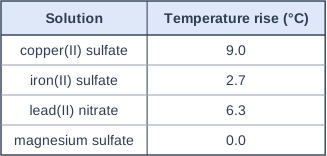
A student adds an excess of zinc powder to 25 cm³ of each of four solutions in turn, in a polystyrene cup. Each solution contains metal ions with a 2+ charge, at a concentration of 0.20 mol/dm³. She measures the temperature rise for each solution.

The table shows her results.

Deduce the order of reactivity of copper, iron, lead, magnesium and zinc, starting with the most reactive.

Explain how you used the results.

Table with columns "Solution", "Temperature rise (°C)". Solution: copper(II) sulfate; Temperature rise (°C): 9.0 | Solution: iron(II) sulfate; Temperature rise (°C): 2.7 | Solution: lead(II) nitrate; Temperature rise (°C): 6.3 | Solution: magnesium sulfate; Temperature rise (°C): 0.0.

Model answer

Order: magnesium, zinc, iron, lead, copper (most reactive first).

There was no temperature rise with magnesium sulfate, so zinc did not displace magnesium: magnesium is more reactive than zinc. The temperature rose with the other three solutions, so zinc displaced iron, lead and copper, which are all less reactive than zinc. The bigger the difference in reactivity between zinc and the metal in the solution, the more energy is given out, so the largest rise (copper, 9.0 °C) shows the least reactive metal and the smallest rise (iron, 2.7 °C) shows the metal closest to zinc.

Explanation

Here the same metal (zinc) is used every time and the metal in the solution changes, so the reasoning is the reverse of the usual experiment. A large temperature rise means the metal in the solution is far below zinc, not that it is very reactive. A common error is to put copper at the top because it gave the largest rise.

Mark scheme
  1. 1 mark

    magnesium, zinc, iron, lead, copper

    All five metals must be in the correct order, most reactive first. ALLOW symbols (Mg, Zn, Fe, Pb, Cu). ALLOW the order written least reactive first if this is made clear.

  2. 1 mark

    magnesium is above zinc, because zinc does not displace magnesium / there is no temperature rise with magnesium sulfate (no reaction)

    ALLOW zinc does not react with magnesium sulfate solution.

  3. 1 mark

    iron, lead and copper are below zinc because zinc displaces them (the temperature rises), and the larger the temperature rise, the bigger the difference in reactivity from zinc / the further below zinc the metal is, so copper (largest rise) is the least reactive

    ALLOW the larger the temperature rise, the less reactive the metal in the solution (compared with zinc). ALLOW the larger the temperature rise, the more energy is given out because the metals are further apart in the reactivity series. DO NOT ALLOW the larger the temperature rise, the more reactive the metal in the solution.

Question 4

4 marks

A solution contains copper(II) ions, Cu²⁺, and iron(II) ions, Fe²⁺. Copper(II) ions are blue, iron(II) ions are pale green and zinc ions are colourless.

A student adds zinc powder to the solution, a little at a time, stirring after each addition.

• At first, only a brown solid forms.
• After more zinc has been added, a grey solid starts to form as well.
• At the end, the solution is colourless.

Explain these observations. Use ideas about the tendency of each metal to form positive ions.

Model answer

Zinc is the most reactive of the three metals: zinc atoms form positive ions most readily, so they lose electrons to form Zn²⁺ ions and zinc can displace both copper and iron.

Copper is the least reactive, so copper atoms have the least tendency to form ions; this means Cu²⁺ ions gain electrons more readily than Fe²⁺ ions. So the brown solid, copper, forms first: Zn + Cu²⁺ → Zn²⁺ + Cu.

Iron cannot stay as a solid while Cu²⁺ ions are present, because iron would displace copper. So the grey solid, iron, only forms once the copper ions have been used up: Zn + Fe²⁺ → Zn²⁺ + Fe.

At the end, all the blue Cu²⁺ ions and pale green Fe²⁺ ions have been replaced by colourless Zn²⁺ ions, so the solution is colourless.

Explanation

The less readily a metal's atoms form positive ions, the more readily its ions turn back into atoms. So when a reactive metal is added to a mixture of ions, the ions of the least reactive metal are removed first. Many answers say only that zinc is more reactive than both metals, which does not explain the order in which the solids appear.

Mark scheme
  1. 1 mark

    zinc is the most reactive of the three metals / zinc atoms form positive ions most readily, so zinc atoms lose electrons to form Zn²⁺ ions and zinc can displace both copper and iron

    ALLOW zinc is above iron and copper in the reactivity series, so it displaces both.

  2. 1 mark

    the brown solid is copper: copper atoms have the least tendency to form positive ions / copper is the least reactive, so Cu²⁺ ions gain electrons (from zinc) more readily than Fe²⁺ ions, and copper forms first

    The brown solid must be identified as copper AND linked to copper being the least reactive / Cu²⁺ ions gaining electrons most readily. ALLOW Cu²⁺ ions are reduced first.

  3. 1 mark

    the grey solid is iron, which forms only when (most of) the Cu²⁺ ions have been used up

    ALLOW any iron that formed while Cu²⁺ ions were still present would itself displace copper, because iron is more reactive than copper. ALLOW Fe²⁺ ions gain electrons (from zinc) to form iron once the copper ions have gone.

  4. 1 mark

    the solution is colourless at the end because all the (blue) Cu²⁺ ions and (pale green) Fe²⁺ ions have been replaced by (colourless) Zn²⁺ ions

    ALLOW the only metal ions left in the solution are zinc ions. ALLOW a correct ionic equation as part of the answer: Zn + Cu²⁺ → Zn²⁺ + Cu or Zn + Fe²⁺ → Zn²⁺ + Fe.

Ready to try the rest? Every answer you write is marked against the mark scheme, so you can see exactly where the marks are.

Study Helper Hints first, answers after you try

Stuck on this one? Ask for a hint and I’ll point you in the right direction, without giving the answer away. Once you’ve checked your answer, I’ll show you how the marks are awarded.