
Level:
Correct: 0
Incorrect: 0
Marks: 0/0
Exam Practice
Course:
Topics:
OCR GCSE Chemistry (Paper 4) Smart practice A mixed round aimed at your weak spots
Unit 4
Predicting and identifying reactions and products
Unit 5
Monitoring and controlling chemical reactions
Unit 6
Global challenges
Unit 7
Practical skills
Avg
score:
–
Topics
done:
0/37

Reversible reactions and dynamic equilibrium

Practise 13 exam-style questions on Reversible reactions and dynamic equilibrium for OCR GCSE Chemistry (Paper 4). Write your answer as you would in the exam and get it marked in seconds against the mark scheme, point by point, with the Study Helper on hand if you get stuck.

  • 13 questions
  • 1–6 marks each
  • Instant marking
  • No sign-up needed
13 questions, marked as you go

Sample questions with model answers

Here are 4 of the questions in this topic, each with a model answer, an explanation of why it earns the marks and the mark scheme an examiner would use.

Question 1

1 mark

Two gases, A and B, react in a sealed flask to form gas C in a reversible reaction:

A(g) + B(g) ⇌ C(g)

At the start, the flask contains 1.0 mol of A, 1.0 mol of B and no C. When dynamic equilibrium has been reached, the flask contains 0.6 mol of C.

What amount of A is in the flask at equilibrium?

Choose your answer.

  • A 0.0 mol
  • B 0.4 mol
  • C 0.6 mol
  • D 1.0 mol

Model answer

B (0.4 mol)

Explanation

Use the equation: A and C are in a 1 : 1 ratio, so the amount of A used equals the amount of C formed. At dynamic equilibrium the amounts stay constant, but they do not have to be equal, and some of every substance is always present. Thinking that the amounts of reactants and products become equal is a common misconception.

Mark scheme
  1. 1 mark

    B / 0.4 mol

    The only correct answer is B: 1 mol of A forms 1 mol of C, so forming 0.6 mol of C uses 0.6 mol of A, leaving 1.0 − 0.6 = 0.4 mol. A is not correct because a reversible reaction in a closed system does not go to completion, so some A remains; C is not correct because the amounts of reactants and products at equilibrium are not necessarily equal; D is not correct because 0.6 mol of A has reacted. ALLOW the letter or the option. If more than one option is given, do not award the mark.
Question 2

1 mark

A reversible reaction in a sealed container has reached dynamic equilibrium. The amounts of the reactants and products are no longer changing.

Explain what the word 'dynamic' tells you about the reaction.

Model answer

Dynamic means that the reaction has not stopped: the forward and reverse reactions are both still happening, at the same rate, so the amounts do not change.

Explanation

At dynamic equilibrium the amounts stay constant because reactants are turned into products at the same rate as products are turned back into reactants. It is wrong to say that the reaction has stopped, or that the amounts of reactants and products are equal.

Mark scheme
  1. 1 mark

    the forward and reverse reactions are both still happening (at the same rate) / the reaction has not stopped

    ALLOW particles are still reacting in both directions. DO NOT ALLOW the reaction has stopped / the amounts of reactants and products are equal.

Question 3

3 marks

Phosphorus pentachloride, PCl₅, breaks down into phosphorus trichloride, PCl₃, and chlorine, Cl₂, in a reversible reaction:

PCl₅(g) ⇌ PCl₃(g) + Cl₂(g)

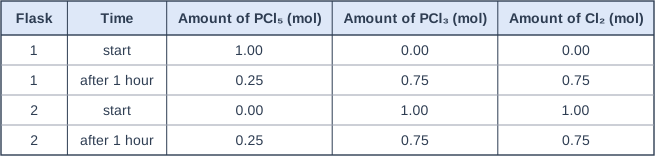
A scientist sets up two sealed flasks of the same size at the same temperature. Flask 1 starts with only PCl₅. Flask 2 starts with only PCl₃ and Cl₂. The table shows the amounts at the start and after one hour, when the amounts had stopped changing.

Explain what these results show about the reaction.

Table with columns "Flask", "Time", "Amount of PCl₅ (mol)", "Amount of PCl₃ (mol)", "Amount of Cl₂ (mol)". Flask: 1; Time: start; Amount of PCl₅ (mol): 1.00; Amount of PCl₃ (mol): 0.00; Amount of Cl₂ (mol): 0.00 | Flask: 1; Time: after 1 hour; Amount of PCl₅ (mol): 0.25; Amount of PCl₃ (mol): 0.75; Amount of Cl₂ (mol): 0.75 | Flask: 2; Time: start; Amount of PCl₅ (mol): 0.00; Amount of PCl₃ (mol): 1.00; Amount of Cl₂ (mol): 1.00 | Flask: 2; Time: after 1 hour; Amount of PCl₅ (mol): 0.25; Amount of PCl₃ (mol): 0.75; Amount of Cl₂ (mol): 0.75.

Model answer

In flask 1, PCl₅ breaks down to form PCl₃ and Cl₂, and in flask 2, PCl₃ and Cl₂ react to form PCl₅, so the reaction goes in both directions: it is reversible. Neither flask reacts completely: after one hour both contain the same mixture, 0.25 mol of PCl₅, 0.75 mol of PCl₃ and 0.75 mol of Cl₂. So the same equilibrium is reached whichever side the reaction starts from. The amounts then stay constant, although they are not equal, because the flasks are closed systems and the forward and reverse reactions are happening at the same rate: this is a dynamic equilibrium.

Explanation

The key evidence is that two different starting mixtures end up with exactly the same composition. That can only happen if the reaction can go both ways and stops changing when the rates of the two reactions are equal. Use the numbers from the table to support each point.

Mark scheme
  1. 1 mark

    the reaction is reversible / goes in both directions: in flask 1 PCl₅ breaks down into PCl₃ and Cl₂, and in flask 2 PCl₃ and Cl₂ react to form PCl₅

    Max 2 if no data from the table are used.

  2. 1 mark

    neither reaction goes to completion: both flasks end with the same mixture (0.25 mol PCl₅, 0.75 mol PCl₃ and 0.75 mol Cl₂), so the same equilibrium is reached from either direction

    ALLOW both flasks reach the same equilibrium mixture. ALLOW some of every substance is present at the end in both flasks.

  3. 1 mark

    the amounts stop changing (but are not equal) because the forward and reverse reactions are happening at the same rate: a dynamic equilibrium in a closed system

    DO NOT ALLOW the reactions have stopped. DO NOT ALLOW the amounts of reactants and products are equal.

Question 4

4 marks

A teacher uses a model of a reversible reaction, A ⇌ B, in a closed system. There are 120 counters, which are red (A) on one side and blue (B) on the other. At the start, all the counters show red.

In each round of the model:
• one in every four red counters is turned over to blue
• one in every eight blue counters is turned over to red.

After several rounds there are 40 red counters and 80 blue counters, and these numbers then stay the same.

Show that the numbers of red and blue counters stay the same when there are 40 red and 80 blue counters.

Explain how the model shows the features of a dynamic equilibrium.

Model answer

Red to blue each round: 40 ÷ 4 = 10 counters
Blue to red each round: 80 ÷ 8 = 10 counters
So 10 counters change each way in every round, and the numbers of red and blue counters stay at 40 and 80.

The model shows a dynamic equilibrium because counters are still being turned over in both directions: both reactions are still happening. The numbers stay constant because the rates of the forward and reverse reactions are equal, not because anything has stopped. The amounts of A and B are constant but not equal (40 and 80), and no counters are added or taken away, just as nothing enters or leaves a closed system.

Explanation

Work out how many counters change each way in one round: 10 each way, so there is no overall change. This mirrors a dynamic equilibrium, where the forward and reverse reactions continue at equal rates in a closed system. Notice that equal rates do not mean equal amounts: here there are twice as many blue counters as red.

Mark scheme
  1. 1 mark

    40 ÷ 4 = 10 red counters are turned to blue in each round

    Stating that the numbers stay at 40 and 80, without the calculation, on its own scores 0 for marking points 1 and 2.

  2. 1 mark

    80 ÷ 8 = 10 blue counters are turned to red in each round, so the same number change each way and the numbers do not change

    ALLOW 10 − 10 = 0 change in each colour.

  3. 2 marks

    features of dynamic equilibrium shown by the model: counters are still being turned over in both directions, so both 'reactions' are still happening (dynamic); the rates of the forward and reverse 'reactions' are equal (the same number each way per round), so the amounts stay constant; the amounts are constant but not equal (40 red and 80 blue); no counters are added or removed, like a closed system

    1 mark for each of these features, max 2. DO NOT ALLOW the counters stop being turned over / the reaction stops.

Ready to try the rest? Every answer you write is marked against the mark scheme, so you can see exactly where the marks are.

Study Helper Hints first, answers after you try

Stuck on this one? Ask for a hint and I’ll point you in the right direction, without giving the answer away. Once you’ve checked your answer, I’ll show you how the marks are awarded.