
Level:
Correct: 0
Incorrect: 0
Marks: 0/0
Exam Practice
Course:
Topics:
OCR GCSE Chemistry (Paper 4) Smart practice A mixed round aimed at your weak spots
Unit 4
Predicting and identifying reactions and products
Unit 5
Monitoring and controlling chemical reactions
Unit 6
Global challenges
Unit 7
Practical skills
Avg
score:
–
Topics
done:
0/37

The Haber process and fertilisers

Practise 15 exam-style questions on The Haber process and fertilisers for OCR GCSE Chemistry (Paper 4). Write your answer as you would in the exam and get it marked in seconds against the mark scheme, point by point, with the Study Helper on hand if you get stuck.

  • 15 questions
  • 1–6 marks each
  • Instant marking
  • No sign-up needed
15 questions, marked as you go

Sample questions with model answers

Here are 4 of the questions in this topic, each with a model answer, an explanation of why it earns the marks and the mark scheme an examiner would use.

Question 1

1 mark

Fertilisers supply elements that crops need. The three main elements that fertilisers supply are nitrogen, phosphorus and potassium.

A gardener wants to add one compound to her soil that supplies two of these three elements.

Which compound should she use?

Choose your answer.

  • A ammonium nitrate, NH₄NO₃
  • B calcium phosphate, Ca₃(PO₄)₂
  • C potassium chloride, KCl
  • D potassium nitrate, KNO₃

Model answer

D

Explanation

Look at the elements in each formula: N for nitrogen, P for phosphorus and K for potassium. Only potassium nitrate, KNO₃, contains two of them. Ammonium nitrate contains nitrogen twice, which is easy to mistake for two different elements.

Mark scheme
  1. 1 mark

    D / potassium nitrate, KNO₃

    The only correct answer is D: potassium nitrate contains potassium (in K⁺ ions) and nitrogen (in NO₃⁻ ions). A is not correct because ammonium nitrate supplies only nitrogen (both of its ions contain nitrogen, but no other main element); B is not correct because calcium phosphate supplies only phosphorus, and it is insoluble, so plants can hardly absorb it; C is not correct because potassium chloride supplies only potassium. ALLOW the letter or the option. If more than one option is given, do not award the mark.
Question 2

2 marks

Ammonia is a toxic gas at room temperature. Its boiling point is −33 °C.

Most of the ammonia made for farming is first converted into solid compounds, such as the salts ammonium nitrate and ammonium sulfate, before it is used as a fertiliser.

Suggest two reasons why.

Model answer

Solid salts are much easier and safer to store, transport and spread, because ammonia gas would have to be kept in pressurised tanks. Also, ammonia would escape into the air before the crops could use it, whereas the salts stay in the soil and dissolve in the soil water, so the roots can absorb them.

Explanation

Converting ammonia into salts is an extra stage in the integrated fertiliser plant, but it makes a product that is safe, easy to handle and stays where the crops can use it. Answers should explain why the gas is a problem, not just say that solids are 'better'.

Mark scheme
  1. 1 mark

    solids are easier / safer / cheaper to store, transport and spread on fields (ammonia would need pressurised or refrigerated tanks)

    1 mark for each of the three points, max 2. ALLOW solids can be packed in bags / spread with simple machines.

  2. 1 mark

    ammonia gas would escape into the air before the crops could take it in, but the salts stay in the soil and dissolve in the soil water, so roots can absorb them

    ALLOW ammonia would evaporate / be lost from the soil. ALLOW the salts are soluble, so they release nitrogen compounds that plants can absorb.

  3. 1 mark

    ammonia is toxic / harmful, so the salts are safer for farm workers / animals / crops

    ALLOW ammonia could harm the crops' roots or leaves. IGNORE 'ammonia smells' on its own.

Question 3

3 marks

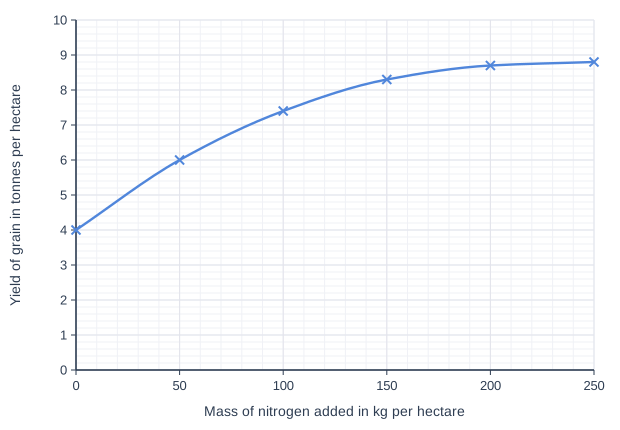
A farmer tests how much nitrogen fertiliser to use on a field of wheat. She spreads ammonium nitrate on strips of the field at different rates and measures the yield of grain from each strip.

The graph shows her results.

Describe how the mass of nitrogen added affects the yield of grain. Use data from the graph.

The farmer decides to add 150 kg of nitrogen per hectare, not 250 kg per hectare. Suggest why.

Line graph of yield of grain in tonnes per hectare (y-axis, 0 to 10) against mass of nitrogen added in kg per hectare (x-axis, 0 to 250). The line is a smooth curve through (0, 4), (50, 6), (100, 7.4), (150, 8.3), (200, 8.7), (250, 8.8).

Model answer

The yield increases as more nitrogen is added, from 4.0 tonnes per hectare with no nitrogen to 8.8 tonnes per hectare with 250 kg of nitrogen per hectare. But each extra 50 kg gives a smaller increase: the first 50 kg adds 2.0 tonnes per hectare, while going from 200 kg to 250 kg adds only 0.1 tonnes per hectare.

Going from 150 kg to 250 kg would raise the yield by only about 0.5 tonnes per hectare, which is probably worth less than the extra fertiliser costs. Also, nitrogen the crop cannot use may wash into rivers and pollute them.

Explanation

Nitrogen is essential for crop growth, so yield rises steeply at first, but once the crop has enough nitrogen, another factor limits growth and the curve levels off. Good answers quote readings and compare the size of the increases; weak answers only say 'more fertiliser gives more grain'.

Mark scheme
  1. 1 mark

    the yield increases as more nitrogen is added, from 4.0 tonnes per hectare with no nitrogen to 8.8 tonnes per hectare with 250 kg of nitrogen per hectare

    Max 2 if no data from the graph are used. ALLOW any correct pair of readings that shows the increase.

  2. 1 mark

    each extra 50 kg of nitrogen gives a smaller increase in yield / the yield levels off: the first 50 kg per hectare adds 2.0 tonnes per hectare, but going from 200 to 250 kg per hectare adds only 0.1 tonnes per hectare

    ALLOW 'diminishing returns' if it is explained. ALLOW any correct comparison of two increases from the graph.

  3. 1 mark

    adding 100 kg more nitrogen per hectare would increase the yield by only about 0.5 tonnes per hectare, which may be worth less than the cost of the extra fertiliser / extra nitrogen that the crop cannot use may be washed into rivers and cause pollution

    ALLOW the extra fertiliser is wasted / not taken up by the crop. ALLOW causes eutrophication / harms water life.

Question 4

4 marks

Potassium sulfate, K₂SO₄, is used as a fertiliser.

In a school laboratory, it can be made by titrating potassium hydroxide solution with dilute sulfuric acid and then crystallising the salt:

2KOH + H₂SO₄ → K₂SO₄ + 2H₂O

In industry, much of it is made by heating solid potassium chloride, which is mined, with concentrated sulfuric acid in a furnace at about 600 °C. Hydrogen chloride gas is given off; it is dissolved in water and sold as hydrochloric acid:

2KCl + H₂SO₄ → K₂SO₄ + 2HCl

Potassium hydroxide is made by the electrolysis of potassium chloride solution.

Explain why industry makes potassium sulfate from potassium chloride rather than from potassium hydroxide. Include the products of the electrolysis of potassium chloride solution in your answer.

Model answer

Potassium hydroxide is made by electrolysing potassium chloride solution: hydrogen forms at the cathode and chlorine at the anode, leaving potassium hydroxide solution. Electrolysis uses a lot of electricity, so potassium hydroxide is much more expensive than potassium chloride, which only has to be mined. Since potassium hydroxide is made from potassium chloride anyway, reacting the potassium chloride directly with sulfuric acid cuts out a whole stage. The industrial method also gives hydrogen chloride, which is sold as hydrochloric acid, whereas the laboratory method gives only water.

Explanation

The laboratory method uses a convenient neutralisation that is easy to control by titration, but industry chooses the cheapest route from raw materials. Potassium is not formed at the cathode in the electrolysis of the solution, because hydrogen is discharged instead: potassium is more reactive than hydrogen. A by-product that can be sold also lowers the cost of the main product.

Mark scheme
  1. 1 mark

    the electrolysis of potassium chloride solution gives hydrogen (at the cathode) and chlorine (at the anode), leaving potassium hydroxide (solution)

    Both gases are needed for this mark. ALLOW correct half equations: 2H⁺ + 2e⁻ → H₂ (or 2H₂O + 2e⁻ → H₂ + 2OH⁻) and 2Cl⁻ → Cl₂ + 2e⁻. DO NOT ALLOW potassium formed at the cathode.

  2. 1 mark

    electrolysis uses a lot of electricity / energy, so potassium hydroxide costs more than potassium chloride, which only has to be mined (and purified)

    ALLOW potassium chloride is a cheap, plentiful raw material.

  3. 1 mark

    potassium hydroxide is itself made from potassium chloride, so using potassium chloride directly cuts out a stage / needs fewer processes and less equipment

    ALLOW the industrial method starts from solids and concentrated acid, so there is no large volume of water to evaporate (unlike the laboratory solution).

  4. 1 mark

    the industrial method makes a useful by-product, hydrochloric acid, which can be sold / the laboratory method only makes water

    ALLOW the by-product brings in money that lowers the overall cost.

Ready to try the rest? Every answer you write is marked against the mark scheme, so you can see exactly where the marks are.

Study Helper Hints first, answers after you try

Stuck on this one? Ask for a hint and I’ll point you in the right direction, without giving the answer away. Once you’ve checked your answer, I’ll show you how the marks are awarded.