
Level:
Correct: 0
Incorrect: 0
Marks: 0/0
Exam Practice
Course:
Topics:
OCR GCSE Chemistry (Paper 4) Smart practice A mixed round aimed at your weak spots
Unit 4
Predicting and identifying reactions and products
Unit 5
Monitoring and controlling chemical reactions
Unit 6
Global challenges
Unit 7
Practical skills
Avg
score:
–
Topics
done:
0/37

Crude oil and fractional distillation

Practise 17 exam-style questions on Crude oil and fractional distillation for OCR GCSE Chemistry (Paper 4). Write your answer as you would in the exam and get it marked in seconds against the mark scheme, point by point, with the Study Helper on hand if you get stuck.

  • 17 questions
  • 1–6 marks each
  • Instant marking
  • No sign-up needed
17 questions, marked as you go

Sample questions with model answers

Here are 4 of the questions in this topic, each with a model answer, an explanation of why it earns the marks and the mark scheme an examiner would use.

Question 1

1 mark

Decane, C₁₀H₂₂, is an alkane in the kerosene fraction. Its relative formula mass (Mr) is 142.

Relative atomic masses (Ar): H = 1.0 C = 12.0

What is the Mr of the alkane with two more carbon atoms in each molecule?

Choose your answer.

  • A 156
  • B 170
  • C 172
  • D 284

Model answer

B. The alkane is C₁₂H₂₆: (12 × 12.0) + (26 × 1.0) = 144 + 26 = 170. Or: each extra CH₂ adds 14, so 142 + 28 = 170.

Explanation

Members of the alkane homologous series all fit CₙH₂ₙ₊₂, so each one has one more carbon atom and two more hydrogen atoms than the one before: each step adds CH₂, which has a relative mass of 14. Using the general formula to write the new formula and then calculating its Mr (C2.1c) is a good way to check.

Mark scheme
  1. 1 mark

    B / 170

    The only correct answer is B: the alkane with two more carbon atoms is C₁₂H₂₆, which fits the general formula CₙH₂ₙ₊₂. Each extra CH₂ group adds 14 to the Mr, so 142 + (2 × 14) = 170, or (12 × 12.0) + (26 × 1.0) = 170. A is not correct because it adds only one CH₂ group (C₁₁H₂₄). C is not correct because it adds C₂H₆ (30) instead of two CH₂ groups (28). D is not correct because it doubles the Mr instead of adding two carbon atoms. ALLOW the letter or the option. If more than one option is given, do not award the mark.
Question 2

2 marks

At a refinery, crude oil is heated to about 400 °C in a furnace before it is passed into the bottom of the fractionating column. Most of the crude oil turns into vapour, but the bitumen stays as a liquid.

Explain why most of the crude oil must be turned into vapour, and why the bitumen stays as a liquid.

Model answer

The hydrocarbons must be vapours so that they can rise up the column. As the vapours rise they cool, and each one condenses at the height where the temperature falls below its boiling point, so they are separated. Bitumen has a boiling point higher than 400 °C, so it does not boil in the furnace and stays as a liquid, which runs to the bottom of the column.

Explanation

Separation in the column depends on vapours rising and condensing at different temperatures, so the crude oil must first be vaporised. Bitumen contains the largest molecules, with the strongest intermolecular forces, so its boiling point is above the furnace temperature. Saying that bitumen is 'too heavy' does not explain why it stays a liquid: the reason is its high boiling point.

Mark scheme
  1. 1 mark

    (as a) vapour it can rise up the column, and the different hydrocarbons then condense at different heights / temperatures (so they are separated)

    ALLOW a liquid would not rise up the column / would just run to the bottom. ALLOW the vapours condense where the temperature falls below their boiling points. IGNORE 'so it can be separated' on its own.

  2. 1 mark

    the boiling point of bitumen is higher than 400 °C / higher than the temperature of the furnace, so it does not boil

    ALLOW bitumen has very large molecules with very strong intermolecular forces, so it needs a higher temperature than 400 °C to boil. DO NOT ALLOW melting point for boiling point. IGNORE 'bitumen is too heavy to rise' on its own.

Question 3

3 marks

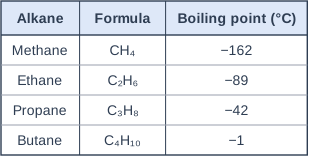
The gases fraction from a fractionating column is a mixture of four alkanes. The table shows their boiling points.

A refinery wants to separate the gases fraction so that it can sell pure propane and pure butane as fuels.

Suggest how the gases fraction could be separated into the four alkanes. Explain why your method works.

Table with columns "Alkane", "Formula", "Boiling point (°C)". Alkane: Methane; Formula: CH₄; Boiling point (°C): −162 | Alkane: Ethane; Formula: C₂H₆; Boiling point (°C): −89 | Alkane: Propane; Formula: C₃H₈; Boiling point (°C): −42 | Alkane: Butane; Formula: C₄H₁₀; Boiling point (°C): −1.

Model answer

The gases could be cooled (and compressed) until they turn into liquids. The liquid mixture could then be fractionally distilled at low temperature: as it warms, methane boils off first at −162 °C, then ethane at −89 °C, propane at −42 °C and finally butane at −1 °C, and each can be collected separately. This works because the four alkanes have different boiling points, because their molecules are different sizes with different strengths of intermolecular forces.

Explanation

The gases fraction can be separated by the same principle as crude oil: fractional distillation, which depends on differences in boiling point. Because all four boiling points are below room temperature, the mixture must first be cooled or compressed to form liquids. Answers that only say 'use fractional distillation' miss the need for very low temperatures.

Mark scheme
  1. 1 mark

    cool (and compress) the mixture until the alkanes condense / turn into liquids

    ALLOW cool to below −162 °C to liquefy all four. ALLOW cool in stages, so that butane condenses first (below −1 °C), then propane (below −42 °C), then ethane (below −89 °C). ALLOW use high pressure to liquefy the gases.

  2. 1 mark

    then (fractionally) distil the liquid mixture / let it warm up slowly so each alkane boils off at its own boiling point, (methane first and butane last) / collect each alkane as it condenses at its own temperature

    ALLOW fractional distillation at a low temperature / under pressure. ALLOW collect each liquid separately as the mixture is cooled in stages. IGNORE 'use a fractionating column' without any idea of low temperature or condensing the gases.

  3. 1 mark

    it works because the four alkanes have different boiling points

    ALLOW the molecules are different sizes, so they have different strengths of intermolecular forces and different boiling points. IGNORE 'they have different masses' on its own.

Question 4

4 marks

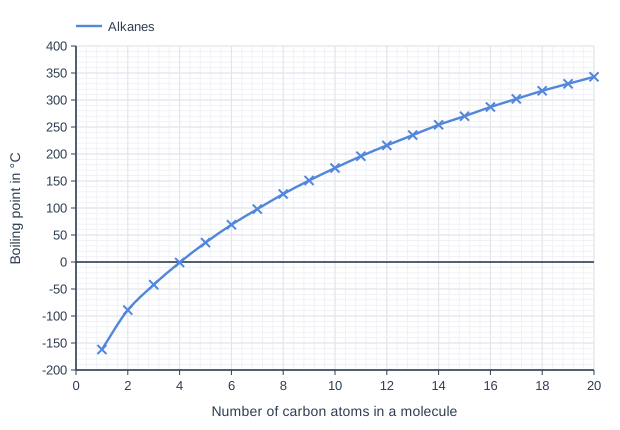
The graph shows the boiling points of the straight-chain alkanes with 1 to 20 carbon atoms in their molecules.

Calculate the mean increase in boiling point for each extra carbon atom:
• from the alkane with 5 carbon atoms to the alkane with 10 carbon atoms
• from the alkane with 15 carbon atoms to the alkane with 20 carbon atoms.

In a fractionating column, each fraction is collected over a range of temperatures. Use your answers to explain why a fraction collected over a 50 °C range near the bottom of the column contains alkanes with more different chain lengths than a fraction collected over a 50 °C range near the top.

Line graph of boiling point in °C (y-axis, -200 to 400) against number of carbon atoms in a molecule (x-axis, 0 to 20). "Alkanes" is a smooth curve through (1, -162), (2, -89), (3, -42), (4, -1), (5, 36), (6, 69), (7, 98), (8, 126), (9, 151), (10, 174), (11, 196), (12, 216), (13, 235), (14, 254), (15, 270), (16, 287), (17, 302), (18, 317), (19, 330), (20, 343).

Model answer

From C₅ to C₁₀: (174 − 36) ÷ 5 = 27.6 °C per carbon atom.
From C₁₅ to C₂₀: (343 − 270) ÷ 5 = 14.6 °C per carbon atom.
For the larger alkanes, the boiling point rises by much less for each extra carbon atom, so their boiling points are closer together. So a 50 °C range near the bottom of the column includes about 50 ÷ 14.6 ≈ 3 or 4 different chain lengths, but a 50 °C range near the top includes only about 50 ÷ 27.6 ≈ 2. The fraction near the bottom therefore contains alkanes with more different chain lengths.

Explanation

There are five steps of one carbon atom between C₅ and C₁₀, so divide the rise in boiling point by 5, not by 6. Boiling point increases with chain length because larger molecules have stronger intermolecular forces, but each extra CH₂ makes a smaller difference to a long chain than to a short one. This is why fractions such as fuel oil contain a much wider range of chain lengths than petrol.

Mark scheme
  1. 1 mark

    (174 − 36) ÷ 5 = 27.6 (°C per carbon atom); or a correct final answer of 27.6 °C and 14.6 °C (or any answers from 26 to 29 °C and from 13 to 16 °C) with no working

    An answer of 27.6 °C and 14.6 °C (or any answers from 26 to 29 °C and from 13 to 16 °C) with no working scores marking points 1 and 2. ALLOW any value from 26 to 29 °C (graph readings). ALLOW 1 mark (out of marking points 1 and 2) for increases of 138 °C and 73 °C that are not divided by 5, or for both values divided by 6 (23 °C and 12 °C).

  2. 1 mark

    (343 − 270) ÷ 5 = 14.6 (°C per carbon atom)

    ALLOW any value from 13 to 16 °C. IGNORE units.

  3. 1 mark

    for the larger alkanes (near the bottom), the boiling point rises less for each extra carbon atom / the boiling points of neighbouring large alkanes are closer together

    ALLOW ECF from the student's two values if the second is smaller than the first. ALLOW the graph gets less steep as the number of carbon atoms increases.

  4. 1 mark

    so more alkanes (more different chain lengths) have boiling points within the same temperature range near the bottom than near the top

    ALLOW a correct quantitative comparison, for example 50 ÷ 14.6 is about 3 or 4 chain lengths near the bottom, compared with 50 ÷ 27.6, about 2, near the top. DO NOT ALLOW answers that say the large molecules break down.

Ready to try the rest? Every answer you write is marked against the mark scheme, so you can see exactly where the marks are.

Study Helper Hints first, answers after you try

Stuck on this one? Ask for a hint and I’ll point you in the right direction, without giving the answer away. Once you’ve checked your answer, I’ll show you how the marks are awarded.