
Level:
Correct: 0
Incorrect: 0
Marks: 0/0
Exam Practice
Course:
Topics:
OCR GCSE Chemistry (Paper 4) Smart practice A mixed round aimed at your weak spots
Unit 4
Predicting and identifying reactions and products
Unit 5
Monitoring and controlling chemical reactions
Unit 6
Global challenges
Unit 7
Practical skills
Avg
score:
–
Topics
done:
0/37

Catalysts and enzymes

Practise 17 exam-style questions on Catalysts and enzymes for OCR GCSE Chemistry (Paper 4). Write your answer as you would in the exam and get it marked in seconds against the mark scheme, point by point, with the Study Helper on hand if you get stuck.

  • 17 questions
  • 1–6 marks each
  • Instant marking
  • No sign-up needed
17 questions, marked as you go

Sample questions with model answers

Here are 4 of the questions in this topic, each with a model answer, an explanation of why it earns the marks and the mark scheme an examiner would use.

Question 1

1 mark

Many reactions in the human body happen quickly at about 37 °C. Outside the body, the same reactions are extremely slow at 37 °C unless they are heated strongly.

Which statement explains why these reactions are fast in the body?

Choose your answer.

  • A Enzymes are catalysts that are used up as the reactions happen.
  • B Enzymes are catalysts that give the reacting particles more energy.
  • C Enzymes are catalysts that lower the activation energy of the reactions.
  • D Enzymes are catalysts that raise the temperature inside the cells.

Model answer

C (Enzymes are catalysts that lower the activation energy of the reactions.)

Explanation

Enzymes act as catalysts in biological systems. Like any catalyst, an enzyme lowers the activation energy, so reactions are fast at body temperature without strong heating. The common errors are to think that a catalyst is used up or that it works by giving the particles more energy.

Mark scheme
  1. 1 mark

    C / Enzymes are catalysts that lower the activation energy of the reactions.

    The only correct answer is C: enzymes are biological catalysts; they provide a pathway with a lower activation energy, so at 37 °C a much greater proportion of collisions have enough energy to react. A is not correct because catalysts, including enzymes, are not used up; B is not correct because a catalyst does not give the particles more energy (raising the temperature does that); D is not correct because enzymes do not raise the temperature: the reactions are fast at 37 °C. ALLOW the letter or the option. If more than one option is given, do not award the mark.
Question 2

2 marks

Carbonic anhydrase is an enzyme in red blood cells. It speeds up the reaction of carbon dioxide with water:

CO₂ + H₂O ⇌ H₂CO₃

Each molecule of the enzyme can convert about 1.0 × 10⁶ molecules of carbon dioxide every second, and the enzyme is not used up.

The Avogadro constant is 6.02 × 10²³.

Calculate the amount, in moles, of carbon dioxide that 2.0 × 10⁻⁹ mol of the enzyme can convert in one second.

Model answer

Number of enzyme molecules = 2.0 × 10⁻⁹ × 6.02 × 10²³ = 1.204 × 10¹⁵
Molecules of CO₂ converted each second = 1.204 × 10¹⁵ × 1.0 × 10⁶ = 1.204 × 10²¹
Amount of CO₂ = 1.204 × 10²¹ ÷ 6.02 × 10²³ = 2.0 × 10⁻³ mol
(or directly: 2.0 × 10⁻⁹ × 1.0 × 10⁶ = 2.0 × 10⁻³ mol)

Explanation

Because each enzyme molecule converts the same number of CO₂ molecules, the ratio of moles is the same as the ratio of molecules, so the Avogadro constant cancels. The calculation shows why only a tiny amount of enzyme is needed: a catalyst is not used up, so each molecule takes part again and again. A common error is to give the number of molecules (1.2 × 10²¹) instead of the amount in moles.

Mark scheme
  1. 1 mark

    number of enzyme molecules = 2.0 × 10⁻⁹ × 6.02 × 10²³ = 1.2 × 10¹⁵, so molecules of CO₂ converted each second = 1.2 × 10¹⁵ × 1.0 × 10⁶ = 1.2 × 10²¹ / amount of CO₂ = 2.0 × 10⁻⁹ × 1.0 × 10⁶; or a correct final answer of 2.0 × 10⁻³ mol with no working

    An answer of 2.0 × 10⁻³ mol with no working scores 2 marks. The Avogadro constant cancels out, so ALLOW the direct route 2.0 × 10⁻⁹ × 1.0 × 10⁶. ALLOW 1 mark for 1.2 × 10²¹ given as the final answer (a number of molecules, not an amount in moles).

  2. 1 mark

    2.0 × 10⁻³ (mol)

    ALLOW 0.0020 / 0.002 (mol). ALLOW 2.0E-3 / 2.0 times 10 to the power −3. IGNORE units.

Question 3

3 marks

Scientists estimate that, without its enzyme, one reaction that takes place in cells would take about 3.0 years for half of the reactant to be used up at 37 °C. With the enzyme, half of the reactant is used up in 0.0050 s.

Calculate how many times faster the reaction is with the enzyme.

1 year = 365 days

Give your answer in standard form to 2 significant figures.

Model answer

Time without the enzyme = 3.0 × 365 × 24 × 60 × 60 = 9.46 × 10⁷ s
Number of times faster = 9.46 × 10⁷ ÷ 0.0050 = 1.89 × 10¹⁰
= 1.9 × 10¹⁰ times faster (2 significant figures)

Explanation

The rate is inversely proportional to the time taken, so the number of times faster is the longer time divided by the shorter time, with both times in the same unit. Convert the years into seconds step by step (days, hours, minutes, seconds). The usual errors are to miss one of the conversion steps or to divide the wrong way round.

Mark scheme
  1. 1 mark

    time without the enzyme in seconds = 3.0 × 365 × 24 × 60 × 60 = 9.46 × 10⁷ s (94 608 000 s); or a correct final answer of 1.9 × 10¹⁰ with no working

    An answer of 1.9 × 10¹⁰ with no working scores 3 marks. ALLOW 2 marks for 1.89 × 10¹⁰ or 18 900 000 000 (correct value, but not in standard form to 2 significant figures). ALLOW ECF for marking points 2 and 3 from an incorrect conversion: for example, stopping at minutes (3.0 × 365 × 24 × 60 = 1 576 800) gives 3.2 × 10⁸ for 2 marks.

  2. 1 mark

    9.46 × 10⁷ ÷ 0.0050 = 1.89 × 10¹⁰; or a correct final answer of 1.9 × 10¹⁰ with no working

    ALLOW 1.892 × 10¹⁰. The division may be written as a ratio of the two times.

  3. 1 mark

    1.9 × 10¹⁰

    ALLOW ECF for this mark from a valid calculation, given in standard form to 2 significant figures. ALLOW typed forms such as 1.9E10 or 1.9 times 10 to the power 10.

Question 4

4 marks

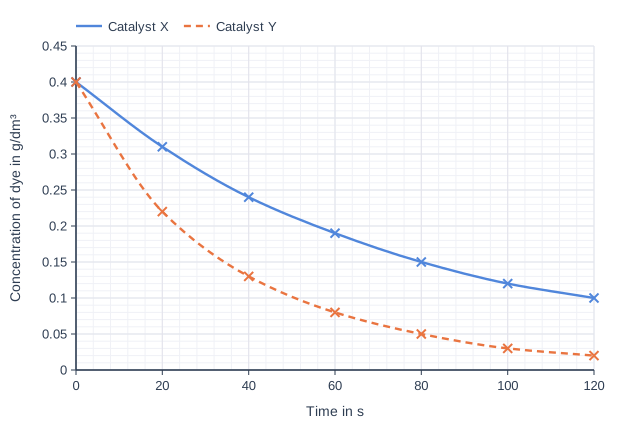
A purple dye in waste water from a factory can be broken down into colourless products by a slow reaction. A scientist tests two powdered catalysts, X and Y. The scientist uses the same mass of each powder, with particles of the same size, the same volume of dye solution and the same temperature. The concentration of the dye is measured every 20 s.

The graph shows the results.

Calculate the mean rate of reaction with catalyst Y during the first 60 s.

Explain which catalyst provides the reaction pathway with the lower activation energy.

Line graph of concentration of dye in g/dm³ (y-axis, 0 to 0.45) against time in s (x-axis, 0 to 120). "Catalyst X" is a smooth curve through (0, 0.4), (20, 0.31), (40, 0.24), (60, 0.19), (80, 0.15), (100, 0.12), (120, 0.1). "Catalyst Y" (dashed) is a smooth curve through (0, 0.4), (20, 0.22), (40, 0.13), (60, 0.08), (80, 0.05), (100, 0.03), (120, 0.02).

Model answer

With Y, the concentration falls from 0.40 g/dm³ to 0.08 g/dm³ in 60 s.
Mean rate = (0.40 − 0.08) ÷ 60 = 0.32 ÷ 60 = 0.0053 g/dm³ per s

Y provides the pathway with the lower activation energy. The dye concentration falls faster with Y (0.08 g/dm³ after 60 s compared with 0.19 g/dm³ with X), and everything else, including the temperature, was the same. With a lower activation energy a greater proportion of the collisions have energy equal to or greater than the activation energy, so there are more successful collisions per second.

Explanation

Mean rate = change in concentration ÷ time, so use the decrease from the start value, not the value at 60 s. Because the temperature, mass and particle size were controlled, the only reason for the faster rate with Y is the catalyst itself: it must give the pathway with the lower activation energy. Do not say that a catalyst gives the particles more energy.

Mark scheme
  1. 1 mark

    decrease in concentration with Y in the first 60 s = 0.40 − 0.08 = 0.32 (g/dm³); or a correct final answer of 0.0053 g/dm³ per s with no working

    An answer of 0.0053 g/dm³ per s with no working scores marking points 1 and 2. ALLOW 0.00533 or 5.3 × 10⁻³. ALLOW 1 mark for 0.0035 (the curve for X used instead of Y). ALLOW 1 mark for 0.0013 (0.08 ÷ 60: the concentration at 60 s used instead of the change). Max 2 if X is chosen as the catalyst with the lower activation energy.

  2. 1 mark

    mean rate = 0.32 ÷ 60 = 0.0053 (g/dm³ per s)

    IGNORE units.

  3. 1 mark

    Y, because the concentration of dye falls faster with Y / the rate is greater with Y (at the same temperature)

    ALLOW the curve for Y is steeper. ALLOW a correct comparison of data, for example after 60 s the concentration is 0.08 g/dm³ with Y but 0.19 g/dm³ with X.

  4. 1 mark

    with a lower activation energy, a greater proportion of collisions have energy equal to or greater than the activation energy, so there are more successful collisions per second

    ALLOW more particles have enough energy to react when they collide, so the reaction is faster. DO NOT ALLOW Y gives the particles more energy.

Ready to try the rest? Every answer you write is marked against the mark scheme, so you can see exactly where the marks are.

Study Helper Hints first, answers after you try

Stuck on this one? Ask for a hint and I’ll point you in the right direction, without giving the answer away. Once you’ve checked your answer, I’ll show you how the marks are awarded.