
Level:
Correct: 0
Incorrect: 0
Marks: 0/0
Exam Practice
Course:
Topics:
OCR GCSE Chemistry (Paper 4) Smart practice A mixed round aimed at your weak spots
Unit 4
Predicting and identifying reactions and products
Unit 5
Monitoring and controlling chemical reactions
Unit 6
Global challenges
Unit 7
Practical skills
Avg
score:
–
Topics
done:
0/37

Functional groups and homologous series

Practise 16 exam-style questions on Functional groups and homologous series for OCR GCSE Chemistry (Paper 4). Write your answer as you would in the exam and get it marked in seconds against the mark scheme, point by point, with the Study Helper on hand if you get stuck.

  • 16 questions
  • 1–6 marks each
  • Instant marking
  • No sign-up needed
16 questions, marked as you go

Sample questions with model answers

Here are 4 of the questions in this topic, each with a model answer, an explanation of why it earns the marks and the mark scheme an examiner would use.

Question 1

1 mark

Which molecule contains both an alcohol (–OH) group and a carboxylic acid (–COOH) group?

Choose your answer.

  • A HOCH₂CH₂OH
  • B HOCH₂COOH
  • C CH₂=CHCH₂OH
  • D CH₃CH₂COOH

Model answer

B

Explanation

Look at what each oxygen atom is joined to. In an alcohol group the O–H is joined to a carbon atom that has no C=O; in a carboxylic acid group the C=O and the O–H are on the same carbon atom. The O–H inside a –COOH group is part of the acid group, so it does not also count as an alcohol group.

Mark scheme
  1. 1 mark

    B / HOCH₂COOH

    The only correct answer is B: HOCH₂COOH (hydroxyethanoic acid, used in some skin creams) has an –OH group joined to a CH₂ carbon atom, which is an alcohol group, and a –COOH group, in which the C=O and the O–H are on the same carbon atom. A is not correct because HOCH₂CH₂OH has two alcohol groups but no –COOH group. C is not correct because CH₂=CHCH₂OH has an alcohol group and a C=C double bond (an alkene group), but no –COOH group. D is not correct because CH₃CH₂COOH (propanoic acid) has only a –COOH group: its O–H is part of the –COOH group, not a separate alcohol group. ALLOW the letter or the option. If more than one option is given, do not award the mark.
Question 2

2 marks

The chloroalkanes are a homologous series of compounds. The first three members of the series are CH₃Cl, C₂H₅Cl and C₃H₇Cl.

Give the general formula of the chloroalkanes.

Use it to give the molecular formula of the chloroalkane with six carbon atoms in each molecule.

Model answer

General formula: CₙH₂ₙ₊₁Cl
For n = 6: C₆H₁₃Cl

Explanation

Each member of a homologous series differs from the next by CH₂, and in every chloroalkane the number of hydrogen atoms is twice the number of carbon atoms plus one, because one hydrogen atom of the alkane CₙH₂ₙ₊₂ has been replaced by a chlorine atom. Putting n = 6 into CₙH₂ₙ₊₁Cl gives C₆H₁₃Cl. Writing CₙH₂ₙ₊₂Cl forgets that the chlorine atom takes the place of a hydrogen atom.

Mark scheme
  1. 1 mark

    CₙH₂ₙ₊₁Cl

    ALLOW CnH2n+1Cl. ALLOW Cl written first or the formula written as CₙH₂ₙ₊₁–Cl. DO NOT ALLOW CₙH₂ₙ₊₂Cl or CₙH₂ₙCl.

  2. 1 mark

    C₆H₁₃Cl

    ALLOW C6H13Cl. ALLOW CH₃CH₂CH₂CH₂CH₂CH₂Cl. ALLOW ECF from a wrong general formula that contains n (for example C₆H₁₄Cl from CₙH₂ₙ₊₂Cl, or C₆H₁₂Cl from CₙH₂ₙCl). DO NOT ALLOW C₆H₁₂Cl or C₆H₁₄Cl unless it follows from the student's general formula.

Question 3

3 marks

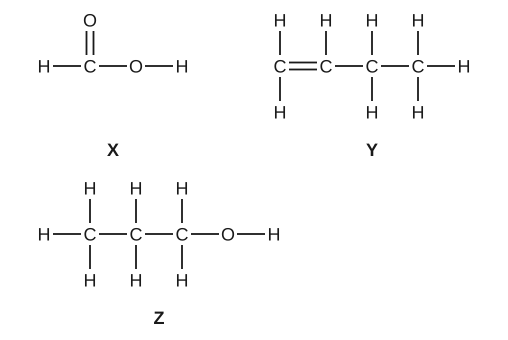
The diagram shows the displayed formulae of three compounds, X, Y and Z.

Name compounds X, Y and Z.

Displayed formulae of three compounds labelled X, Y and Z.

Model answer

X is methanoic acid.
Y is but-1-ene (butene).
Z is propan-1-ol (propanol).

Explanation

First find the functional group: –COOH means a carboxylic acid (-oic acid), C=C means an alkene (-ene) and –OH means an alcohol (-ol). Then count every carbon atom, including the carbon of a –COOH group: one carbon is meth-, three is prop- and four is but-. A common error is to name X as methanol because it contains an O–H bond, without noticing the C=O double bond on the same carbon atom.

Mark scheme
  1. 1 mark

    X: methanoic acid

    ALLOW formic acid. DO NOT ALLOW methanol or ethanoic acid: X has only one carbon atom, and it is part of the –COOH group. IGNORE a correct formula given with the name.

  2. 1 mark

    Y: but-1-ene / butene

    ALLOW 1-butene. DO NOT ALLOW butane, propene or but-2-ene.

  3. 1 mark

    Z: propan-1-ol / propanol

    ALLOW 1-propanol. DO NOT ALLOW propan-2-ol, propane or propanoic acid.

Question 4

5 marks

Stearic acid, C₁₇H₃₅COOH, is a saturated carboxylic acid: it fits the general formula CₙH₂ₙ₊₁COOH.

Linoleic acid, C₁₇H₃₁COOH, is found in sunflower oil. It is unsaturated: its hydrocarbon chain contains C=C double bonds.

A chemist converts linoleic acid into stearic acid by reacting it with hydrogen, using a nickel catalyst. Hydrogen adds across every C=C double bond.

Relative atomic mass (Ar): H = 1.0 C = 12.0 O = 16.0

Deduce the number of C=C double bonds in one molecule of linoleic acid. Explain your answer.

Calculate the minimum mass of hydrogen, in g, needed to convert 5.60 kg of linoleic acid into stearic acid.

Model answer

Stearic acid has 35 hydrogen atoms in its chain (2 × 17 + 1 = 35); linoleic acid has 31, which is 4 fewer. Each C=C double bond means 2 fewer hydrogen atoms, so linoleic acid has 2 C=C double bonds.
Mr of linoleic acid, C₁₈H₃₂O₂ = (18 × 12.0) + (32 × 1.0) + (2 × 16.0) = 280
Moles of linoleic acid = 5600 g ÷ 280 = 20.0 mol
Each molecule reacts with 2 H₂: moles of H₂ = 2 × 20.0 = 40.0 mol
Mass of hydrogen = 40.0 × 2.0 = 80.0 g

Explanation

Compare the formula with the general formula of a saturated acid: every C=C removes two hydrogen atoms, so four missing hydrogen atoms means two C=C bonds. For the mass, convert kg to g, divide by the Mr to get moles, then use the ratio 1 mol linoleic acid : 2 mol H₂. Using a 1 : 1 ratio (40 g) or forgetting to convert 5.60 kg to grams are the common errors.

Mark scheme
  1. 1 mark

    Mr of linoleic acid = (18 × 12.0) + (32 × 1.0) + (2 × 16.0) = 280 and moles of linoleic acid = 5600 ÷ 280 = 20.0 (mol); or a correct final answer of 80.0 g with no working

    An answer of 80 g with no working scores marking points 1, 2 and 3. ALLOW 5.60 ÷ 280 = 0.0200 (kmol). ALLOW ECF for marking points 2 and 3 from a wrong number of C=C double bonds given in the answer to the first part. If no number of C=C double bonds is given, an answer of 40 g scores marking points 1 and 3 only.

  2. 1 mark

    moles of H₂ = 2 × 20.0 = 40.0 (mol), because one H₂ molecule adds across each C=C double bond; or a correct final answer of 80.0 g with no working

    ALLOW 0.0400 (kmol).

  3. 1 mark

    mass of hydrogen = 40.0 × 2.0 = 80.0 (g)

    ALLOW 80 g. ALLOW 0.080 kg only if the unit kg is given.

  4. 1 mark

    linoleic acid has four fewer hydrogen atoms than stearic acid (C₁₇H₃₁ instead of C₁₇H₃₅)

    ALLOW a saturated acid with 17 carbon atoms in its chain has 2 × 17 + 1 = 35 hydrogen atoms, but linoleic acid has 31.

  5. 1 mark

    each C=C double bond means two fewer hydrogen atoms, so linoleic acid has two C=C double bonds

    ALLOW 2 C=C because each C=C needs one H₂ molecule (two hydrogen atoms) to become saturated. DO NOT ALLOW 4 C=C double bonds.

Ready to try the rest? Every answer you write is marked against the mark scheme, so you can see exactly where the marks are.

Study Helper Hints first, answers after you try

Stuck on this one? Ask for a hint and I’ll point you in the right direction, without giving the answer away. Once you’ve checked your answer, I’ll show you how the marks are awarded.