
Level:
Correct: 0
Incorrect: 0
Marks: 0/0
Exam Practice
Course:
Topics:
Edexcel GCSE Physics (Paper 2) Smart practice A mixed round aimed at your weak spots
Unit 1
Key concepts of physics
Unit 8
Energy - forces doing work
Unit 9
Forces and their effects
Unit 10
Electricity and circuits
Unit 11
Static electricity
Unit 12
Magnetism and the motor effect
Unit 13
Electromagnetic induction
Unit 14
Particle model
Unit 15
Forces and matter
Avg
score:
–
Topics
done:
0/34

The heating effect of a current

Practise 15 exam-style questions on The heating effect of a current for Edexcel GCSE Physics (Paper 2). Write your answer as you would in the exam and get it marked in seconds against the mark scheme, point by point, with the Study Helper on hand if you get stuck.

  • 15 questions
  • 1–6 marks each
  • Instant marking
  • No sign-up needed
15 questions, marked as you go

Sample questions with model answers

Here are 4 of the questions in this topic, each with a model answer, an explanation of why it earns the marks and the mark scheme an examiner would use.

Question 1

1 mark

Heater X has a current of 2.0 A and a potential difference of 12 V across it. It is switched on for 60 s.

Heater Y has a current of 4.0 A and a potential difference of 6.0 V across it. It is switched on for 30 s.

Use the equation
E = I × V × t

Compared with heater X, how much energy does heater Y transfer?

Choose your answer.

  • A a quarter as much
  • B half as much
  • C the same
  • D twice as much

Model answer

B - heater Y transfers half as much energy (720 J compared with 1440 J).

Explanation

E = I × V × t: for X, 2.0 × 12 × 60 = 1440 J; for Y, 4.0 × 6.0 × 30 = 720 J. Doubling the current doubles the energy, but halving both the p.d. and the time quarters it, so overall Y transfers half as much. Each wrong option comes from ignoring one or more of the three factors.

Mark scheme
  1. 1 mark

    B / half as much (1)

    The only correct answer is B: X transfers 2.0 × 12 × 60 = 1440 J and Y transfers 4.0 × 6.0 × 30 = 720 J, which is half as much. A is not correct because it halves the energy twice (for the p.d. and the time) but ignores the doubled current; C is not correct because it only lets the doubled current cancel the halved time and ignores the halved p.d.; D is not correct because it only takes account of the doubled current. Accept the letter or the option. If more than one option is given, do not award the mark.
Question 2

2 marks

A games console contains a fan that blows air over its electronic components while it is switched on.

Explain why the console needs a fan.

Model answer

When the console is on, there are currents in its electronic components, and because they have resistance this heats them. The fan blows air over the components to transfer this energy away, so they do not overheat and get damaged.

Explanation

Unwanted heating is a disadvantage of the heating effect: it wastes energy and can damage components. Fans, vents and heat sinks transfer the energy to the surroundings so the components stay at a safe temperature. A full answer gives both the cause of the heating and what the fan does about it.

Mark scheme
  1. 1 mark

    the currents in the components heat them / energy is transferred to the thermal store of the components (the heating effect) (1)

    An explanation linking the two points. accept 'the components get hot because of their resistance'.

  2. 1 mark

    the fan transfers energy away from them / cools them, so they do not overheat / get damaged / stop working (1)

    accept 'to keep the temperature of the components low'. Ignore 'to keep the console cool' on its own, with no reason.

Question 3

3 marks

A 3D printer has a heated bed that keeps the printed plastic warm. The heated bed transfers 18 kJ of energy in 2.5 minutes. The current in the heated bed is 10 A.

Calculate the potential difference across the heated bed.

Use the equation
E = I × V × t

Model answer

E = 18 kJ = 18 000 J
t = 2.5 × 60 = 150 s
E = I × V × t, so V = E ÷ (I × t)
V = 18 000 ÷ (10 × 150)
V = 12 V

Explanation

Two conversions are needed: 18 kJ = 18 000 J and 2.5 minutes = 150 s. Rearranging E = I × V × t gives V = E ÷ (I × t) = 18 000 ÷ 1500 = 12 V. Forgetting to convert the minutes gives 720 V, which is far too large for a 3D printer.

Mark scheme
  1. 1 mark

    conversions: 18 kJ = 18 000 J and 2.5 minutes = 150 s (1)

    Both conversions are needed for this mark. They may be seen in the substitution.

  2. 1 mark

    substitution and rearrangement: (V =) 18 000 ÷ (10 × 150) (1)

    allow 18 000 = 10 × V × 150. allow ecf from incorrect conversions.

  3. 1 mark

    evaluation: 12 (V) (1)

    An answer of 12 (V) with no working scores 3 marks. 720 V (the time left as 2.5 minutes, the only error) or 0.012 V (the energy left in kJ, the only error) scores 2 marks: only the conversion mark is lost, and the substitution and evaluation marks are awarded by ecf. 0.72 V (both left unconverted) scores 1 mark. A wrong rearrangement (e.g. 18 000 × 10 × 150) scores the conversion mark only.

Question 4

4 marks

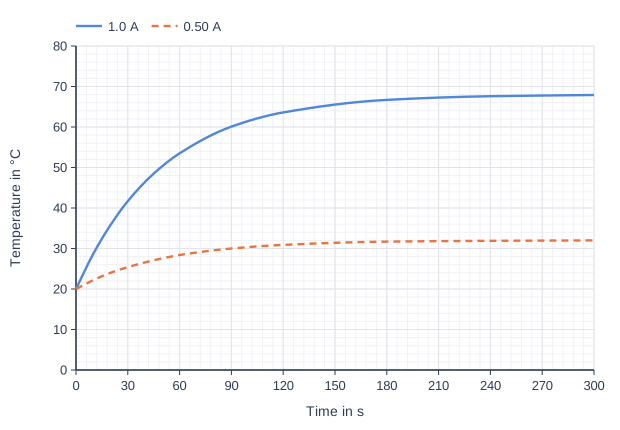
Ayesha tapes a temperature sensor to a resistor. She switches on the current and records the temperature of the resistor for 300 s. She does this first with a current of 0.50 A and then, after the resistor has cooled, with a current of 1.0 A.

The graph shows her results.

Explain why the temperature of the resistor stops rising, and why its final temperature is higher when the current is 1.0 A.

Line graph of temperature in °C (y-axis, 0 to 80) against time in s (x-axis, 0 to 300). "1.0 A" is a smooth curve through (0, 20), (10, 28.7), (20, 35.8), (30, 41.7), (45, 48.5), (60, 53.5), (90, 60.1), (120, 63.6), (180, 66.7), (240, 67.6), (300, 67.9). "0.50 A" (dashed) is a smooth curve through (0, 20), (10, 22.2), (20, 24), (30, 25.4), (45, 27.1), (60, 28.4), (90, 30), (120, 30.9), (180, 31.7), (240, 31.9), (300, 32).

Model answer

When there is a current, it does work against the resistance, so energy is transferred to the thermal store of the resistor at a steady rate and its temperature rises. As the resistor gets hotter, it transfers energy to the surroundings by heating at a greater rate. The temperature stops rising when the energy dissipated to the surroundings each second equals the energy supplied by the current each second. With 1.0 A, both the current and the p.d. are larger, so much more energy is supplied each second (E = I × V × t). The resistor has to reach a higher temperature (about 68 °C instead of 32 °C) before it loses energy to the surroundings as fast as it is supplied.

Explanation

A steady temperature means a balance: energy in per second equals energy out per second, not that the resistor is 'full'. A hotter object loses energy faster, so a resistor supplied with energy at a greater rate settles at a higher temperature. Many answers explain the rise in temperature but not why it levels off.

Mark scheme
  1. 1 mark

    the current does work against the resistance, transferring energy to the thermal store of the resistor at a steady rate (1)

    An explanation linking the four points. accept 'energy is supplied to the resistor at a constant rate'.

  2. 1 mark

    as the resistor gets hotter, it transfers energy to the surroundings (by heating) at a greater rate (1)

    accept 'the hotter the resistor is compared with the room, the faster it loses energy'.

  3. 1 mark

    the temperature stops rising when energy is transferred to the surroundings at the same rate as it is supplied by the current (1)

    accept 'when the energy lost each second equals the energy supplied each second'. Do not accept 'the resistor is full of energy / cannot hold any more energy'.

  4. 1 mark

    with 1.0 A, more energy is supplied each second (larger current and larger p.d., E = I × V × t), so the resistor must be hotter before it loses energy at the same rate (1)

    accept 'more energy is transferred to the resistor each second, so it reaches a higher temperature before the energy lost each second balances it'. accept 'more collisions per second between electrons and ions' for more energy each second.

Ready to try the rest? Every answer you write is marked against the mark scheme, so you can see exactly where the marks are.

Study Helper Hints first, answers after you try

Stuck on this one? Ask for a hint and I’ll point you in the right direction, without giving the answer away. Once you’ve checked your answer, I’ll show you how the marks are awarded.