
Level:
Correct: 0
Incorrect: 0
Marks: 0/0
Exam Practice
Course:
Topics:
Edexcel GCSE Physics (Paper 2) Smart practice A mixed round aimed at your weak spots
Unit 1
Key concepts of physics
Unit 8
Energy - forces doing work
Unit 9
Forces and their effects
Unit 10
Electricity and circuits
Unit 11
Static electricity
Unit 12
Magnetism and the motor effect
Unit 13
Electromagnetic induction
Unit 14
Particle model
Unit 15
Forces and matter
Avg
score:
–
Topics
done:
0/34

Contact and non-contact forces

Practise 13 exam-style questions on Contact and non-contact forces for Edexcel GCSE Physics (Paper 2). Write your answer as you would in the exam and get it marked in seconds against the mark scheme, point by point, with the Study Helper on hand if you get stuck.

  • 13 questions
  • 1–6 marks each
  • Instant marking
  • No sign-up needed
13 questions, marked as you go

Sample questions with model answers

Here are 4 of the questions in this topic, each with a model answer, an explanation of why it earns the marks and the mark scheme an examiner would use.

Question 1

1 mark

Physical quantities are either scalar quantities or vector quantities.

Which list contains only vector quantities?

Choose your answer.

  • A weight, mass, friction
  • B friction, tension, weight
  • C air resistance, energy, tension
  • D weight, work done, friction

Model answer

B - friction, tension, weight.

Explanation

A vector quantity has a size and a direction; a scalar has a size only. Every force, including weight, friction, tension and air resistance, is a vector. Mass, energy and work done are scalars: work done is worked out from a force and a distance, but it is an amount of energy, which has no direction, so each wrong list contains one scalar.

Mark scheme
  1. 1 mark

    B / friction, tension, weight (1)

    The only correct answer is B: friction, tension and weight are all forces, and every force has a size and a direction, so all three are vectors. A is not correct because mass has size only, so it is a scalar (weight, the force on the mass, is the vector). C is not correct because energy has size only, so it is a scalar. D is not correct because work done is the energy transferred by a force, and energy has size only, so it is a scalar even though it is calculated from a force. Accept the letter or the option. If more than one option is given, do not award the mark.
Question 2

2 marks

Friction and the gravitational force are two different types of force.

Explain why friction is a contact force but the gravitational force is a non-contact force.

Model answer

Friction only acts where two surfaces are touching and moving, or trying to move, over each other, so it is a contact force. The gravitational force acts between objects that are not touching, because each object is in the gravitational field of the other: for example, the Earth pulls on a ball falling through the air, so it is a non-contact force.

Explanation

A contact force needs the objects to touch; a non-contact force acts at a distance through a field. Gravitational, electrostatic and magnetic forces are non-contact forces, while friction, the normal contact force, air resistance and tension are contact forces. Saying that gravity 'pulls things down' does not explain why it needs no contact.

Mark scheme
  1. 1 mark

    friction acts only when two surfaces are touching / in contact (and move or try to move over each other) (1)

    Accept 'friction needs the surfaces to rub against each other'. Do not accept 'friction slows things down' (does not explain contact).

  2. 1 mark

    the gravitational force acts between objects that are not touching / acts at a distance, because each (mass) is in the gravitational field of the other (1)

    Accept a correct example, e.g. 'the Earth pulls on a falling ball / on the Moon without touching it'. Ignore 'gravity is everywhere' unqualified. Do not accept 'gravity only acts on falling objects'.

Question 3

3 marks

Two children each have a mass of 35 kg. They each pull on a rope tied to the same sledge with a force of 60 N.

Explain why the total mass of the two children must be 70 kg, but the resultant of their two pulling forces can be any value from 0 N to 120 N.

Model answer

Mass is a scalar quantity: it has a size but no direction, so the two masses always simply add to give 35 + 35 = 70 kg. Force is a vector quantity: it has a size and a direction, so the resultant depends on the directions in which the children pull. If they pull in the same direction the resultant is 60 + 60 = 120 N; if they pull in opposite directions the forces cancel and the resultant is 0 N; if they pull at an angle to each other the resultant is somewhere between 0 N and 120 N.

Explanation

Scalars are added like ordinary numbers, but when vectors are added their directions must be taken into account. Two equal forces give the largest resultant when they act in the same direction and cancel when they act in opposite directions. Answers that only say 'force is a vector' without linking it to the directions of the pulls do not explain the range of values.

Mark scheme
  1. 1 mark

    mass is a scalar / has size only (no direction), so the masses always simply add (35 + 35 = 70 kg) (1)

    An explanation linking all three points. Ignore 'mass is measured in kg'.

  2. 1 mark

    force is a vector / has size and direction, so the resultant depends on the directions in which the children pull (1)

    Accept 'the forces can act in different directions'. Do not accept 'force is a vector' with no reference to direction.

  3. 1 mark

    pulling in the same direction gives 60 + 60 = 120 N, pulling in opposite directions gives 60 - 60 = 0 N, and pulling at an angle to each other gives a value in between (1)

    Both extremes (same direction 120 N and opposite directions 0 N) are needed for this mark; the 'in between' idea may be implied. Accept a correct example of an angle, e.g. at right angles the resultant is about 85 N.

Question 4

4 marks

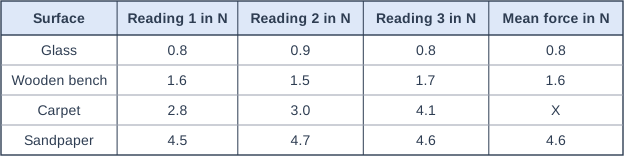
Leah investigates the friction force between a wooden block and different surfaces. She pulls the block across each surface with a newtonmeter, keeping the block moving at a steady speed. She takes three readings for each surface.

The table shows her results.

Calculate the mean force X for the carpet, ignoring any anomalous result.

Explain why the newtonmeter reading is equal to the friction force on the block only when the block moves at a steady speed.

Table with columns "Surface", "Reading 1 in N", "Reading 2 in N", "Reading 3 in N", "Mean force in N". Surface: Glass; Reading 1 in N: 0.8; Reading 2 in N: 0.9; Reading 3 in N: 0.8; Mean force in N: 0.8 | Surface: Wooden bench; Reading 1 in N: 1.6; Reading 2 in N: 1.5; Reading 3 in N: 1.7; Mean force in N: 1.6 | Surface: Carpet; Reading 1 in N: 2.8; Reading 2 in N: 3.0; Reading 3 in N: 4.1; Mean force in N: X | Surface: Sandpaper; Reading 1 in N: 4.5; Reading 2 in N: 4.7; Reading 3 in N: 4.6; Mean force in N: 4.6.

Model answer

The reading of 4.1 N is anomalous because it is much higher than the other two readings, so I leave it out.
X = (2.8 + 3.0) ÷ 2 = 2.9 N
When the block moves at a steady speed it is not accelerating, so the forces on it are balanced and the resultant force is zero. This means the forward pull of the newtonmeter is equal in size to the backward friction force. If the block were speeding up, the pull would be greater than the friction, so the reading would be too high.

Explanation

An anomalous result does not fit the pattern of the repeats, so it is left out of the mean: (2.8 + 3.0) ÷ 2 = 2.9 N. At a steady speed the resultant force is zero, so the pulling force measured by the newtonmeter balances the friction force exactly. A common error is to include the anomaly, which gives 3.3 N.

Mark scheme
  1. 1 mark

    identifies 4.1 (N) as the anomalous result and leaves it out (1)

    May be shown by the calculation. Award the first two marks for 2.9 (N) without working.

  2. 1 mark

    (X = (2.8 + 3.0) ÷ 2 =) 2.9 (N) (1)

    3.3 (N) (the anomalous result included) scores 0 for these two marks.

  3. 1 mark

    at a steady speed (in a straight line) the forces on the block are balanced / the resultant force on the block is zero (1)

    Accept 'it is not accelerating, so there is no resultant force'. Do not accept 'there are no forces on the block'.

  4. 1 mark

    so the pull of the newtonmeter (forwards) is equal in size to the friction force (backwards) / if the block were speeding up the pull would be greater than the friction (1)

    Accept ORA: 'if the block accelerated, the reading would be bigger than the friction force'. Ignore references to Newton's third law.

Ready to try the rest? Every answer you write is marked against the mark scheme, so you can see exactly where the marks are.

Study Helper Hints first, answers after you try

Stuck on this one? Ask for a hint and I’ll point you in the right direction, without giving the answer away. Once you’ve checked your answer, I’ll show you how the marks are awarded.