
Level:
Correct: 0
Incorrect: 0
Marks: 0/0
Exam Practice
Course:
Topics:
Edexcel GCSE Physics (Paper 2) Smart practice A mixed round aimed at your weak spots
Unit 1
Key concepts of physics
Unit 8
Energy - forces doing work
Unit 9
Forces and their effects
Unit 10
Electricity and circuits
Unit 11
Static electricity
Unit 12
Magnetism and the motor effect
Unit 13
Electromagnetic induction
Unit 14
Particle model
Unit 15
Forces and matter
Avg
score:
–
Topics
done:
0/34

Pressure in liquids, upthrust and floating

Practise 16 exam-style questions on Pressure in liquids, upthrust and floating for Edexcel GCSE Physics (Paper 2). Write your answer as you would in the exam and get it marked in seconds against the mark scheme, point by point, with the Study Helper on hand if you get stuck.

  • 16 questions
  • 1–6 marks each
  • Instant marking
  • No sign-up needed
16 questions, marked as you go

Sample questions with model answers

Here are 4 of the questions in this topic, each with a model answer, an explanation of why it earns the marks and the mark scheme an examiner would use.

Question 1

1 mark

Three solid blocks each have a mass of 1.0 kg:
- a lead block (density 11 300 kg/m³)
- an oak block (density 700 kg/m³)
- a polystyrene block (density 25 kg/m³)

Which block has the greatest upthrust on it from the surrounding air?

Choose your answer.

  • A the lead block
  • B the oak block
  • C the polystyrene block
  • D all have the same upthrust

Model answer

C - the polystyrene block. It has the greatest volume, so it displaces the greatest weight of air.

Explanation

Upthrust acts in gases as well as liquids and is equal to the weight of the fluid displaced. Blocks of equal mass have very different volumes: the polystyrene block's volume is 0.040 m³, about 450 times that of the lead block. A common misconception is that objects of equal mass must have equal upthrust.

Mark scheme
  1. 1 mark

    C / the polystyrene block (1)

    The only correct answer is C: the upthrust equals the weight of the air displaced, which depends on the volume of the block; for the same mass, the least dense block has the greatest volume (polystyrene 0.040 m³), so it displaces the most air. A is not correct because lead is the densest, so the lead block has the smallest volume and the smallest upthrust; B is not correct because the oak block's volume (about 0.0014 m³) is much smaller than the polystyrene block's; D is not correct because upthrust depends on the volume of fluid displaced, not on the mass of the object. Accept the letter or the option. If more than one option is given, do not award the mark.
Question 2

3 marks

A cold-water storage tank is on the roof of a block of flats. Pipes full of water connect the tank to the taps in the flats.

The surface of the water in the tank is 22.0 m above a tap on the ground floor and 7.0 m above a tap on the top floor. Both taps are closed.

Calculate the difference between the water pressure at the ground-floor tap and the water pressure at the top-floor tap.

Use the equation
P = h × ρ × g

(density of water = 1000 kg/m³, gravitational field strength = 10 N/kg)

Model answer

The difference in depth below the water surface is 22.0 - 7.0 = 15.0 m.
Difference in pressure = h × ρ × g = 15.0 × 1000 × 10 = 150 000 Pa
(Check: 220 000 Pa at the ground floor and 70 000 Pa at the top floor; 220 000 - 70 000 = 150 000 Pa.)

Explanation

The pressure due to the water at each tap depends on the vertical height of the water surface above it, so the difference in pressure depends only on the difference in height, 15.0 m. Working out both pressures and subtracting gives the same answer. Atmospheric pressure adds equally at both taps, so it cancels in the difference.

Mark scheme
  1. 1 mark

    (difference in height =) 22.0 - 7.0 = 15.0 (m) (1)

    An answer of 150 000 Pa with no working scores 3 marks (accept 1.5 × 10⁵ Pa or 150 kPa). Alternative method: P (ground floor) = 22.0 × 1000 × 10 = 220 000 Pa and P (top floor) = 7.0 × 1000 × 10 = 70 000 Pa scores MP1 and MP2; 220 000 - 70 000 = 150 000 Pa scores MP3. An answer of 220 000 Pa or 70 000 Pa only scores 1 mark. Atmospheric pressure acts on the water in the tank and so adds the same amount at both taps: it does not change the difference.

  2. 1 mark

    substitution: (P =) 15.0 × 1000 × 10 (1)

    ecf from their difference in height.

  3. 1 mark

    evaluation: 150 000 (Pa) (1)

    accept 1.5 × 10⁵ (Pa) / 150 kPa.

Question 3

3 marks

Leo puts a fresh egg into a beaker of tap water. The egg sinks to the bottom.

He then dissolves salt in the water until the solution has a density of 1150 kg/m³ (tap water has a density of 1000 kg/m³). The egg rises and then floats, with part of it above the surface.

Explain these observations in terms of the forces on the egg.

Model answer

The egg's weight is the same in both liquids. When it is completely under the liquid, it displaces its own volume of liquid, and the upthrust equals the weight of that liquid. In tap water the upthrust is less than the egg's weight, so the resultant force is downwards and the egg sinks. The salt solution is denser, so the same volume of it weighs more and the upthrust on the submerged egg is greater, now greater than the egg's weight, so the egg rises. As part of the egg comes above the surface, it displaces less liquid and the upthrust decreases, until the upthrust equals the weight and the egg floats.

Explanation

Whether an object sinks or floats depends on whether the upthrust when it is fully submerged is less or greater than its weight. Increasing the density of the liquid increases the upthrust on the same volume, so it can change a sinking object into a floating one. A floating object settles where the upthrust equals its weight; answers that only compare densities do not explain the forces.

Mark scheme
  1. 1 mark

    when it is completely under the liquid, the egg displaces the same volume (its own volume) of liquid in both cases (1)

    An explanation linking any three of the five points; max 3. Max 1 if the answer only compares densities (e.g. 'the egg is denser than tap water but less dense than the salt solution') and does not refer to upthrust and weight.

  2. 1 mark

    the upthrust equals the weight of liquid displaced; the salt solution is denser, so the same volume of it weighs more, so the upthrust on the submerged egg is greater in the salt solution (1)

    accept the upthrust increases as the salt dissolves / as the density of the liquid increases.

  3. 1 mark

    in tap water the upthrust is less than the weight of the egg, so the egg sinks (1)

    accept the resultant force is downwards in tap water.

  4. 1 mark

    in the salt solution the upthrust on the submerged egg is greater than its weight, so it rises (1)

    accept the resultant force is upwards in the salt solution.

  5. 1 mark

    as part of the egg rises above the surface, less liquid is displaced, so the upthrust decreases until it equals the weight, and the egg floats (1)

    accept the egg floats when the upthrust equals its weight.

Question 4

5 marks

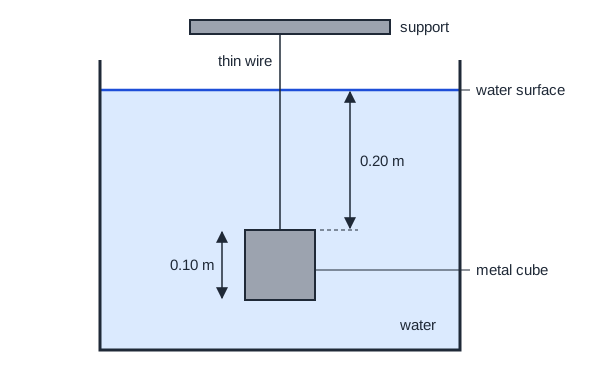
The diagram shows a metal cube hanging from a thin wire, completely under water. Each side of the cube is 0.10 m long. The top face of the cube is horizontal and 0.20 m below the water surface.

Consider only the pressure due to the water.

Show that the upthrust on the cube is equal to the weight of the water it displaces.

Use the equation
P = h × ρ × g

(density of water = 1000 kg/m³, gravitational field strength = 10 N/kg)

Diagram of a tank of water. A metal cube hangs from a thin wire attached to a support above the tank and is completely under the water. A dimension arrow shows that the top face of the cube is 0.20 m below the water surface, and another shows that each side of the cube is 0.10 m long.

Model answer

Pressure on the top face (0.20 m deep) = 0.20 × 1000 × 10 = 2000 Pa
Pressure on the bottom face (0.30 m deep) = 0.30 × 1000 × 10 = 3000 Pa
Area of each face = 0.10 × 0.10 = 0.010 m²
Force on the top face = 2000 × 0.010 = 20 N downwards
Force on the bottom face = 3000 × 0.010 = 30 N upwards
The forces on the side faces cancel, so the upthrust = 30 - 20 = 10 N upwards.
Volume of water displaced = 0.10³ = 0.0010 m³; mass = 0.0010 × 1000 = 1.0 kg; weight = 1.0 × 10 = 10 N.
So the upthrust (10 N) equals the weight of the water displaced (10 N).

Explanation

Upthrust exists because the pressure in a liquid increases with depth: the bottom face is deeper than the top face, so the upward force on it is larger than the downward force on the top. The difference, 10 N, is exactly the weight of the 0.0010 m³ of water the cube displaces. A common error is to use 0.20 m for both faces, or to forget that the bottom face is 0.30 m deep.

Mark scheme
  1. 1 mark

    (pressure on the top face =) 0.20 × 1000 × 10 = 2000 (Pa) (1)

    Show that: a correct answer with no working scores 0; the working must be seen. Alternative for MP1 to MP4: difference in pressure between the bottom and top faces = 0.10 × 1000 × 10 = 1000 Pa (MP1 and MP2); force = 1000 × 0.010 (MP3) = 10 N upwards (MP4). allow atmospheric pressure added to both pressures, provided the difference in the forces is used.

  2. 1 mark

    (pressure on the bottom face =) 0.30 × 1000 × 10 = 3000 (Pa) (1)

    the bottom face is 0.20 + 0.10 = 0.30 m below the surface.

  3. 1 mark

    forces on the faces (area 0.010 m²): 2000 × 0.010 = 20 N downwards on the top and 3000 × 0.010 = 30 N upwards on the bottom (1)

    both forces are needed for this mark; ecf from their pressures; F = P × A must be recalled; area = 0.10 × 0.10 = 0.010 m².

  4. 1 mark

    (upthrust = resultant force =) 30 - 20 = 10 (N) (upwards) (1)

    ecf from their forces; accept the forces on the four side faces cancel (they are equal and opposite), as an additional comment.

  5. 1 mark

    weight of water displaced: volume = 0.10³ = 0.0010 m³, mass = 0.0010 × 1000 = 1.0 kg, weight = 1.0 × 10 = 10 N, the same as the upthrust (1)

    the comparison with the upthrust must be stated or clear.

Ready to try the rest? Every answer you write is marked against the mark scheme, so you can see exactly where the marks are.

Study Helper Hints first, answers after you try

Stuck on this one? Ask for a hint and I’ll point you in the right direction, without giving the answer away. Once you’ve checked your answer, I’ll show you how the marks are awarded.