
Level:
Correct: 0
Incorrect: 0
Marks: 0/0
Exam Practice
Course:
Topics:
Edexcel GCSE Physics (Paper 2) Smart practice A mixed round aimed at your weak spots
Unit 1
Key concepts of physics
Unit 8
Energy - forces doing work
Unit 9
Forces and their effects
Unit 10
Electricity and circuits
Unit 11
Static electricity
Unit 12
Magnetism and the motor effect
Unit 13
Electromagnetic induction
Unit 14
Particle model
Unit 15
Forces and matter
Avg
score:
–
Topics
done:
0/34

Core practical: investigating circuits

Practise 15 exam-style questions on Core practical: investigating circuits for Edexcel GCSE Physics (Paper 2). Write your answer as you would in the exam and get it marked in seconds against the mark scheme, point by point, with the Study Helper on hand if you get stuck.

  • 15 questions
  • 1–6 marks each
  • Instant marking
  • No sign-up needed
15 questions, marked as you go

Sample questions with model answers

Here are 4 of the questions in this topic, each with a model answer, an explanation of why it earns the marks and the mark scheme an examiner would use.

Question 1

1 mark

Ama is investigating how the current in a fixed resistor changes with the potential difference across it. Her school has no variable resistors left.

Suggest one other way Ama could change the potential difference across the resistor.

Model answer

Ama could use a variable power supply and change its voltage setting, or change the number of cells in the battery.

Explanation

The variable resistor is only one way of changing the potential difference across the component being tested. A variable power supply or a battery with more or fewer cells does the same job, as does putting different fixed resistors in series with the test resistor. Replacing the test resistor itself is not acceptable, because then a different component is being investigated.

Mark scheme
  1. 1 mark

    use a variable (d.c.) power supply / change the voltage setting of the power supply (1)

    Any one from this point and the two that follow; max 1. Accept 'use a power pack with different voltage settings'.

  2. 1 mark

    change the number of cells (in the battery) (1)

    accept 'add or remove cells', 'use different numbers of batteries'.

  3. 1 mark

    connect different fixed resistors in series with the resistor being tested (1)

    accept 'add a fixed resistor in series'. Do not accept 'use a potentiometer' or 'use a rheostat' (these are variable resistors). Do not accept 'use a different resistor' or 'change the resistor' (that changes the component being investigated). Ignore 'change the current' with no method.
Question 2

2 marks

Priya investigates how the current in a fixed resistor changes with the potential difference across it. She keeps the current small, and she switches off the circuit between readings.

Explain why Priya does this.

Model answer

When there is a current in the resistor, energy is transferred that heats it. If the resistor got hotter, its resistance would change, so the temperature would not be controlled and the readings would not show the relationship for a constant resistance. Small currents and switching off between readings stop the resistor warming up.

Explanation

The resistance of a metal resistor depends on its temperature, so temperature must be controlled. A current heats the resistor, more so for larger currents and longer times, so keeping the current small and switching off between readings keeps the temperature, and so the resistance, constant. Answers about saving energy or safety miss the point about valid results.

Mark scheme
  1. 1 mark

    a current heats the resistor / the temperature of the resistor would increase (1)

    An explanation linking the two points. accept 'there is an energy transfer that heats the resistor (and wires)'. A larger current or a longer time switched on heats it more.

  2. 1 mark

    (a rise in temperature) changes / increases the resistance, so the temperature (a control variable) would not stay constant / the resistance would not stay constant (1)

    accept 'so the results would not be valid because the resistance changes'. Ignore 'to save energy / the battery' and 'for safety' unless linked to heating. Do not accept 'the current would get too strong' or 'so the resistor does not break' on their own.

Question 3

3 marks

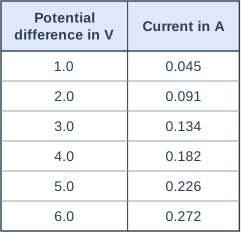
Leon investigates how the current in a fixed resistor depends on the potential difference across it. The table shows his results.

Leon concludes that the current in the resistor is directly proportional to the potential difference across it.

Explain whether Leon's results support his conclusion. Use data from the table in your answer.

Table with columns "Potential difference in V", "Current in A". Potential difference in V: 1.0; Current in A: 0.045 | Potential difference in V: 2.0; Current in A: 0.091 | Potential difference in V: 3.0; Current in A: 0.134 | Potential difference in V: 4.0; Current in A: 0.182 | Potential difference in V: 5.0; Current in A: 0.226 | Potential difference in V: 6.0; Current in A: 0.272.

Model answer

Yes, the results support Leon's conclusion. When the potential difference doubles from 2.0 V to 4.0 V, the current doubles from 0.091 A to 0.182 A, and from 3.0 V to 6.0 V it doubles from 0.134 A to 0.272 A. Potential difference ÷ current is about 22 Ω for every reading (for example 2.0 ÷ 0.091 = 22.0 and 5.0 ÷ 0.226 = 22.1), so the resistance is constant and a graph would be a straight line through the origin.

Explanation

Direct proportionality needs more than both quantities increasing: doubling one must double the other, or their ratio must stay constant. Here V ÷ I is 22.0 to 22.4 Ω for every row, and the small spread is measurement error, so the resistor has a constant resistance. A common error is to say 'as V goes up, I goes up, so they are proportional', which scores no credit.

Mark scheme
  1. 1 mark

    doubling the potential difference (about) doubles the current, with data, e.g. 2.0 V to 4.0 V: 0.091 A to 0.182 A / 3.0 V to 6.0 V: 0.134 A to 0.272 A (1)

    An explanation linking any three of the five points; max 3. Ignore 'the current increases as the potential difference increases' on its own: that is a positive correlation, not evidence of direct proportionality. accept any other correct doubling or tripling pair, e.g. 1.0 V to 3.0 V: 0.045 A to 0.134 A.

  2. 1 mark

    potential difference ÷ current is (about) the same for every reading, e.g. about 22 (Ω), shown for at least two readings (1)

    accept current ÷ potential difference is (about) constant, about 0.045 (A/V). Values between 22.0 and 22.4 are all correct; accept 'the small differences are due to (random) measurement error'.

  3. 1 mark

    so the resistance (of the resistor) is constant (1)

    accept 'the resistance stays at about 22 Ω'.

  4. 1 mark

    a graph of current against potential difference would be a straight line through the origin (1)

    both 'straight line' and 'through the origin / (0, 0)' are needed.

  5. 1 mark

    (so) the results support the conclusion (1)

    Award this mark only if at least one of the first two points (data evidence) is also awarded. Do not award it for a judgement based only on 'both go up'. Answers that say the results do not support the conclusion because the values of V ÷ I are not exactly equal do not score this mark.

Question 4

4 marks

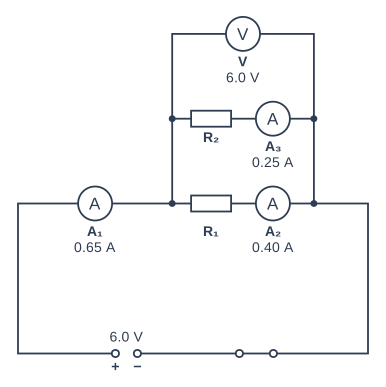
Ella tests a parallel circuit. The diagram shows her circuit and the meter readings.

Ella's teacher says the readings show that the total resistance of the two resistors in parallel is less than the resistance of either resistor on its own.

Use calculations of resistance from the readings to show that the teacher is correct.

Circuit diagram. Going round the loop from the + terminal of the d.c. power supply (labelled 6.0 V): ammeter A₁ (reading 0.65 A); then two branches in parallel (one branch has resistor R₁ then ammeter A₂ (reading 0.40 A); the other branch has resistor R₂ then ammeter A₃ (reading 0.25 A)), with voltmeter V (reading 6.0 V) connected across this parallel section; then a closed switch; and back to the − terminal of the d.c. power supply.

Model answer

The voltmeter shows 6.0 V across both resistors.
R₁ = V ÷ I = 6.0 ÷ 0.40 = 15 Ω
R₂ = 6.0 ÷ 0.25 = 24 Ω
The current from the supply is 0.65 A, so the total resistance = 6.0 ÷ 0.65 = 9.2 Ω.
9.2 Ω is less than 15 Ω and less than 24 Ω, so the total resistance is less than the resistance of either resistor.

Explanation

In a parallel circuit each branch has the same p.d. as the whole parallel section, so R = V ÷ I can be used for each branch (A₂ and A₃) and for the whole section (A₁). The total current is the sum of the branch currents, so for the same 6.0 V the combination takes more current than either resistor and has less resistance. Adding 15 Ω and 24 Ω is the rule for series, not parallel.

Mark scheme
  1. 1 mark

    (resistance of R₁ =) 6.0 ÷ 0.40 = 15 (Ω) (1)

    This is a 'show that' question: the calculations must be seen; a statement that the teacher is correct with no calculations scores 0. allow R1 for R₁.

  2. 1 mark

    (resistance of R₂ =) 6.0 ÷ 0.25 = 24 (Ω) (1)

    allow R2 for R₂.

  3. 1 mark

    (total resistance =) 6.0 ÷ 0.65 = 9.2 (Ω) (1)

    allow values that round to 9.2 or 9.23. Also allow 1 ÷ R = 1 ÷ 15 + 1 ÷ 24, giving 9.2 Ω (a correct method, although students are not expected to know it). Do not accept 15 + 24 = 39 Ω (that is the rule for resistors in series).

  4. 1 mark

    9.2 Ω is less than 15 Ω (and 24 Ω), so the total resistance is less than either resistor (1)

    The comparison must use a calculated total resistance (allow ecf from their values). accept 'the p.d. is the same (6.0 V) but the total current (0.65 A) is larger than the current in either resistor, so the total resistance is smaller (R = V ÷ I)' for this mark. Ignore 'adding a resistor in parallel decreases resistance' with no use of the readings.

Ready to try the rest? Every answer you write is marked against the mark scheme, so you can see exactly where the marks are.

Study Helper Hints first, answers after you try

Stuck on this one? Ask for a hint and I’ll point you in the right direction, without giving the answer away. Once you’ve checked your answer, I’ll show you how the marks are awarded.