Level:
Correct: 0
Incorrect: 0
Marks: 0/0
Exam Practice
Course:
Topics:
Edexcel GCSE Physics (Paper 2) Smart practice A mixed round aimed at your weak spots
Unit 1
Key concepts of physics
Unit 8
Energy - forces doing work
Unit 9
Forces and their effects
Unit 10
Electricity and circuits
Unit 11
Static electricity
Unit 12
Magnetism and the motor effect
Unit 13
Electromagnetic induction
Unit 14
Particle model
Unit 15
Forces and matter
Avg
score:
–
Topics
done:
0/34

Gas pressure, temperature and absolute zero

Practise 15 exam-style questions on Gas pressure, temperature and absolute zero for Edexcel GCSE Physics (Paper 2). Write your answer as you would in the exam and get it marked in seconds against the mark scheme, point by point, with the Study Helper on hand if you get stuck.

  • 15 questions
  • 1–6 marks each
  • Instant marking
  • No sign-up needed
15 questions, marked as you go

Sample questions with model answers

Here are 4 of the questions in this topic, each with a model answer, an explanation of why it earns the marks and the mark scheme an examiner would use.

Question 1

1 mark

Absolute zero is the lowest possible temperature.

Give the temperature of absolute zero in degrees Celsius.

Model answer

-273 °C

Explanation

Absolute zero is -273 °C (more precisely -273.15 °C), which is 0 K on the kelvin scale. A common slip is to leave out the minus sign; 0 °C is the melting point of ice, not absolute zero.

Mark scheme
  1. 1 mark

    -273 (°C) (1)

    accept -273.15 °C; the minus sign is needed: do not accept 273 °C; do not accept 0 °C or 0 K (the question asks for degrees Celsius)

Question 2

2 marks

In 2018, NASA's Cold Atom Laboratory on the International Space Station cooled a cloud of rubidium atoms to about one ten-millionth of a kelvin above absolute zero (0 K).

Explain why no substance can ever be cooled to a temperature below 0 K.

Model answer

Cooling a substance takes energy away from its particles, so they move more slowly. At absolute zero, 0 K, the particles have stopped moving and have no kinetic energy left. They cannot move more slowly than not moving at all, so no further cooling is possible and no temperature can be lower than 0 K.

Explanation

Temperature is linked to the movement of particles: the colder a substance, the more slowly its particles move. At absolute zero they have stopped, so there is no movement or kinetic energy left to remove. Answers that only say absolute zero is 'the lowest temperature' repeat the idea in the question without explaining it.

Mark scheme
  1. 1 mark

    at absolute zero / 0 K the particles have stopped moving / have no (kinetic) energy (1)

    An explanation linking two points. accept 'there is no movement of the particles at 0 K'; accept 'atoms' or 'molecules' for particles

  2. 1 mark

    cooling makes the particles move more slowly / removes their (kinetic) energy, and particles cannot move more slowly than not moving at all / cannot have less than zero (kinetic) energy (1)

    accept 'there is no more energy to take away, so the temperature cannot fall any further'; ignore 'it is too cold' or 'the equipment cannot do it' (the answer must be in terms of particles)

Question 3

3 marks

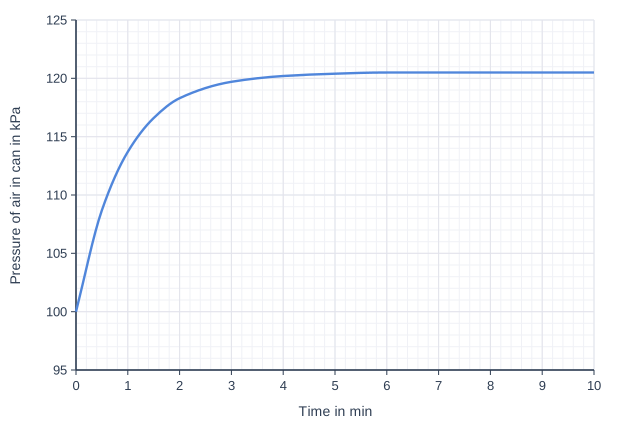
A sealed, rigid metal can contains air at 20 °C. A pressure sensor connected to a data logger measures the pressure of the air in the can.

At time 0, the can is put into a large beaker of water at 80 °C.

The graph shows the pressure of the air in the can for the next 10 minutes.

Explain the shape of the graph.

Line graph of pressure of air in can in kPa (y-axis, 95 to 125) against time in min (x-axis, 0 to 10). The line is a smooth curve through (0, 100), (0.5, 108.7), (1, 113.7), (1.5, 116.6), (2, 118.3), (3, 119.7), (4, 120.2), (5, 120.4), (6, 120.5), (8, 120.5), (10, 120.5).

Model answer

When the can is put in the hot water, the air inside is heated and its temperature rises. The air particles gain kinetic energy and move faster, so they collide with the walls of the can more often and with more force, and the pressure increases. The pressure levels off at about 120 kPa when the air has reached the temperature of the water, 80 °C. The temperature then stays the same, so the average speed of the particles stays the same and the collisions with the walls do not change, so the pressure stays constant.

Explanation

The rise in pressure follows the rise in temperature of the air: faster particles hit the walls more often and harder. The curve levels off because energy stops being transferred once the air reaches the water's temperature, so the particles' average speed, and the pressure, then stay the same. Saying the particles stop moving when the graph is level is a common error.

Mark scheme
  1. 1 mark

    the air (in the can) is heated / its temperature rises, so the (air) particles move faster / have more kinetic energy (1)

    Any three from the four points; max 3. accept 'the particles gain (kinetic) energy'; do not accept 'the particles expand / get bigger'

  2. 1 mark

    the particles collide with the walls (of the can) more often / with more force, so the pressure increases (1)

    the collisions must be with the walls / inside of the can; do not accept 'more collisions between particles'

  3. 1 mark

    the pressure stops increasing / levels off (at about 120 kPa) when the air reaches the temperature of the water / 80 °C / when the temperature stops rising (1)

    accept 'the pressure rises more slowly as the air gets closer to the temperature of the water'; accept a level value from 120 to 121 kPa; ignore 'the air runs out of energy'

  4. 1 mark

    (when the temperature is constant) the average speed / kinetic energy of the particles stays the same, so the collisions with the walls (and the force on the walls) do not change (1)

    accept 'the particles keep moving at the same average speed'; do not accept 'the particles stop moving' or 'the collisions stop'

Question 4

4 marks

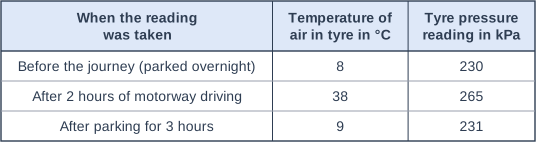
Amir measures the pressure of the air in one of his car's tyres at three different times. A sensor in the tyre measures the temperature of the air inside it. The volume of the tyre can be assumed to stay the same.

The table shows his results.

The car handbook says: 'Check the tyre pressures when the tyres are cold.'

Use the data and ideas about particles to explain why the handbook gives this instruction.

Table with columns "When the reading was taken", "Temperature of air in tyre in °C", "Tyre pressure reading in kPa". When the reading was taken: Before the journey (parked overnight); Temperature of air in tyre in °C: 8; Tyre pressure reading in kPa: 230 | When the reading was taken: After 2 hours of motorway driving; Temperature of air in tyre in °C: 38; Tyre pressure reading in kPa: 265 | When the reading was taken: After parking for 3 hours; Temperature of air in tyre in °C: 9; Tyre pressure reading in kPa: 231.

Model answer

Before the journey the air in the tyre was at 8 °C and the pressure was 230 kPa. After two hours on the motorway the air was at 38 °C, 30 °C hotter, and the pressure had risen to 265 kPa. After parking, the air cooled to 9 °C and the pressure fell back to 231 kPa.

At a higher temperature the air particles have more kinetic energy and move faster. They collide with the inside of the tyre more often, and each collision exerts a greater force, so the pressure is greater.

The recommended pressure is for cold tyres. A reading taken when the tyres are warm is higher than the cold pressure, so a tyre that is under-inflated could appear to be correct, or a driver might let air out and leave the tyre under-inflated when it cools.

Explanation

Driving warms the tyres and the air inside them, so at constant volume the particles move faster and hit the tyre walls more often and harder, raising the pressure; the table shows it returning to about 230 kPa when the air cools. Readings are only comparable with the handbook value if they are taken at the same, cold, temperature. Answers that describe the data without linking it to particle motion, or explain the particles without saying why a warm reading misleads, cannot gain full marks.

Mark scheme
  1. 1 mark

    use of data: after the motorway drive the air is (30 °C) hotter and the pressure is (35 kPa) higher than before the journey / the pressure falls back to about 230 kPa when the tyre has cooled (1)

    Max 3 from MP1-MP4, plus MP5. The data must be quoted for MP1 (e.g. 8 °C and 230 kPa compared with 38 °C and 265 kPa); allow 'the pressure rises by 35 kPa when the temperature rises by 30 °C'

  2. 1 mark

    at a higher temperature the air particles move faster / have more kinetic energy (1)

    accept 'the particles gain energy and speed up'; do not accept 'the particles expand'

  3. 1 mark

    so the particles collide with the inside of the tyre / walls more often (1)

    accept 'more collisions with the tyre (walls) per second'; do not accept 'more collisions' with no mention of the walls / tyre

  4. 1 mark

    and each collision exerts a greater force (on the tyre), so the pressure is greater (1)

    accept 'they hit the walls harder'

  5. 1 mark

    a pressure reading taken when the tyres are warm is higher than the cold reading, so the tyre might seem to have enough air when it does not / the driver might let air out and the tyre would be under-inflated when cold / the recommended pressure is for cold tyres, so a warm reading cannot be compared with it (1)

    the link between the warm reading and a wrong decision about the tyre is needed; ignore 'so the reading is accurate' on its own

Ready to try the rest? Every answer you write is marked against the mark scheme, so you can see exactly where the marks are.

Study Helper Hints first, answers after you try

Stuck on this one? Ask for a hint and I’ll point you in the right direction, without giving the answer away. Once you’ve checked your answer, I’ll show you how the marks are awarded.