
Level:
Correct: 0
Incorrect: 0
Marks: 0/0
Exam Practice
Course:
Topics:
Edexcel GCSE Physics (Paper 2) Smart practice A mixed round aimed at your weak spots
Unit 1
Key concepts of physics
Unit 8
Energy - forces doing work
Unit 9
Forces and their effects
Unit 10
Electricity and circuits
Unit 11
Static electricity
Unit 12
Magnetism and the motor effect
Unit 13
Electromagnetic induction
Unit 14
Particle model
Unit 15
Forces and matter
Avg
score:
–
Topics
done:
0/34

Moments, levers and gears

Practise 16 exam-style questions on Moments, levers and gears for Edexcel GCSE Physics (Paper 2). Write your answer as you would in the exam and get it marked in seconds against the mark scheme, point by point, with the Study Helper on hand if you get stuck.

  • 16 questions
  • 1–6 marks each
  • Instant marking
  • No sign-up needed
16 questions, marked as you go

Sample questions with model answers

Here are 4 of the questions in this topic, each with a model answer, an explanation of why it earns the marks and the mark scheme an examiner would use.

Question 1

1 mark

Four gear wheels, P, Q, R and S, are arranged in a row. Each gear meshes with the next one in the row. Gear P is turned clockwise.

Which statement is correct?

Choose your answer.

  • A Q and S turn anticlockwise
  • B all four gears turn clockwise
  • C only S turns anticlockwise
  • D Q and R turn anticlockwise

Model answer

A - Q and S turn anticlockwise.

Explanation

Where two gears mesh, the teeth of one push the teeth of the other, so the second gear turns in the opposite direction. Along a row of gears the direction alternates: clockwise, anticlockwise, clockwise, anticlockwise. A common error is to think that only the last gear in the row changes direction.

Mark scheme
  1. 1 mark

    A / Q and S turn anticlockwise (1)

    The only correct answer is A: two gears that mesh turn in opposite directions, so P turns clockwise, Q anticlockwise, R clockwise and S anticlockwise. B is not correct because the teeth of meshing gears push each other in opposite directions, so neighbouring gears cannot turn the same way; C is not correct because Q also turns anticlockwise, since it meshes directly with P; D is not correct because R meshes with Q, which turns anticlockwise, so R turns clockwise. Accept the letter or the option. If more than one option is given, do not award the mark.
Question 2

2 marks

Both the moment of a force and the work done by a force can be given in newton metres (N m).

Explain why the moment of a force is not the same quantity as the work done by a force.

Model answer

For work done, the distance is the distance moved by the object in the direction of the force, and the work done is the energy transferred. For a moment, the distance is the perpendicular distance from the pivot to the line of action of the force, and the moment is the turning effect of the force. A force can have a moment even when nothing moves, for example the weight of a child on a balanced seesaw, but it then does no work.

Explanation

Both quantities are a force multiplied by a distance, but the distances mean different things: for work done it is how far the force moves along its own direction, and for a moment it is the perpendicular distance from the pivot. That is why work done is an energy, usually given in joules, while a moment is a turning effect. Confusing the two is a common error in questions on levers and gears.

Mark scheme
  1. 1 mark

    work done uses the distance moved (by the object) in the direction of the force (1)

    Any two from the five points; max 2. Ignore 'they have different units' or 'work done is in joules' on its own, since 1 J = 1 N m.

  2. 1 mark

    a moment uses the perpendicular / normal distance from the pivot to the (line of action of the) force (1)

    accept 'the distance from the pivot at right angles to the force'. Do not accept 'the distance from the pivot' with no idea that it is perpendicular to the force.

  3. 1 mark

    a force can have a moment when nothing moves, but it then does no work (1)

    accept any correct example, e.g. the weights of two children on a balanced seesaw, or a push on a locked door.

  4. 1 mark

    work done is energy transferred, but a moment is a turning effect (of a force) (1)

    Both parts are needed: this is one difference, stated for both quantities. accept 'work done measures the energy transferred; a moment measures how much a force tends to make something rotate'.

  5. 1 mark

    a moment has a direction (clockwise or anticlockwise), but work done / energy has no direction (1)

    accept 'a moment is clockwise or anticlockwise, but work done is a scalar'.

Question 3

3 marks

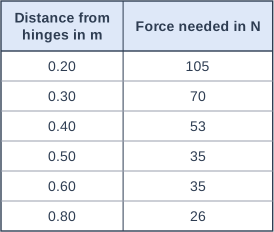
Josh investigates the force needed to open a heavy door that is fitted with a door closer. He hooks a newtonmeter onto the door at different distances from the hinges and pulls at right angles to the door. For each distance, he records the force needed to just start opening the door.

The table shows his results.

One of his results is anomalous.

Use moments to identify the anomalous result. Calculate the force Josh should have recorded at that distance.

Table with columns "Distance from hinges in m", "Force needed in N". Distance from hinges in m: 0.20; Force needed in N: 105 | Distance from hinges in m: 0.30; Force needed in N: 70 | Distance from hinges in m: 0.40; Force needed in N: 53 | Distance from hinges in m: 0.50; Force needed in N: 35 | Distance from hinges in m: 0.60; Force needed in N: 35 | Distance from hinges in m: 0.80; Force needed in N: 26.

Model answer

The moment needed to open the door should be the same at every distance.
Force × distance: 0.20 × 105 = 21 N m, 0.30 × 70 = 21 N m, 0.40 × 53 = 21.2 N m, 0.60 × 35 = 21 N m, 0.80 × 26 = 20.8 N m, but 0.50 × 35 = 17.5 N m.
So the result at 0.50 m is anomalous.
The moment needed is about 21 N m, so at 0.50 m:
force = 21 ÷ 0.50 = 42 N

Explanation

The door closer needs the same moment to start the door turning wherever Josh pulls, so force × perpendicular distance should be constant: the force is inversely proportional to the distance. Calculating the moment for each row shows that only the 0.50 m result does not fit. Noticing that 35 N appears twice is not enough: the moments show which of the two results is wrong.

Mark scheme
  1. 1 mark

    calculates force × distance (the moment) for at least two results and shows that it is (about) 21 N m, e.g. 105 × 0.20 = 21 and 70 × 0.30 = 21 (1)

    An answer of 42 N for the result at 0.50 m with no working scores marking points 2 and 3. accept moments of 20.8 N m to 21.2 N m.

  2. 1 mark

    the result at 0.50 m / 35 N at 0.50 m is anomalous (its moment is only 17.5 N m) (1)

    Do not accept the result at 0.60 m (35 N), whose moment is 21 N m.

  3. 1 mark

    (force =) 21 ÷ 0.50 = 42 (N) (1)

    accept 41 N to 43 N (from a moment of 20.8 N m to 21.2 N m, or the mean moment of the other five results). allow ecf from the candidate's value of the moment for this mark.

Question 4

4 marks

In a cement mixer, an electric motor turns a small gear called a pinion. The teeth of the pinion mesh with a large ring gear that is fixed around the drum, so the drum turns.

- The motor exerts a moment of 12 N m on the pinion.
- The teeth of the pinion are 4.0 cm from its axle.
- The teeth of the ring gear are 30 cm from the axis of the drum.

Calculate the moment that the pinion exerts on the drum. Ignore friction.

Model answer

The force between the teeth: moment = force × distance, so
force = 12 ÷ 0.040 = 300 N
The teeth of the pinion push on the teeth of the ring gear with this force, 0.30 m from the axis of the drum:
moment on the drum = 300 × 0.30 = 90 N m

Explanation

Gears transmit a turning effect through the force between their teeth: the teeth of each gear push on the other with equal and opposite forces. The moment on each gear is this force × the distance of its teeth from its axle, so the ring gear gets a moment 30 ÷ 4.0 = 7.5 times bigger than the motor's, although it turns 7.5 times more slowly. Common errors are converting only one of the distances to metres and inverting the ratio.

Mark scheme
  1. 1 mark

    rearrangement and substitution: (force between the teeth =) 12 ÷ 0.040 (1)

    An answer of 90 N m with no working scores 4 marks. Alternative method: the force between the teeth is the same on both gears, so moment on the drum = 12 × (30 ÷ 4.0) = 90 N m (scores all 4 marks).

  2. 1 mark

    evaluation: 300 (N) (1)

  3. 1 mark

    (moment on the drum =) 300 × 0.30 (1)

    allow ecf from an incorrect force.

  4. 1 mark

    evaluation: 90 (N m) (1)

    allow ecf from marking point 3. An answer of 90 to any other power of ten (e.g. 9000 or 0.90, from converting only one of the distances) scores 3 marks. 12 × 4.0 ÷ 30 (1.6 N m, the ratio inverted) is a wrong method and scores 0.

Ready to try the rest? Every answer you write is marked against the mark scheme, so you can see exactly where the marks are.

Study Helper Hints first, answers after you try

Stuck on this one? Ask for a hint and I’ll point you in the right direction, without giving the answer away. Once you’ve checked your answer, I’ll show you how the marks are awarded.