
Level:
Correct: 0
Incorrect: 0
Marks: 0/0
Exam Practice
Course:
Topics:
Edexcel GCSE Physics (Paper 2) Smart practice A mixed round aimed at your weak spots
Unit 1
Key concepts of physics
Unit 8
Energy - forces doing work
Unit 9
Forces and their effects
Unit 10
Electricity and circuits
Unit 11
Static electricity
Unit 12
Magnetism and the motor effect
Unit 13
Electromagnetic induction
Unit 14
Particle model
Unit 15
Forces and matter
Avg
score:
–
Topics
done:
0/34

Charging by friction and electrostatic phenomena

Practise 15 exam-style questions on Charging by friction and electrostatic phenomena for Edexcel GCSE Physics (Paper 2). Write your answer as you would in the exam and get it marked in seconds against the mark scheme, point by point, with the Study Helper on hand if you get stuck.

  • 15 questions
  • 1–6 marks each
  • Instant marking
  • No sign-up needed
15 questions, marked as you go

Sample questions with model answers

Here are 4 of the questions in this topic, each with a model answer, an explanation of why it earns the marks and the mark scheme an examiner would use.

Question 1

1 mark

A Van de Graaff generator in a school laboratory builds up much more charge on its metal dome on cold, dry days than on damp days.

Which of these is the best explanation?

Choose your answer.

  • A less charge leaks away in dry air
  • B dry air causes more friction
  • C damp air adds positive charge
  • D metals conduct better when dry

Model answer

A (less charge leaks away in dry air)

Explanation

Charge can build up on the dome only if it cannot escape. On damp days, moisture on the insulating surfaces and in the air lets charge leak away gradually, so the dome cannot reach such a large charge; dry air and dry surfaces are much better insulators. The weather does not change how well metals conduct, so D is wrong.

Mark scheme
  1. 1 mark

    A / less charge leaks away in dry air (1)

    The only correct answer is A. In damp conditions a thin film of moisture forms on the insulating surfaces of the generator and charge leaks away along it and into the moist air, so less charge can build up on the dome; in dry conditions very little charge leaks away. B is not correct because the air does not rub against the generator to charge it - the charge comes from the belt and rollers, and the difference between dry and damp days is how quickly charge leaks away; C is not correct because damp air does not add charge - it lets charge leak away; D is not correct because the dome and other metal parts are good conductors in any weather. Accept the letter or the option. If more than one option is given, do not award the mark.
Question 2

2 marks

On a dry day, a person who walks across a carpet can become charged to a potential difference of several thousand volts between their body and the earth. When they then touch a metal door handle, they feel a small shock.

The UK mains supply has a potential difference of only 230 V, but a shock from the mains is much more dangerous.

Suggest why the shock from the door handle is not dangerous, even though the potential difference is so large.

Model answer

Only a very small amount of charge is stored on the person, so when it flows to the door handle only a small amount of energy is transferred (E = Q × V). The charge also flows for only a tiny fraction of a second, whereas the mains supply keeps driving a current through the body for as long as there is contact.

Explanation

The energy transferred depends on the charge as well as on the potential difference, and the charge on a person is tiny, so the energy is small. A static shock is over almost instantly, but the mains supply can keep a current passing through the body. Saying simply that 'the current is small' is not correct, because the current in a spark can be large for a very short time.

Mark scheme
  1. 1 mark

    only a very small amount of charge is stored on the person / flows in the shock (1)

    Any two from the three points; max 2. Accept 'there is not much charge on the body'.

  2. 1 mark

    so only a small amount of energy is transferred (to the body) (E = Q × V) (1)

    Accept 'the energy transferred is small'. This point can be awarded on its own.

  3. 1 mark

    the charge flows for only a very short time / the current lasts for only a tiny fraction of a second, whereas the mains supply keeps the current going (1)

    Do not credit 'the current is very small' on its own: the current in a static spark can be quite large, but it lasts for only a very short time. Ignore 'static is not real electricity'.

Question 3

3 marks

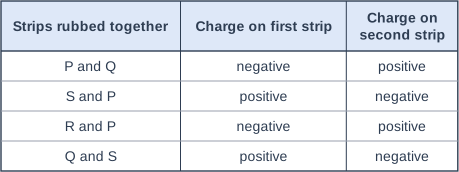
A student has four plastic strips, P, Q, R and S, each made of a different material. She rubs pairs of strips together and then tests the charge on each strip. The table shows her results.

The four materials can be put in a list in order of how easily they gain electrons when rubbed.

The student then rubs strip R with strip S.

Predict the type of charge on strip S, and explain your prediction using the results in the table.

Table with columns "Strips rubbed together", "Charge on first strip", "Charge on second strip". Strips rubbed together: P and Q; Charge on first strip: negative; Charge on second strip: positive | Strips rubbed together: S and P; Charge on first strip: positive; Charge on second strip: negative | Strips rubbed together: R and P; Charge on first strip: negative; Charge on second strip: positive | Strips rubbed together: Q and S; Charge on first strip: positive; Charge on second strip: negative.

Model answer

Strip S will become positive.

When R is rubbed with P, R becomes negative, so R gains electrons more easily than P. When S is rubbed with P, S becomes positive, so P gains electrons more easily than S. So R gains electrons more easily than S: electrons are transferred from S to R, leaving S with a positive charge (and R with an equal negative charge).

Explanation

In each pair, the strip that becomes negative is the one that gains electrons more easily. Linking 'R and P' with 'S and P' puts R above P and P above S, so R takes electrons from S and S is left positive. A common error is to decide from only one row of the table, or to say that positive charge moves onto S.

Mark scheme
  1. 1 mark

    (strip S becomes) positive (1)

    Points 2 and 3 can only be awarded if S is predicted to be positive.

  2. 1 mark

    (because) electrons are transferred from S to R / R gains electrons from S (1)

    Accept 'S loses electrons to R'. Do not accept 'protons / positive charge move from R to S'.

  3. 1 mark

    R gains electrons more easily than P (R is negative when rubbed with P) and P gains electrons more easily than S (S is positive when rubbed with P), so R gains electrons more easily than S (1)

    Both the 'R and P' and the 'S and P' results must be used. Accept the order R, P, S, Q (from gains electrons most easily to least easily) if it is linked to these results. The 'P and Q' and 'Q and S' results do not decide the order of R and S.

Question 4

4 marks

On a dry day, Lily slides down a long plastic slide in a playground. At the bottom, while she is still sitting on the slide, she touches the slide's metal frame, which is fixed into the ground. She sees a tiny spark and feels a small electric shock.

Explain why Lily gets an electric shock. Use ideas about the movement of electrons in your answer.

Model answer

As Lily slides down, friction between her clothes and the plastic transfers electrons between them, so she becomes charged. The plastic slide and the dry air are insulators, so the charge cannot flow away to earth and it stays on her. The metal frame is a good conductor and is connected to the ground. When her hand gets close enough to the frame, electrons suddenly flow between her body and the earth through the spark and the frame, and this brief flow of charge through her body is the shock she feels.

Explanation

The shock is a sudden flow of the charge that built up on Lily by friction, which could not escape earlier because the plastic slide and dry air are insulators. The charge flows only when she touches, or almost touches, an earthed conductor such as the metal frame. Answers about protons moving, or answers that never mention electrons, cannot reach full marks.

Mark scheme
  1. 1 mark

    friction / rubbing between her clothes and the plastic slide transfers electrons (between them) (1)

    An explanation linking any four of the five points; max 4. Max 3 if electrons are not mentioned anywhere in the answer. Accept 'electrons are rubbed off her clothes onto the slide' or the reverse. Do not accept 'protons / positive charges are transferred'.

  2. 1 mark

    so Lily becomes (electrically) charged / has extra electrons or is short of electrons (1)

    Either sign of charge is accepted.

  3. 1 mark

    the charge cannot flow away (to earth) because the plastic slide is an (electrical) insulator (1)

    Accept 'the plastic stops her being earthed'. Accept 'the dry air is an insulator'.

  4. 1 mark

    the metal frame is a conductor (connected to earth / the ground) (1)

    Accept 'metal lets electrons flow through it to the ground'.

  5. 1 mark

    when she touches the metal, electrons flow suddenly between her and earth (through the frame), and this flow of charge through her body is the shock (1)

    Accept 'electrons jump from her to the frame' or 'from the frame to her'. Accept 'a short current passes through her'.

Ready to try the rest? Every answer you write is marked against the mark scheme, so you can see exactly where the marks are.

Study Helper Hints first, answers after you try

Stuck on this one? Ask for a hint and I’ll point you in the right direction, without giving the answer away. Once you’ve checked your answer, I’ll show you how the marks are awarded.