
Level:
Correct: 0
Incorrect: 0
Marks: 0/0
Exam Practice
Course:
Topics:
Edexcel GCSE Physics (Paper 2) Smart practice A mixed round aimed at your weak spots
Unit 1
Key concepts of physics
Unit 8
Energy - forces doing work
Unit 9
Forces and their effects
Unit 10
Electricity and circuits
Unit 11
Static electricity
Unit 12
Magnetism and the motor effect
Unit 13
Electromagnetic induction
Unit 14
Particle model
Unit 15
Forces and matter
Avg
score:
–
Topics
done:
0/34

Generators, dynamos, microphones and loudspeakers

Practise 16 exam-style questions on Generators, dynamos, microphones and loudspeakers for Edexcel GCSE Physics (Paper 2). Write your answer as you would in the exam and get it marked in seconds against the mark scheme, point by point, with the Study Helper on hand if you get stuck.

  • 16 questions
  • 1–6 marks each
  • Instant marking
  • No sign-up needed
16 questions, marked as you go

Sample questions with model answers

Here are 4 of the questions in this topic, each with a model answer, an explanation of why it earns the marks and the mark scheme an examiner would use.

Question 1

1 mark

In a pair of headphones, a varying current passes through a small coil attached to a thin diaphragm. The coil sits in the magnetic field of a permanent magnet.

What makes the diaphragm move?

Choose your answer.

  • A the motor effect on the coil
  • B electromagnetic induction in the coil
  • C static charge on the diaphragm
  • D the diaphragm being magnetised

Model answer

A - the motor effect on the coil.

Explanation

Headphones and loudspeakers use the motor effect: a current-carrying coil in a magnetic field experiences a force, so a varying current makes the coil and diaphragm vibrate. A microphone does the reverse, using electromagnetic induction to turn movement into a current. Mixing up the two effects is a common error: induction needs movement to produce a current, while the motor effect needs a current to produce movement.

Mark scheme
  1. 1 mark

    A / the motor effect on the coil (1)

    The only correct answer is A: the coil carries a current in the magnetic field of the permanent magnet, so there is a force on it (the motor effect); as the current varies, the force varies, so the coil and the diaphragm move. B is not correct because electromagnetic induction is what happens in a microphone, where movement produces a current; in headphones a current produces movement. C is not correct because the diaphragm is moved by a magnetic force on the coil, not by static charge. D is not correct because the force acts on the current-carrying coil, not on a magnetised diaphragm. Accept the letter or the option. If more than one option is given, do not award the mark.
Question 2

2 marks

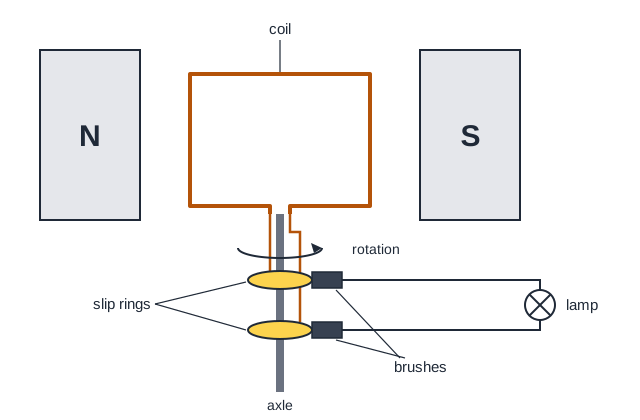
The diagram shows a simple alternator. The coil is turned between the poles of a magnet. Each end of the coil is joined to its own slip ring. The slip rings turn with the coil, and two fixed brushes press against them. Wires from the brushes go to a lamp.

Explain why the alternator needs slip rings and brushes, and why the current in the lamp is an alternating current.

A simple alternator. A rectangular coil of wire sits between the north pole (N) of a magnet on the left and the south pole (S) on the right. The coil is fixed to the top of a vertical axle, and a curved arrow labelled rotation shows the coil and axle turning. The two ends of the coil run down beside the axle to two rings on the axle, labelled slip rings. Two small blocks labelled brushes press on the right-hand side of the rings, and wires from the brushes go to a lamp.

Model answer

The coil keeps turning but the lamp and its wires are fixed. The slip rings turn with the coil and the fixed brushes slide on them, so the coil stays connected to the lamp without the wires becoming twisted. Each end of the coil is always joined, through its own ring and brush, to the same side of the lamp. So when the current induced in the coil reverses every half turn, the current in the lamp reverses too, and the lamp has an alternating current.

Explanation

The current induced in a rotating coil reverses every half turn, because each side of the coil moves first one way and then the other way through the field. Slip rings simply keep each end of the coil connected to the same side of the external circuit, so this alternating current is passed on unchanged. A common misconception is that the slip rings themselves make the current alternate.

Mark scheme
  1. 1 mark

    the slip rings and brushes connect the turning coil to the fixed circuit / lamp (the brushes slide on the rings) without the wires becoming twisted (1)

    An explanation linking the two points. Accept 'so the coil can keep rotating while it is still connected to the lamp'. Do not accept 'the brushes clean the rings' or 'the slip rings make the coil turn'.

  2. 1 mark

    each end of the coil is always connected (through its own ring and brush) to the same side of the lamp, so when the current induced in the coil reverses (every half turn), the current in the lamp reverses too (1)

    Accept 'the connections are never swapped, so the alternating current from the coil passes straight to the lamp'. Do not accept 'the slip rings change the current to a.c.' or 'the slip rings reverse the current' (they do not change the current; the reversal happens in the coil).

Question 3

3 marks

Erin connects a loudspeaker to a 1.5 V cell. As soon as the cell is connected, the cone of the loudspeaker moves outwards once, making a click. The cone then stays still in its new position, and no more sound is heard.

Explain these observations.

Model answer

The current from the cell passes through the coil, which is in the magnetic field of the loudspeaker's permanent magnet, so there is a force on the coil and the cone attached to it (the motor effect). When the cell is connected, this force starts suddenly, so the cone jumps outwards once and pushes the air once, which is heard as a click. The cell gives a steady direct current, so the force stays constant and in one direction: the cone stays in its new position and does not vibrate, so it produces no further sound waves.

Explanation

A loudspeaker works by the motor effect: the force on its coil is proportional to the current and reverses when the current reverses. A sound wave needs the cone to vibrate, which needs a force that keeps changing; a steady direct current gives a steady force, so the cone moves once and then stays put. Students sometimes say the cell has 'run out', but the current is still there - it is just not changing.

Mark scheme
  1. 1 mark

    the current in the coil is in the magnetic field of the (permanent) magnet, so there is a force on the coil (and cone) / the motor effect (1)

    An explanation linking the three points. Accept 'the magnetic field of the coil interacts with the field of the magnet, producing a force'. Do not accept 'electromagnetic induction makes the cone move'.

  2. 1 mark

    when the cell is connected, the force starts suddenly, so the cone moves outwards once and pushes the air once / produces a single pressure pulse, heard as the click (1)

    Accept 'the cone jumps out once, making one compression in the air'.

  3. 1 mark

    the current from the cell is direct / steady, so the force is constant and in one direction, so the cone stays where it is / does not vibrate, and no (more) sound wave is produced (1)

    The steady (d.c.) current must be linked to a constant force (or no vibration) and to no sound. Do not accept 'the cell has run out' or 'the current stops'.

Question 4

4 marks

Some smart doorbells contain a microphone, so that a visitor can speak to the person inside.

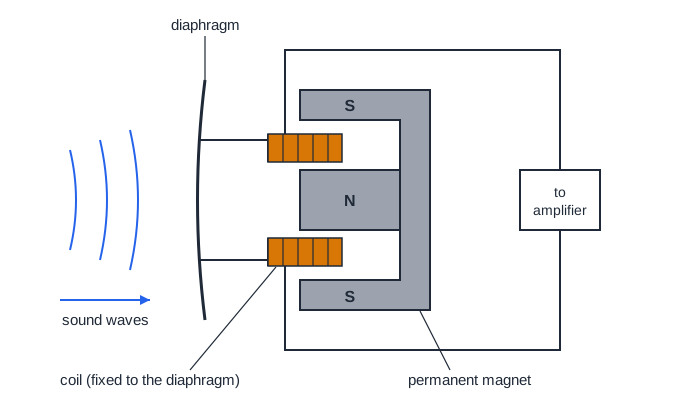
The diagram shows a cross-section of a moving-coil microphone. The coil is fixed to the back of a thin diaphragm and sits in the magnetic field of a permanent magnet.

Explain how the microphone converts the pressure variations in a sound wave into an alternating current in the wires to the amplifier.

Cross-section of a moving-coil microphone. Sound waves, shown as curved lines with an arrow, arrive from the left at a thin curved diaphragm. A coil, labelled coil (fixed to the diaphragm), is joined to the back of the diaphragm and sits in a gap in a permanent magnet: between a central pole marked N and outer pole pieces marked S. Wires from the coil go to a box labelled to amplifier.

Model answer

The compressions and rarefactions of the sound wave push the diaphragm in and out, so it vibrates. The coil is fixed to the diaphragm, so it moves backwards and forwards with it, in the magnetic field of the permanent magnet. As the coil moves, its wire cuts the magnetic field lines, so a potential difference is induced across the coil and a current passes in the wires to the amplifier. Each time the diaphragm changes direction the coil moves the other way, so the induced current reverses: it is an alternating current that varies in step with the pressure variations of the sound.

Explanation

A moving-coil microphone is a tiny generator: the sound wave makes the coil move relative to the magnet, and electromagnetic induction produces a current. Because the coil moves backwards and forwards, the current alternates with the same frequency as the sound, and its size follows the size of the pressure variations. A common error is to say the microphone uses the motor effect, which is how a loudspeaker works.

Mark scheme
  1. 1 mark

    the pressure variations (compressions and rarefactions) push the diaphragm in and out / make the diaphragm vibrate (1)

    An explanation linking the four points. Accept 'the sound waves make the diaphragm vibrate'. Do not accept 'the sound wave hits the magnet'.

  2. 1 mark

    the coil moves backwards and forwards with the diaphragm, in the magnetic field of the magnet / relative to the magnet (1)

    Accept 'the coil vibrates in the magnetic field'.

  3. 1 mark

    the wire of the coil cuts the magnetic field lines / the field through the coil changes, so a p.d. is induced across the coil (and a current in the circuit) (1)

    Accept 'electromagnetic induction produces a current'. Do not accept 'the motor effect' for this point; an answer that says the motor effect produces the current does not score this point.

  4. 1 mark

    each time the diaphragm changes direction, the coil's movement reverses, so the induced p.d. / current reverses: the current alternates (in step with the pressure variations) (1)

    Accept 'the current varies in the same way as the pressure of the sound wave' or 'the current has the same frequency as the sound'. Ignore 'the current is amplified'.

Ready to try the rest? Every answer you write is marked against the mark scheme, so you can see exactly where the marks are.

Study Helper Hints first, answers after you try

Stuck on this one? Ask for a hint and I’ll point you in the right direction, without giving the answer away. Once you’ve checked your answer, I’ll show you how the marks are awarded.