
Level:
Correct: 0
Incorrect: 0
Marks: 0/0
Exam Practice
Course:
Topics:
Edexcel GCSE Physics (Paper 2) Smart practice A mixed round aimed at your weak spots
Unit 1
Key concepts of physics
Unit 8
Energy - forces doing work
Unit 9
Forces and their effects
Unit 10
Electricity and circuits
Unit 11
Static electricity
Unit 12
Magnetism and the motor effect
Unit 13
Electromagnetic induction
Unit 14
Particle model
Unit 15
Forces and matter
Avg
score:
–
Topics
done:
0/34

Power and efficiency

Practise 16 exam-style questions on Power and efficiency for Edexcel GCSE Physics (Paper 2). Write your answer as you would in the exam and get it marked in seconds against the mark scheme, point by point, with the Study Helper on hand if you get stuck.

  • 16 questions
  • 1–6 marks each
  • Instant marking
  • No sign-up needed
16 questions, marked as you go

Sample questions with model answers

Here are 4 of the questions in this topic, each with a model answer, an explanation of why it earns the marks and the mark scheme an examiner would use.

Question 1

1 mark

Energy is supplied to an electric motor at a rate of 400 W. The motor wastes energy at a rate of 100 W.

What is the efficiency of the motor?

Choose your answer.

  • A 0.25
  • B 0.75
  • C 1.33
  • D 4.0

Model answer

B - 0.75.

Explanation

In each second the motor is supplied with 400 J and wastes 100 J, so 300 J is useful and the efficiency is 300 ÷ 400 = 0.75. Because the powers apply to the same time, the efficiency can be worked out from the useful power and the total power supplied. Watch for answers greater than 1, which come from dividing the wrong way round.

Mark scheme
  1. 1 mark

    B / 0.75 (1)

    The only correct answer is B: each second 400 J is supplied and 100 J is wasted, so 300 J is transferred usefully; efficiency = useful energy transferred ÷ total energy supplied = 300 ÷ 400 = 0.75. A is not correct because 100 ÷ 400 = 0.25 is the fraction of the energy supplied that is wasted. C is not correct because 400 ÷ 300 is the efficiency fraction inverted, and an efficiency can never be greater than 1. D is not correct because 400 ÷ 100 compares the energy supplied with the energy wasted. Accept the letter or the option. If more than one option is given, do not award the mark.
Question 2

2 marks

An LED lamp in a living room is switched on for an evening. Some of the energy supplied to the lamp is transferred by light, and the rest heats the lamp.

Explain why, eventually, all of the energy supplied to the lamp is stored in a less useful way.

Model answer

The light from the lamp is absorbed by the walls, the furniture and other objects in the room, which increases their thermal energy store. So in the end all of the energy supplied, both the light and the energy that heated the lamp, is dissipated: it is spread out in the thermal store of the surroundings, which warm up only very slightly, so it cannot easily be used to do anything useful.

Explanation

In every system change some energy is dissipated, and here even the useful output, light, ends up heating the surroundings once it is absorbed. Energy that is spread thinly through the surroundings raises their temperature by a tiny amount, so it is stored in a less useful way. Energy is never destroyed: say where it ends up.

Mark scheme
  1. 1 mark

    the light is absorbed by the walls / furniture / objects in the room, so it heats them / increases their thermal energy store (1)

    An explanation linking two points. Accept 'the light ends up heating the room'. Accept heat for thermal energy. Ignore 'LEDs are efficient' (not relevant to where the energy ends up).

  2. 1 mark

    so all the energy (from the light and from the warm lamp) is dissipated / spread out in the thermal energy store of the surroundings, raising their temperature only slightly, so it cannot easily be used to do anything useful (1)

    Accept 'the energy is spread thinly through the room / surroundings'. Do not accept 'the energy is used up / destroyed', or 'energy is lost' without saying where it goes.

Question 3

3 marks

A shop sells an electric panel heater and an electric desk fan. The label on the heater says that it is 'almost 100% efficient'.

Explain why an electric heater can have an efficiency close to 100% but an electric fan cannot.

Model answer

The job of a heater is to heat the room, so its useful energy transfer is to the thermal energy store of the room. Almost all of the energy supplied to the heater ends up heating the room, so very little is wasted and its efficiency is close to 100%. The job of a fan is to move air, so only the kinetic energy of the air is useful. Some of the energy supplied is wasted heating the motor, because of friction and the current in its coils, and some is transferred by sound, so a smaller fraction of the energy supplied is useful.

Explanation

Efficiency depends on what the useful output is. For a heater the useful output is heating, which is where nearly all the energy supplied ends up, so it is almost 100% efficient. For a fan, heating is a wasted transfer, so the fan's efficiency is lower. Weak answers just say the heater 'doesn't waste energy' without saying why.

Mark scheme
  1. 1 mark

    the useful energy transfer of the heater is heating the room / transferring energy to the thermal energy store of the room (1)

    An explanation linking three points. Accept heat for thermal energy.

  2. 1 mark

    (almost) all of the energy supplied to the heater ends up heating the room / very little is transferred in any other way, so (almost) none is wasted (1)

    Accept 'any light or sound it gives out also ends up heating the room'. Do not accept 'the heater does not waste energy' with no reason.

  3. 1 mark

    the useful energy of the fan is (only) the kinetic energy (store) of the moving air, but some energy is wasted heating the motor / by friction in the motor / by sound, so a smaller fraction of the energy supplied is useful (1)

    Both the useful output and a wasted transfer are needed for this mark. Accept 'the fan's motor gets warm, which is not useful'. Ignore 'the fan has moving parts' unless linked to friction or heating.

Question 4

5 marks

An engineer tests three electric scooters, A, B and C. Each scooter carries the same rider up the same hill at a steady speed. The total mass of the rider and scooter is 85 kg, and the top of the hill is 16 m higher than the bottom.

The useful energy transferred is the increase in the gravitational potential energy store of the rider and scooter.

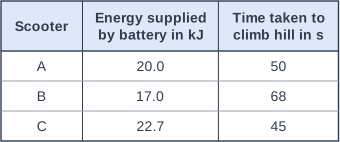
The table shows the energy supplied by each scooter's battery and the time taken to climb the hill.

Joe says, 'Scooter C is the most powerful, so it must also be the most efficient.'

Use the data to evaluate Joe's statement.

(g = 10 N/kg)

Table with columns "Scooter", "Energy supplied by battery in kJ", "Time taken to climb hill in s". Scooter: A; Energy supplied by battery in kJ: 20.0; Time taken to climb hill in s: 50 | Scooter: B; Energy supplied by battery in kJ: 17.0; Time taken to climb hill in s: 68 | Scooter: C; Energy supplied by battery in kJ: 22.7; Time taken to climb hill in s: 45.

Model answer

useful energy for each scooter = ΔGPE = 85 × 10 × 16 = 13 600 J
efficiency: A = 13 600 ÷ 20 000 = 0.68; B = 13 600 ÷ 17 000 = 0.80; C = 13 600 ÷ 22 700 = 0.60
power supplied: A = 20 000 ÷ 50 = 400 W; B = 17 000 ÷ 68 = 250 W; C = 22 700 ÷ 45 = 504 W
Joe is right that C is the most powerful, because it transfers energy at the greatest rate (504 W). But he is wrong that it must be the most efficient: C is the least efficient (0.60) and B, the least powerful, is the most efficient (0.80). C climbs the hill fastest, so more work is done against air resistance and more energy is dissipated for the same useful energy. Power and efficiency are different quantities.

Explanation

Power is how fast energy is transferred; efficiency is the fraction of the energy supplied that is useful. All three scooters transfer the same useful energy, 13 600 J, so the one that needs the least energy from its battery (B) is the most efficient, while C, which climbs fastest and is the most powerful, wastes the most. A good evaluation uses calculated values for both quantities before reaching a conclusion.

Mark scheme
  1. 1 mark

    (ΔGPE =) 85 × 10 × 16 = 13 600 (J) (1)

    Any five from the six points; max 5. Accept 13.6 kJ.

  2. 1 mark

    efficiency of one scooter calculated correctly, e.g. A: 13 600 ÷ 20 000 = 0.68 (1)

    Allow ecf from the student's ΔGPE. Accept percentages. Also accept, for this mark and the next, the reasoning that the useful energy is the same (13 600 J) for all three scooters, so the scooter supplied with the least energy is the most efficient.

  3. 1 mark

    B is the most efficient (0.80) and C is the least efficient (0.60) (1)

    Accept C: 13 600 ÷ 22 700 = 0.599 / 0.6; B: 13 600 ÷ 17 000 = 0.8. Accept 'B needs the least energy (17.0 kJ) and C the most (22.7 kJ) for the same useful energy'. Accept energy wasted A 6400 J, B 3400 J, C 9100 J, so C wastes the most.

  4. 1 mark

    power of C = 22 700 ÷ 45 = 504 (W), greater than A (400 W) and B (250 W), so C is the most powerful (1)

    Accept useful power output instead: C 13 600 ÷ 45 = 302 W, A 272 W, B 200 W. Accept 'C transfers the energy in the shortest time and its battery supplies the most energy, so its power is greatest'.

  5. 1 mark

    conclusion: Joe is right that C is the most powerful but wrong that it is the most efficient / C is the least efficient, because power (rate of energy transfer) and efficiency (fraction of the energy supplied that is useful) are different (1)

    The conclusion must be supported by at least one power and one efficiency (or energy comparison). Allow a conclusion that is consistent with the student's own calculated values (ecf).

  6. 1 mark

    suggested reason: C climbs fastest, so the air resistance on it is greatest / more energy is dissipated heating the air (and the motor) for the same useful energy (1)

    Accept 'C's motor and battery get hotter, wasting more energy'. Do not accept 'C uses more energy because it is more powerful' with no idea of energy being wasted.

Ready to try the rest? Every answer you write is marked against the mark scheme, so you can see exactly where the marks are.

Study Helper Hints first, answers after you try

Stuck on this one? Ask for a hint and I’ll point you in the right direction, without giving the answer away. Once you’ve checked your answer, I’ll show you how the marks are awarded.