
Level:
Correct: 0
Incorrect: 0
Marks: 0/0
Exam Practice
Course:
Topics:
Edexcel GCSE Physics (Paper 2) Smart practice A mixed round aimed at your weak spots
Unit 1
Key concepts of physics
Unit 8
Energy - forces doing work
Unit 9
Forces and their effects
Unit 10
Electricity and circuits
Unit 11
Static electricity
Unit 12
Magnetism and the motor effect
Unit 13
Electromagnetic induction
Unit 14
Particle model
Unit 15
Forces and matter
Avg
score:
–
Topics
done:
0/34

Induced potential difference and transformers

Practise 15 exam-style questions on Induced potential difference and transformers for Edexcel GCSE Physics (Paper 2). Write your answer as you would in the exam and get it marked in seconds against the mark scheme, point by point, with the Study Helper on hand if you get stuck.

  • 15 questions
  • 1–6 marks each
  • Instant marking
  • No sign-up needed
15 questions, marked as you go

Sample questions with model answers

Here are 4 of the questions in this topic, each with a model answer, an explanation of why it earns the marks and the mark scheme an examiner would use.

Question 1

1 mark

When the north pole of a bar magnet is pushed into a coil, the needle of a centre-zero ammeter connected to the coil moves to the right.

Which of these would also make the needle move to the right?

Choose your answer.

  • A pulling the north pole out
  • B pushing the south pole in
  • C pulling the south pole out
  • D holding the north pole still in it

Model answer

C - pulling the south pole out.

Explanation

The direction of the induced current depends on the direction of movement and on which pole is used (the direction of the magnetic field). Changing one of them reverses the current, but changing both cancels out, so pulling the south pole out gives the same direction as pushing the north pole in. A common error is to choose A or B, each of which reverses the current.

Mark scheme
  1. 1 mark

    C / pulling the south pole out (1)

    The only correct answer is C: reversing the direction of movement reverses the induced current, and so does reversing the pole (the direction of the magnetic field); making both changes together gives the original direction. A is not correct because only the direction of movement is reversed, so the needle moves to the left. B is not correct because only the pole is reversed, so the needle moves to the left. D is not correct because there is no movement, so no current is induced and the needle stays at zero. Accept the letter or the option. If more than one option is given, do not award the mark.
Question 2

2 marks

A straight copper wire is held between the poles of a horseshoe magnet. The ends of the wire are connected to a sensitive centre-zero ammeter. When the wire is moved quickly downwards between the poles, the needle moves to the left.

State two different ways of making the needle move to the right, using the same apparatus.

Model answer

1. Move the wire upwards between the poles instead of downwards.
2. Turn the magnet round so that the north and south poles swap sides, then move the wire downwards as before.

Explanation

The direction of an induced current reverses if the direction of movement is reversed or if the magnetic field is reversed. Doing both at once gives the original direction again, so each change must be made on its own. Changing the speed only changes the size of the current.

Mark scheme
  1. 1 mark

    move the wire upwards (between the poles) (1)

    Accept 'move the wire in the opposite direction'. Accept 'move the magnet downwards while holding the wire still' (the relative movement is reversed). Do not accept 'move the wire faster' or 'move the wire more slowly' (this changes the size of the current, not its direction).

  2. 1 mark

    reverse the magnetic field / turn the magnet round so that the poles are swapped (and move the wire downwards again) (1)

    Accept 'swap the positions of the north and south poles'. If one way reverses both the movement and the field together (e.g. 'turn the magnet round and move the wire upwards'), that way scores 0, because the needle would move to the left again.

Question 3

3 marks

Ellie quickly pushes a strong bar magnet into a coil of wire, first with the two ends of the coil joined together by a short wire, and then with the two ends not joined.

With the ends joined, she feels a force opposing the movement of the magnet. With the ends not joined, she feels almost no force.

Explain this difference.

Model answer

In both cases the magnetic field through the coil changes, so a potential difference is induced. When the ends are joined, the circuit is complete, so there is an induced current. This current produces a magnetic field that opposes the movement of the magnet, so Ellie must push against a force and do work, which is transferred to electrical energy and then heats the coil. When the ends are not joined there is no current, so the coil produces no magnetic field and there is no opposing force.

Explanation

An induced p.d. needs only a changing magnetic field, but an induced current also needs a complete circuit. It is the magnetic field of the induced current that opposes the change, so with the ends not joined there is no current, no field and no opposing force. A common error is to say that no p.d. is induced in the coil when its ends are not joined.

Mark scheme
  1. 1 mark

    a potential difference is induced in the coil in both cases (because the magnetic field through it changes) (1)

    An explanation linking any three from the five points; max 3. Do not accept 'no p.d. is induced when the ends are not joined' (a p.d. is still induced; there is just no current): this statement contradicts MP1, so MP1 is not awarded, but other points may still score.

  2. 1 mark

    only when the ends are joined is there a complete circuit, so a current is induced (1)

    Accept 'with the ends not joined there is no current because the circuit is not complete'.

  3. 1 mark

    the induced current produces a magnetic field that opposes the movement of the magnet / repels the magnet (1)

    Accept 'the end of the coil nearest the magnet becomes the same pole as the magnet, so it repels it'.

  4. 1 mark

    with no current, the coil produces no magnetic field, so there is no opposing force (1)

  5. 1 mark

    with the ends joined, the work Ellie does is transferred to electrical energy (which heats the coil); with no current, no energy is transferred, so (almost) no work is needed (1)

    Accept 'energy is conserved, so energy can only be transferred to the coil if Ellie does work against a force'.

Question 4

4 marks

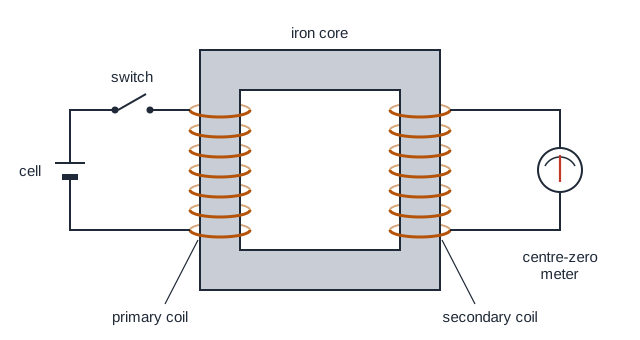
The diagram shows two coils wound on an iron core. The primary coil is connected to a cell and a switch. The secondary coil is connected to a centre-zero meter.

When the switch is closed, the needle of the meter flicks to the right and then returns to zero, even though the switch stays closed. When the switch is opened again, the needle flicks briefly to the left.

Explain these observations.

Two coils on a square, ring-shaped iron core. The coil labelled primary coil, on the left side of the core, is connected in a circuit with a cell and an open switch. The coil labelled secondary coil, on the right side of the core, is connected to a centre-zero meter whose needle points straight up.

Model answer

When the switch is closed, the current in the primary coil rises quickly from zero to its steady value, so the magnetic field in the iron core increases. This changing field passes through the secondary coil and induces a p.d., so a current passes briefly through the meter and the needle flicks. Once the current from the cell is steady, the magnetic field is constant, so no p.d. is induced and the needle returns to zero. When the switch is opened, the current and the field fall to zero. The field is now decreasing, a change in the opposite direction, so the induced current is in the opposite direction and the needle flicks to the left.

Explanation

Only a changing magnetic field induces a p.d. in the secondary coil. Switching a direct current on or off changes the field for a moment, but a steady direct current gives a steady field, which is why a transformer needs an alternating supply to work continuously. An increasing field and a decreasing field induce p.d.s in opposite directions.

Mark scheme
  1. 1 mark

    when the switch is closed, the current in the primary coil increases (from zero), so the magnetic field (in the core) increases / changes (1)

    An explanation linking the four points.

  2. 1 mark

    the changing magnetic field through the secondary coil induces a p.d. / a current (in the secondary coil), so the needle flicks (1)

    Do not accept 'current from the cell passes through the core to the meter'.

  3. 1 mark

    once the current (from the cell) is steady, the magnetic field is constant / not changing, so no p.d. is induced and the reading returns to zero (1)

    Accept 'a direct current produces a steady field, which does not induce a p.d.'.

  4. 1 mark

    when the switch is opened, the magnetic field decreases (to zero), a change in the opposite direction, so the induced p.d. / current is in the opposite direction (1)

    Accept 'the field collapses, so the current is induced the other way'. The reversal must be linked to the field decreasing instead of increasing.

Ready to try the rest? Every answer you write is marked against the mark scheme, so you can see exactly where the marks are.

Study Helper Hints first, answers after you try

Stuck on this one? Ask for a hint and I’ll point you in the right direction, without giving the answer away. Once you’ve checked your answer, I’ll show you how the marks are awarded.