
Level:
Correct: 0
Incorrect: 0
Marks: 0/0
Exam Practice
Course:
Topics:
Edexcel GCSE Physics (Paper 2) Smart practice A mixed round aimed at your weak spots
Unit 1
Key concepts of physics
Unit 8
Energy - forces doing work
Unit 9
Forces and their effects
Unit 10
Electricity and circuits
Unit 11
Static electricity
Unit 12
Magnetism and the motor effect
Unit 13
Electromagnetic induction
Unit 14
Particle model
Unit 15
Forces and matter
Avg
score:
–
Topics
done:
0/34

Gas pressure, volume and doing work on a gas

Practise 16 exam-style questions on Gas pressure, volume and doing work on a gas for Edexcel GCSE Physics (Paper 2). Write your answer as you would in the exam and get it marked in seconds against the mark scheme, point by point, with the Study Helper on hand if you get stuck.

  • 16 questions
  • 1–6 marks each
  • Instant marking
  • No sign-up needed
16 questions, marked as you go

Sample questions with model answers

Here are 4 of the questions in this topic, each with a model answer, an explanation of why it earns the marks and the mark scheme an examiner would use.

Question 1

1 mark

The equation P₁ × V₁ = P₂ × V₂ can be used to calculate the pressure or volume of a gas only in some situations.

For which of these situations can the equation be used?

Choose your answer.

  • A sealed syringe squeezed slowly
  • B gas heated in a sealed rigid can
  • C a bicycle tyre being pumped up
  • D air leaking out of a balloon

Model answer

A - sealed syringe squeezed slowly.

Explanation

P₁ × V₁ = P₂ × V₂ only applies to a fixed mass of gas at a constant temperature. A sealed syringe keeps the mass fixed, and squeezing it slowly keeps the temperature steady. Heating changes the temperature, and pumping air in or letting it leak out changes the mass, so the equation cannot be used for B, C or D.

Mark scheme
  1. 1 mark

    A / sealed syringe squeezed slowly (1)

    The only correct answer is A: the equation applies only to a fixed mass of gas at constant temperature; in a sealed syringe no air gets in or out, and squeezing it slowly gives time for energy to be transferred to the surroundings, so the temperature stays (almost) the same. B is not correct because the temperature of the gas changes, so its pressure changes even though its volume does not, and P × V does not stay the same. C is not correct because air is being added to the tyre, so the mass of gas is not fixed (pumping also warms the air). D is not correct because air is escaping, so the mass of gas is not fixed. Accept the letter or the option. If more than one option is given, do not award the mark.
Question 2

2 marks

A steel tank with a volume of 0.042 m³ contains nitrogen gas at a pressure of 225 kPa. It is joined by a short pipe with a closed tap to a second tank, of volume 0.018 m³, from which all the air has been pumped out.

The tap is opened and the nitrogen expands to fill both tanks. The temperature of the nitrogen stays the same, and the volume of the pipe is so small that it can be ignored.

Show that the final pressure of the nitrogen is about 160 kPa.

Use the equation
P₁ × V₁ = P₂ × V₂

Model answer

After the tap is opened, the nitrogen fills both tanks:
V₂ = 0.042 + 0.018 = 0.060 m³

P₁ × V₁ = P₂ × V₂
225 × 0.042 = P₂ × 0.060
P₂ = 9.45 ÷ 0.060 = 157.5 kPa, which is about 160 kPa

Explanation

When the tap opens, the gas expands into the empty tank, so its new volume is the total volume of both tanks, 0.060 m³. With a larger volume at the same temperature, its particles hit the walls less often and the pressure falls in proportion: 225 × 0.042 ÷ 0.060 = 157.5 kPa. In a 'show that' question the working must be seen and the answer given more precisely than the value in the question.

Mark scheme
  1. 1 mark

    substitution using the total volume: 225 × 0.042 = P₂ × (0.042 + 0.018) / (P₂ =) 225 × 0.042 ÷ 0.060 (1)

    A correct answer with no working scores 0; the working must be seen. Using only the second tank's volume for V₂ (225 × 0.042 ÷ 0.018 = 525 kPa) is a wrong method and scores 0.

  2. 1 mark

    evaluation: (P₂ =) 157.5 (kPa) (1)

    the answer must be given to more significant figures than the value in the question: accept 157.5 / 158 (kPa) / 1.575 × 10⁵ Pa; do not accept 160 kPa on its own

Question 3

3 marks

A syringe contains 60 cm³ of air at a pressure of 100 kPa. The density of this air is 1.2 kg/m³.

Jamal blocks the end of the syringe so that no air can escape. He pushes the plunger in slowly until the pressure of the air is 250 kPa. The temperature of the air stays the same.

Calculate the density of the air at 250 kPa.

Use the equation
P₁ × V₁ = P₂ × V₂

Model answer

P₁ × V₁ = P₂ × V₂
100 × 60 = 250 × V₂
V₂ = 6000 ÷ 250 = 24 cm³

The mass of air does not change:
mass = density × volume = 1.2 × (60 × 10⁻⁶) = 7.2 × 10⁻⁵ kg

density = mass ÷ volume = 7.2 × 10⁻⁵ ÷ (24 × 10⁻⁶) = 3.0 kg/m³

Explanation

Compressing the air does not change its mass, so the same mass fills a smaller volume and the density increases. The volume falls from 60 cm³ to 24 cm³, a factor of 2.5, so the density rises by the same factor, from 1.2 kg/m³ to 3.0 kg/m³. A common slip is to mix cm³ and m³ when dividing the mass by the volume.

Mark scheme
  1. 1 mark

    substitution and rearrangement: (V₂ =) 100 × 60 ÷ 250 (= 24 cm³) (1)

    An answer of 3.0 kg/m³ with no working scores 3 marks. Alternative method: the mass is fixed, so the density is inversely proportional to the volume, and at constant temperature the volume is inversely proportional to the pressure, so (density =) 1.2 × 250 ÷ 100 = 3.0 kg/m³ scores all 3 marks. Award 2 marks for an answer with a power of ten error (e.g. 3.0 × 10⁻⁶ from a volume left in cm³).

  2. 1 mark

    the mass of air stays the same: (mass =) 1.2 × 60 × 10⁻⁶ = 7.2 × 10⁻⁵ (kg) / the density increases by the same factor as the volume decreases (60 ÷ 24 = 2.5) (1)

    density = mass ÷ volume must be recalled; accept the mass as 0.072 g; ecf from their V₂

  3. 1 mark

    evaluation: (density =) 3.0 (kg/m³) (1)

    accept 3 (kg/m³); ecf from an arithmetic slip in V₂; an answer of 0.48 kg/m³ (the density made smaller instead of larger, 1.2 × 24 ÷ 60) is a wrong method and scores MP1 only, if V₂ = 24 cm³ is seen

Question 4

5 marks

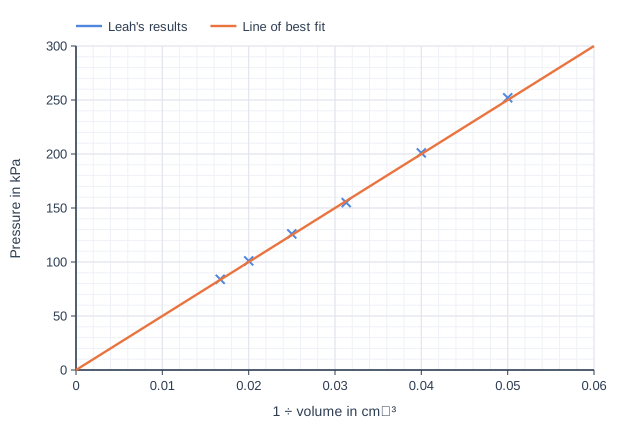
Leah investigates how the pressure of a sample of nitrogen depends on its volume. The nitrogen is trapped in a cylinder by a gas-tight piston, and the cylinder stands in a water bath that keeps its temperature constant. A pressure sensor measures the pressure of the nitrogen.

Leah moves the piston to change the volume in steps. She plots the pressure against 1 ÷ volume and draws a straight line of best fit. The graph shows her results and her line.

Explain how the graph shows that P₁ × V₁ = P₂ × V₂ for the nitrogen.

Use the gradient of the line to determine the volume of the nitrogen when its pressure is 180 kPa.

Line graph of pressure in kPa (y-axis, 0 to 300) against 1 ÷ volume in cm⁻³ (x-axis, 0 to 0.06). "Leah's results" is shown as plotted points only (no line), at (0.0167, 84), (0.02, 101), (0.025, 126), (0.0313, 155), (0.04, 201), (0.05, 252). "Line of best fit" joins the points (0, 0), (0.06, 300).

Model answer

The graph of pressure against 1 ÷ volume is a straight line through the origin, so the pressure is directly proportional to 1 ÷ volume: the pressure is inversely proportional to the volume. This means that pressure × volume is the same for every result (it equals the gradient of the line), which is what P₁ × V₁ = P₂ × V₂ says.

Gradient of the line of best fit = 300 ÷ 0.060 = 5000 kPa cm³, so P × V = 5000 kPa cm³.

At 180 kPa: V = 5000 ÷ 180 = 28 cm³.

Explanation

If P × V is constant, then P = constant × (1 ÷ V), so a graph of P against 1 ÷ V is a straight line through the origin whose gradient is P × V. Reading the gradient over a large part of the line gives P × V = 5000 kPa cm³, and dividing by 180 kPa gives the volume. Common errors are stopping at 1 ÷ V (0.036) instead of inverting it, and describing the line as straight without saying that it passes through the origin.

Mark scheme
  1. 1 mark

    the graph is a straight line through the origin (1)

    An answer of 28 cm³ with no working scores marking points 3, 4 and 5. Accept 'the pressure is directly proportional to 1 ÷ volume'. Do not accept 'a straight line' with no reference to the origin, or 'the pressure is proportional to the volume'.

  2. 1 mark

    so the pressure is inversely proportional to the volume / pressure × volume is constant (it is the gradient), so P₁ × V₁ = P₂ × V₂ (1)

    Accept 'P = gradient × (1 ÷ V), so P × V = gradient, the same for every point'. Accept a correct calculation of P × V for two points on the line, shown to be equal.

  3. 1 mark

    gradient of the line of best fit, e.g. 300 ÷ 0.060 = 5000 (kPa cm³) (1)

    Accept 4900 to 5100, from any two points read from the line. Accept P × V for one point on the line, e.g. 250 × 20 = 5000. Alternative method for marking points 3 and 4: reading 1 ÷ V at 180 kPa from the line (0.036 cm⁻³) and inverting it, V = 1 ÷ 0.036.

  4. 1 mark

    (V = gradient ÷ P =) 5000 ÷ 180 (1)

    allow ecf from their gradient. Accept 180 × V = 5000.

  5. 1 mark

    28 (cm³) (1)

    Accept 27 to 29 cm³ (from a gradient of 4900 to 5100, or from reading the graph). An answer of 0.036 (the value of 1 ÷ V, not inverted) scores marking point 3 only. allow ecf from their gradient.

Ready to try the rest? Every answer you write is marked against the mark scheme, so you can see exactly where the marks are.

Study Helper Hints first, answers after you try

Stuck on this one? Ask for a hint and I’ll point you in the right direction, without giving the answer away. Once you’ve checked your answer, I’ll show you how the marks are awarded.