Level:
Correct: 0
Incorrect: 0
Marks: 0/0

The purpose and nature of businesses

Practise 17 exam-style questions on The purpose and nature of businesses for AQA GCSE Business (Paper 2). Write your answer as you would in the exam and get it marked in seconds against the mark scheme, point by point, with the Study Helper on hand if you get stuck.

  • 17 questions
  • 1–12 marks each
  • Instant marking
  • No sign-up needed
17 questions, marked as you go

Sample questions with model answers

Here are 4 of the questions in this topic, each with a model answer, an explanation of why it earns the marks and the mark scheme an examiner would use.

Question 1

1 mark

A clothing retailer has £20 000 left in its marketing budget. It chooses to spend the money on a television advert instead of a social media campaign.

What is the opportunity cost of this decision?

Choose your answer.

  • The £20 000 spent on the television advert
  • The social media campaign that was not chosen
  • The extra sales revenue from the television advert
  • The profit left after paying for the advert

Model answer

The social media campaign that was not chosen

Explanation

Opportunity cost is the next best alternative given up when a choice is made. Because the retailer can only spend its £20 000 once, choosing the television advert means giving up the social media campaign and the benefits it would have brought. The most common mistake is to think the opportunity cost is the money spent, but the £20 000 is the cost of the advert, not what was given up.

Mark scheme
  1. 1 mark

    The social media campaign that was not chosen

    If more than one option is given, 0 marks.

Question 2

2 marks

Explain one reason why a business that sells wants, rather than needs, may see its sales fall when its customers' incomes fall.

Model answer

Wants are not essential for survival, unlike needs such as food and heating. When customers' incomes fall they must still pay for their needs, so they cut back on or delay buying wants first, which means the business's sales fall.

Explanation

The reason must use the difference between needs and wants: needs must still be bought, but wants are non-essential, so they are the first spending customers cut. Then explain the effect on the business, such as falling demand and lower sales revenue. Saying only that customers have less money does not explain why a business selling wants is hit harder.

Mark scheme
  1. 1 mark

    Identifies a reason: wants are not essential / are luxuries that people can live without / customers must still pay for needs such as food, housing and heating first / customers have less money left after paying for essentials

    Do not accept 'customers have less money' on its own: the reason must show why wants are affected more than needs. Do not credit a definition of a need or a want on its own unless it is used to explain why sales of wants fall.

  2. 1 mark

    Explains the consequence: so customers cut back on or delay buying wants first, so demand for the business's products falls / its sales revenue falls

    Examples of developed answers: Wants are not essential for survival (1), so when incomes fall customers stop buying them before they cut back on food or bills, which reduces the business's sales (1). Customers must keep paying for needs such as housing and food (1), so they have less money left to spend on wants and demand for them falls (1).

Question 3

4 marks

Item A
Kemi's Pantry

Kemi worked for six years as a sales assistant in a department store in Leicester, earning a salary of £21 500 a year. She enjoyed talking to customers, but her shifts were set by her manager and she had no say in how the store was run. Kemi had always cooked West African dishes at home, and she noticed that local supermarkets sold very few West African spice blends.

In 2024 Kemi left her job and used £8 000 of her savings to start Kemi's Pantry as a sole trader. She had been saving the money for a deposit on a flat. She rents a small kitchen unit where she mixes and packs her own spice blends, and she sells them at weekend food markets and through her own website. She often works 60 hours a week, testing new recipes in the evenings and packing online orders before the markets open.

Kemi keeps careful records of every sale and plans each week's production around the orders she expects. She has created eight blends, including a jollof rice mix and a suya pepper rub, which customers say they cannot find anywhere else. A local delicatessen has asked to stock two of her blends, and Kemi is designing new labels so that her jars stand out on its shelves.

Explain one characteristic of an entrepreneur that Kemi has shown. You should use the information in Item A in your answer.

Model answer

Kemi has shown that she is willing to take a risk. She left a secure job that paid her £21 500 a year and used £8 000 of savings that she had been keeping for a deposit on a flat. If Kemi's Pantry had failed, she could have lost this money and been left with no regular income. Taking the risk allowed her to use the opportunity she had spotted, because local supermarkets sold very few West African spice blends. So far the risk has paid off: her blends are popular enough that a local delicatessen wants to stock them, which should increase her sales further.

Explanation

To reach Level 2, name one characteristic and use specific evidence from Item A, such as the £8 000 of savings or the 60-hour weeks, to explain how it has affected Kemi or her business. Listing several characteristics without explaining any of them, or describing entrepreneurs in general, stays in Level 1. Hard working, innovative, organised and willing to take a risk can all be supported from the item.

Mark scheme
  1. 4 marks

    Levels of response (4 marks). AO1 = 2, AO2 = 2.
    Level 2 (3-4 marks): Sound understanding and application of the topics. Applies knowledge and understanding to the context sufficiently. A sound understanding of one or more business concepts and issues.
    Level 1 (1-2 marks): Basic understanding and application of the topics. Applies basic knowledge and understanding to the context. A basic understanding of one or more business concepts.
    0 marks: nothing to reward.

    Indicative content (not a checklist; credit other valid points): Application (evidence from Item A):
    - Willing to take a risk: she left a secure job paying £21 500 a year and used £8 000 of savings she had been keeping for a flat deposit.
    - Hard working: she often works 60 hours a week, testing recipes in the evenings and packing online orders before the markets open.
    - Innovative: she has created eight blends that customers say they cannot find anywhere else; she spotted that local supermarkets sold very few West African spice blends; she is designing new labels so her jars stand out.
    - Organised: she keeps careful records of every sale and plans each week's production around the orders she expects.
    Analysis (examples): because she was willing to risk her savings and give up her salary she could take the opportunity of a gap in the market, but if the business failed she could lose the £8 000 and her flat deposit; her innovative blends give her products rivals do not sell, so customers return and the delicatessen wants to stock them, increasing sales; planning production around expected orders means she wastes fewer ingredients and does not run out of stock at markets, keeping costs down; her long hours allow her to sell both at markets and online.
    Level 2 (3-4 marks): one characteristic is identified and its effect on Kemi or her business is explained using evidence from Item A. Level 1 (1-2 marks): a characteristic is identified or described with little or no use of Item A. An answer not applied to Kemi's Pantry cannot go above Level 1. Only one characteristic needs to be explained; if several are given, credit the best.

Question 4

9 marks

Item C
Paper Lantern Cards

Gethin owns Paper Lantern Cards, an independent card and gift shop on a busy shopping street in Swansea. Most of the shop's sales revenue comes from greeting cards, which it buys from suppliers and sells at an average price of £3.50 each.

The business environment around the shop has changed quickly. More people now send birthday messages by phone or on social media, and large online companies let customers design a personalised card, which they print and post for them. Higher prices for food and energy also mean that many of Gethin's customers have less money to spend on gifts.

Customers' environmental expectations are changing too. Several regular customers have complained that most of the shop's cards are wrapped in plastic film and decorated with plastic glitter. Gethin has found a supplier of plastic-free cards made from recycled card, but they cost the shop 9p more per card than his current range. A rival shop nearby now promotes itself as 'plastic-free', and the local newspaper wrote an article about it last month.

Gethin is considering spending £6 500 on a website on which customers could design their own personalised cards. The shop would print the cards on a new printer and post them, charging £4.25 a card plus postage. A web designer has warned Gethin that online sales take time to build, and that he would need to pay for online advertising to compete with the large online card companies. Gethin already works six days a week in the shop.

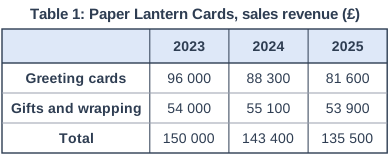
Table 1 shows the shop's sales revenue for the last three years.

Recommend whether Gethin should spend £6 500 on a website to sell personalised cards online.

Give reasons for your recommendation.

Table 1: Paper Lantern Cards, sales revenue (£). Table with columns (row headings), "2023", "2024", "2025". Greeting cards; 2023: 96 000; 2024: 88 300; 2025: 81 600 | Gifts and wrapping; 2023: 54 000; 2024: 55 100; 2025: 53 900 | Total; 2023: 150 000; 2024: 143 400; 2025: 135 500.

Model answer

I recommend that Gethin should spend the £6 500 on the website, as long as he also plans for the advertising and the time it will need.

The main reason is that technology has changed how people buy cards. Table 1 shows that card revenue has fallen every year, from £96 000 in 2023 to £81 600 in 2025, a fall of 15%, while gifts and wrapping have stayed at about £54 000. More people send messages by phone, and large online companies let customers design a personalised card that is posted for them. If Gethin only sells through the shop, his card sales are likely to keep falling, and total revenue has already dropped from £150 000 to £135 500. A website would let him reach customers outside Swansea and sell a personalised product at £4.25, more than his average shop price of £3.50, so each online sale brings in more revenue.

However, there are strong reasons against. The large online card companies are well known and spend heavily on advertising, and the web designer has warned that online sales take time to build. Gethin would need to sell about 1 500 cards just to bring in £6 500 of revenue, before paying for printing, postage and advertising. Customers also have less money to spend. Gethin already works six days a week, so designing, printing and posting orders could leave him no time to run the shop well unless he pays for extra staff, which would add to his costs.

On balance, I still recommend the website, because doing nothing means accepting a steady fall in his biggest source of revenue. Its success depends on whether he can make his cards different from the large companies, for example by offering plastic-free cards, which would also meet changing environmental expectations. If he cannot afford enough advertising, he should start with a simpler website and build it up as sales grow.

Explanation

Level 3 needs a clear recommendation backed by the case evidence: the falling card revenue in Table 1, the £4.25 online price, the £6 500 cost, the strong online competition and Gethin's lack of time. The best answers weigh both sides and say what the decision depends on before concluding. Answers that discuss websites in general without using the shop's figures cannot go above Level 2.

Mark scheme
  1. 9 marks

    Levels of response (9 marks). AO2 = 3, AO3 = 6.
    Level 3 (7-9 marks): Detailed analysis and evaluation of topics based on the context. Sustained line of reasoning, which is coherent, relevant, substantiated with a focused conclusion that is fully justified. Business areas are fully analysed. Applies knowledge and understanding to the context sufficiently.
    Level 2 (4-6 marks): Sound analysis and evaluation of topics based on the context. A line of reasoning, with a conclusion that has some justification. Business areas are partially analysed. Applies some knowledge and understanding to the context.
    Level 1 (1-3 marks): Basic analysis and evaluation of topics based on the context. Basic line of reasoning with a conclusion. Basic analysis of business areas. Basic knowledge and understanding is applied to the context.
    0 marks: nothing to reward.

    Indicative content (not a checklist; credit other valid points): Application (evidence from Item C and Table 1):
    - Greeting card revenue fell from £96 000 (2023) to £88 300 (2024) to £81 600 (2025), a fall of 15%; total revenue fell from £150 000 to £135 500 (about 9.7%); gifts and wrapping stayed at about £54 000.
    - More people send messages by phone or social media; large online companies print and post personalised cards.
    - Online cards would sell at £4.25 plus postage, compared with the shop's average of £3.50.
    - The website costs £6 500, plus a new printer and online advertising; online sales take time to build.
    - Gethin already works six days a week; customers have less money to spend.
    Analysis - for the website: technology has changed how people buy cards, so selling only in the shop means accepting a continuing fall in the biggest source of revenue; a website reaches customers far beyond Swansea; each online card brings in more revenue (£4.25 rather than £3.50); personalised cards respond to what customers now want.
    Analysis - against: the large online companies are well known with big advertising budgets, so Gethin may struggle to compete; he would need to sell about 1 500 cards just to bring in £6 500 of revenue, before paying for printing, postage and advertising; with no spare time, he may need to pay for staff, adding to costs; customers have less to spend; the opportunity cost of the £6 500 (for example switching to plastic-free cards to compete with the rival).
    Evaluation - what does it depend on? how much the advertising costs; whether Gethin can make his online cards different from the large companies (for example plastic-free or local designs); whether card sales in the shop keep falling at the same rate; whether he can find time or staff; whether he has the £6 500 without borrowing.
    Level 3 (7-9 marks) needs a recommendation that is fully justified using evidence from the case and Table 1, weighing both sides. Accept either recommendation, or a conditional one, if it is justified. A generic answer that does not use the case cannot go above Level 2, however well developed.

Ready to try the rest? Every answer you write is marked against the mark scheme, so you can see exactly where the marks are.

Study Helper Hints first, answers after you try

Stuck on this one? Ask for a hint and I’ll point you in the right direction, without giving the answer away. Once you’ve checked your answer, I’ll show you how the marks are awarded.