Level:
Correct: 0
Incorrect: 0
Marks: 0/0

The purpose and methods of market research

Practise 26 exam-style questions on The purpose and methods of market research for AQA GCSE Business (Paper 2). Write your answer as you would in the exam and get it marked in seconds against the mark scheme, point by point, with the Study Helper on hand if you get stuck.

  • 26 questions
  • 1–12 marks each
  • Instant marking
  • No sign-up needed
20 questions, marked as you go

Sample questions with model answers

Here are 4 of the questions in this topic, each with a model answer, an explanation of why it earns the marks and the mark scheme an examiner would use.

Question 1

1 mark

A business has annual sales of £2 million in a market where total annual sales are £16 million.

What is the business's market share?

Choose your answer.

  • 1.25%
  • 8%
  • 12.5%
  • 14%

Model answer

12.5%

Explanation

Market share = (sales of the business ÷ total market sales) × 100 = (2 ÷ 16) × 100 = 12.5%. The wrong options come from common slips: 1.25% puts the decimal point in the wrong place, 8% divides the market by the business's sales, and 14% subtracts instead of dividing. Always divide the business's sales by the total sales of the market.

Mark scheme
  1. 1 mark

    12.5%

    (£2 million ÷ £16 million) × 100 = 12.5%. If more than one option is given, 0 marks.

Question 2

2 marks

Explain how qualitative market research is different from quantitative market research.

Model answer

Qualitative research collects people's opinions, feelings and reasons, for example what customers in a focus group like or dislike about a product and why. Quantitative research collects numerical data that can be counted and analysed, for example the percentage of people in a survey who say they would buy the product.

Explanation

Qualitative data is about opinions and reasons, usually in words, while quantitative data is numbers that can be counted, compared and shown in charts. For the second mark the answer must make the comparison, not just describe one type. Saying 'qualitative is about quality and quantitative is about quantity' is too vague to earn marks.

Mark scheme
  1. 1 mark

    Qualitative research collects opinions, feelings, attitudes or reasons (eg why people buy a product), usually in words rather than numbers

    Accept a valid example, eg the views given in a focus group or answers to open questions.

  2. 1 mark

    whereas quantitative research collects numerical data / statistics that can be counted, measured, analysed or shown in charts

    This mark is for the comparison with quantitative research; the points may come in either order. Examples of developed answers: Qualitative research finds out people's opinions and reasons, such as why they like a product (1), whereas quantitative research produces numbers, such as the percentage of people who would buy it (1). Qualitative data is descriptive and is often collected in focus groups or interviews (1), but quantitative data is numerical and is often collected in large surveys (1). Do not accept 'qualitative is about quality and quantitative is about quantity' without further explanation.

Question 3

4 marks

Item B
Quill & Ink

Quill & Ink is an online business that sells notebooks, pens and art materials. It is a partnership run by Sam and Joy from a small warehouse in Northampton. Most orders are for small items costing less than £15 in total, and Quill & Ink charges £3.95 for delivery on every order. Delivery takes three to five working days. Several large online retailers offer free delivery on orders over £20.

Quill & Ink's sales grew quickly for three years, but growth slowed in 2025, and many customers who used to order regularly have stopped. The partners want to understand why.

The business has 8 000 customers who have agreed to receive emails. The partners plan to email all of them an online questionnaire with ten questions, mostly multiple-choice questions and ratings from 1 to 5, plus one open question: 'What one thing would make you shop with us more often?' Customers who complete it will receive a 10% discount code.

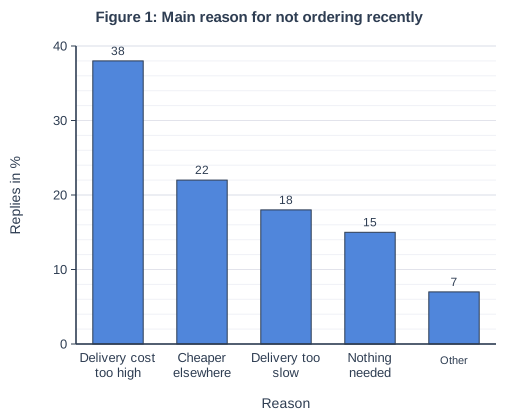
Last year the partners emailed a shorter questionnaire to 6 500 customers, and 780 replied. Figure 1 shows how the customers who had not ordered for six months answered the question 'What is the main reason you have not ordered from us recently?'

Explain one benefit to Quill & Ink of using an online questionnaire to research its customers. You should use the information in Item B in your answer.

Figure 1: Main reason for not ordering recently. Bar chart of replies in % for each reason: Delivery cost too high 38, Cheaper elsewhere 22, Delivery too slow 18, Nothing needed 15, Other 7.

Model answer

An online questionnaire is a cheap and quick way for Quill & Ink to reach all of its customers. The partners already have the email addresses of 8 000 customers who have agreed to receive emails, so they can send the questionnaire to all of them at almost no cost, with no printing, postage or interviewers. If about 12% reply, as happened last year, they would get around 960 responses, which is a large enough sample to show clear patterns. Because most questions are multiple-choice or 1 to 5 ratings, the answers can be counted and compared quickly, so Sam and Joy can find out why sales growth has slowed and act before more customers stop ordering.

Explanation

Level 2 answers apply the benefit to Quill & Ink's situation, for example its 8 000 email addresses, the 12% response rate last year or its mainly multiple-choice questions, and explain what this means for the business. Listing general benefits of questionnaires without using Item B stays in Level 1.

Mark scheme
  1. 4 marks

    Levels of response (4 marks). AO1 = 2, AO2 = 2.
    Level 2 (3-4 marks): Sound understanding and application of the topics. Applies knowledge and understanding to the context sufficiently. A sound understanding of one or more business concepts and issues.
    Level 1 (1-2 marks): Basic understanding and application of the topics. Applies basic knowledge and understanding to the context. A basic understanding of one or more business concepts.
    0 marks: nothing to reward.

    Indicative content (not a checklist; credit other valid points): Application: 8 000 customers have agreed to receive emails; ten questions, mostly multiple-choice and 1 to 5 ratings, plus one open question; a 10% discount code for completing it; last year 780 of 6 500 customers (12%) replied; it is an online business, so its customers already shop online; sales growth slowed in 2025 and many regular customers have stopped ordering. Possible benefits: cheap and quick to send to all 8 000 customers, with no printing, postage or interviewers, which suits a small partnership; it reaches the business's actual customers, so the results are relevant; a 12% response would give about 960 replies, a large sample; multiple-choice and rating questions give quantitative data that is easy to count and compare; the open question adds qualitative reasons; results come back quickly, so the partners can act on the slowdown before more customers are lost; the discount code may encourage replies and repeat orders. Level 2: a benefit is explained and applied to Quill & Ink, with a consequence for the business. Level 1: a basic benefit of questionnaires with little or no use of the case. An answer not applied to Quill & Ink cannot go above Level 1.

Question 4

9 marks

Item A
Spokeworks

Tomasz is a qualified bike mechanic who plans to start Spokeworks, a mobile bike repair service in York, as a sole trader. He would drive a fully equipped van to customers' homes and workplaces and repair bikes on the spot, so customers would not need to take their bikes to a shop. He has £9 000 of savings and would need a bank loan of £14 000 to buy and fit out the van.

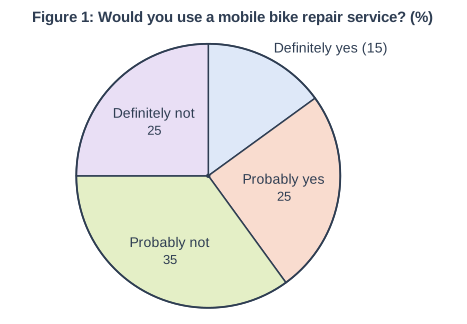
To find out whether there is enough demand, Tomasz carried out a questionnaire with 400 cyclists. He stopped people on cycle paths around the city and also asked members of his own cycling club. Figure 1 shows the answers to one question: 'Would you use a mobile bike repair service?'

Tomasz also carried out internet research. A report by a local cycling charity says that about 12 000 adults in the area ride a bike at least once a week. Tomasz expects each customer to spend an average of £45 a year with Spokeworks.

Many people who answered 'Probably not' or 'Definitely not' wrote that they already use one of the four bike shops in York, which all offer repairs, or that they repair their own bikes. Several people who answered 'Definitely yes' wrote that they would pay extra for a repair at their workplace, so that they would not have to take time off work. Tomasz estimates that his running costs in the first year, including fuel, parts, insurance and loan repayments, will be about £52 000.

Recommend whether Tomasz should start Spokeworks.

Give reasons for your recommendation. Use the market research findings in Item A to support your answer.

Figure 1: Would you use a mobile bike repair service? (%). Pie chart. A circle divided into sectors, drawn clockwise from the top (12 o'clock): Definitely yes (15 printed in it), 54°; Probably yes (25 printed in it), 90°; Probably not (35 printed in it), 126°; Definitely not (25 printed in it), 90°. (Angles are not printed on the chart; these are the drawn sizes, which can be measured with a protractor.)

Model answer

I recommend that Tomasz should start Spokeworks, but with care.

The market research suggests there is enough demand. Figure 1 shows that 15% of the 400 cyclists answered 'Definitely yes'. Applying this to the 12 000 adults who cycle every week in the area gives 1 800 customers, and at £45 each that is forecast revenue of £81 000 a year. This is well above the expected running costs of £52 000, which already include loan repayments, so Tomasz could make about £29 000 in the first year. The forecast is also cautious, because it ignores the further 25% who answered 'Probably yes'. The qualitative comments are useful too: several 'Definitely yes' customers would pay extra for repairs at their workplace, so Tomasz has found a clear target market of commuters and a unique selling point that the four bike shops in York cannot offer, because customers do not have to take time off work.

However, the findings may not be reliable. Part of the sample came from Tomasz's own cycling club, and these people may be keener cyclists than average or may want to support him, so the 15% could overstate demand. Saying 'Definitely yes' in a questionnaire is also not the same as paying for a repair. Most people surveyed (60%) said 'Probably not' or 'Definitely not', many because they already use a bike shop or repair their own bikes, so competition is strong. If revenue were a third lower than forecast, at about £54 000, Tomasz would only just cover his costs, and as a sole trader he would still have to repay the £14 000 loan.

On balance, the research is positive enough for Tomasz to go ahead, because even a cautious forecast covers his costs, and the workplace service gives him a clear advantage over the bike shops. The decision depends on how representative his sample was, so before buying the van he could check demand by contacting large employers in York to see whether they would book regular workplace repair days.

Explanation

Top-level answers use the research findings rather than just describing them: for example, calculating forecast revenue of £81 000 from Figure 1, comparing it with £52 000 of costs, and then questioning whether a sample that includes Tomasz's own cycling club is reliable. Any recommendation can reach Level 3 if it is justified and the conclusion says what it depends on. Answers that only say 'he should do more research' without weighing the evidence, or that ignore the case, cannot go above Level 2.

Mark scheme
  1. 9 marks

    Levels of response (9 marks). AO2 = 3, AO3 = 6.
    Level 3 (7-9 marks): Detailed analysis and evaluation of topics based on the context. Sustained line of reasoning, which is coherent, relevant, substantiated with a focused conclusion that is fully justified. Business areas are fully analysed. Applies knowledge and understanding to the context sufficiently.
    Level 2 (4-6 marks): Sound analysis and evaluation of topics based on the context. A line of reasoning, with a conclusion that has some justification. Business areas are partially analysed. Applies some knowledge and understanding to the context.
    Level 1 (1-3 marks): Basic analysis and evaluation of topics based on the context. Basic line of reasoning with a conclusion. Basic analysis of business areas. Basic knowledge and understanding is applied to the context.
    0 marks: nothing to reward.

    Indicative content (not a checklist; credit other valid points): Application - for: Figure 1: 15% answered 'Definitely yes' and 25% 'Probably yes' (40% positive); forecast revenue of 15% × 12 000 × £45 = £81 000 against running costs of about £52 000 (which include loan repayments), leaving about £29 000 in year 1; the forecast is cautious because it ignores 'Probably yes'; several 'Definitely yes' customers would pay extra for repairs at their workplace, a clear target market (commuters) and a USP compared with bike shops, as customers do not need time off work; Tomasz is a qualified mechanic. Application - against: 60% answered 'Probably not' or 'Definitely not'; four bike shops in York already offer repairs and many cyclists repair their own bikes; part of the sample came from Tomasz's own cycling club, so it may be biased (keen cyclists or friends wanting to support him); 400 people answered, and saying 'Definitely yes' does not guarantee a purchase; the 12 000 figure is secondary data from a charity report and may not be accurate; he would risk £9 000 of savings and a £14 000 loan as a sole trader with unlimited liability; if revenue were a third lower (about £54 000) he would barely cover his costs. Analysis: eg the research suggests revenue comfortably above costs, but if the sample overstates demand, revenue could fall below costs and Tomasz could struggle to repay the loan. Evaluation - what does it depend on? how representative the sample is; whether stated intentions become real sales; whether workplace repairs can be priced higher; whether Tomasz could test demand first, eg by approaching employers or starting part-time. Any justified recommendation can be credited. Credit correct calculations used to support the answer. Level 3 needs a sustained line of reasoning using the research findings and a focused, fully justified conclusion. A generic answer that does not use the case cannot go above Level 2, however well developed.

Ready to try the rest? Every answer you write is marked against the mark scheme, so you can see exactly where the marks are.

Study Helper Hints first, answers after you try

Stuck on this one? Ask for a hint and I’ll point you in the right direction, without giving the answer away. Once you’ve checked your answer, I’ll show you how the marks are awarded.