Item A
Bramblewick Chocolate Ltd
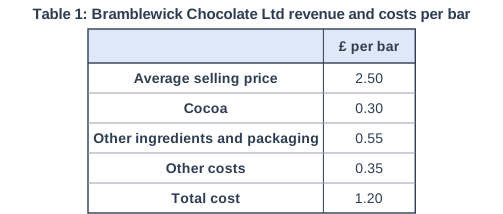
Bramblewick Chocolate Ltd is a small chocolate maker in Whitby, North Yorkshire, owned by Hannah and Sam. It sells about 80 000 bars a year through its own shop, its website and delicatessens across the north of England. Table 1 shows its revenue and costs for each bar.
A television documentary recently showed that some cocoa farmers in West Africa, where Bramblewick's cocoa comes from, are paid so little that their children have to work on the farms instead of going to school. Bramblewick buys its cocoa through a dealer, and Hannah cannot be sure how much the farmers are paid.
Hannah wants to switch to fair trade cocoa, which guarantees farmers a fair minimum price. It would cost 40% more than the cocoa Bramblewick buys now. Sam is worried about profit: 'If we raise our price, some customers will buy cheaper chocolate instead. If we don't, we earn less on every bar.'
In an online survey of 600 Bramblewick customers, 55% said they would pay 20p more for a fair trade bar, but 30% said price was the most important reason they chose a chocolate bar. A rival chocolate maker in York launched a fair trade range last year and now advertises itself as 'the ethical choice'. Two delicatessens have asked Bramblewick whether its cocoa is ethically sourced.
Recommend whether Bramblewick Chocolate should switch to fair trade cocoa.
Give reasons for your recommendation.
Model answer
I recommend that Bramblewick should switch to fair trade cocoa and raise its price slightly.
The ethical case is strong. The documentary showed that some West African cocoa farmers are paid so little that their children work instead of going to school, and Bramblewick cannot be sure that this is not happening in its own supply chain. Fair trade cocoa guarantees farmers a fair minimum price, so switching would mean Bramblewick is acting in a way its stakeholders see as fair and honest. It would also protect its reputation: two delicatessens are already asking about ethical sourcing, and a rival in York advertises itself as 'the ethical choice'. If Bramblewick does nothing, it risks losing stockists and customers to that rival.
However, there is a trade-off with profit. The fair trade cocoa costs 40% more, which adds 12p to the cost of each bar. If the price stays at £2.50, profit per bar falls from £1.30 to £1.18, a fall of 9.23%, or about £9 600 a year on 80 000 bars. Sam is right that a price rise could lose some customers, because 30% of those surveyed said price was the most important reason they chose a chocolate bar.
The survey suggests a price rise is the answer. 55% of customers said they would pay 20p more for a fair trade bar. At £2.70, profit per bar would be £1.38, higher than now, so even if a few price-sensitive customers left, Bramblewick could earn as much as before. It could also use its fair trade cocoa in its promotion, which would help it compete with the York rival.
Overall, switching is the right decision because it removes a serious risk to Bramblewick's reputation and may not reduce profit at all. It depends on whether customers really pay the higher price, as survey answers do not always match what people do, so Bramblewick could start with a smaller rise of 12p, which keeps profit per bar the same.