Level:
Correct: 0
Incorrect: 0
Marks: 0/0

The marketing mix: promotion

Practise 26 exam-style questions on The marketing mix: promotion for AQA GCSE Business (Paper 2). Write your answer as you would in the exam and get it marked in seconds against the mark scheme, point by point, with the Study Helper on hand if you get stuck.

  • 26 questions
  • 1–12 marks each
  • Instant marking
  • No sign-up needed
20 questions, marked as you go

Sample questions with model answers

Here are 4 of the questions in this topic, each with a model answer, an explanation of why it earns the marks and the mark scheme an examiner would use.

Question 1

1 mark

A brand of tomato ketchup has been sold in the UK for over 50 years and is known by most households. Its latest adverts do not mention any new features or special offers: they simply show the bottle and the brand name.

Which one of the following is the main reason for this promotion?

Choose your answer.

  • To inform customers about a new product
  • To remind customers about the product
  • To change the image of the product
  • To create sales of a new product

Model answer

To remind customers about the product

Explanation

The ketchup is not new and the adverts give no new information, so their purpose is to keep a well-known brand in customers' minds so that they keep buying it rather than a rival's. Informing customers and creating sales of a new product apply to a product at the introduction stage. Changing the image would need a new message, such as a healthier recipe or a different target market.

Mark scheme
  1. 1 mark

    To remind customers about the product

    Accept 'to remind customers'. If more than one option is given, 0 marks.

Question 2

2 marks

Explain one drawback to a business of advertising on television.

Model answer

Television advertising is very expensive, because the business must pay to make the advert and to buy air time at peak viewing times. If the advert does not increase sales by enough to cover this cost, the business's profit will fall.

Explanation

High cost is the drawback most answers give, so the explanation mark depends on saying what this means for the business, such as falling profit or being unaffordable for a small firm. Other good drawbacks are wasted coverage for a niche product and viewers skipping adverts. Saying only 'it is expensive' scores 1 mark.

Mark scheme
  1. 1 mark

    Identifying a drawback: very expensive (to make the advert and/or to buy air time, especially at peak times) / reaches many people who are not in the target market / viewers skip or fast-forward adverts, or watch streaming services without adverts / the advert is on screen for only a short time / it takes a long time to plan and produce

    1 mark for identifying a drawback of television advertising for the business.

  2. 1 mark

    Explaining the consequence of the drawback for the business

    Examples of developed answers: TV adverts are very expensive to produce and show at peak times (1) so a small business may not be able to afford them / profits fall if sales do not rise enough to cover the cost (1). Many viewers skip adverts or watch programmes without adverts (1) so the business may pay for an advert that few target customers see (1). A TV advert reaches a very wide audience (1) so a niche business pays to reach many people who will never buy its product (1). Do not accept 'it costs money' without the idea that it is expensive. Ignore drawbacks for viewers.

Question 3

4 marks

Item A
Clee View Farm Shop

Clee View Farm Shop is run as a partnership by two brothers, Owen and Huw Pryce, on their family farm near Ludlow in Shropshire. The shop sells meat and vegetables from the farm alongside cheese, bread, jams and chutneys from other local producers. It is on a busy main road, and many customers stop on their way home from work.

Two large supermarkets in Ludlow sell similar products at lower prices. Owen and Huw cannot afford to compete on price, so they want to increase the amount each customer spends during a visit. Last month they added two point of sale displays: a stand of the farm's new range of chutneys next to the tills, with a sign telling the story of how each chutney is made from the farm's own fruit, and a small chilled cabinet of local cheeses beside the bread counter. On Saturdays, a member of staff also offers free samples of a different local cheese.

Since the displays were added, the average amount spent per customer has risen from £18.50 to £21.20, and sales of chutney have doubled. Owen has noticed that many customers pick up a jar of chutney while they queue to pay.

Explain one reason why Clee View Farm Shop uses point of sale displays.

You should use the information in Item A in your answer.

Model answer

Clee View uses point of sale displays to increase the amount each customer spends, because it cannot afford to compete with the two Ludlow supermarkets on price. The chutney stand is next to the tills, where customers wait to pay, so they see the jars and often pick one up on impulse, as Owen has noticed. The sign explaining that each chutney is made from the farm's own fruit gives customers a reason to buy something they cannot get in a supermarket. This has worked: chutney sales have doubled and average spending per customer has risen from £18.50 to £21.20.

Explanation

Level 2 answers give one clear reason, such as encouraging impulse buys to raise spending per customer, and support it with Clee View's evidence: the stand beside the tills, the story on the sign and the rise from £18.50 to £21.20. A general description of point of sale displays with no link to the farm shop stays in Level 1. One reason, well applied, is enough.

Mark scheme
  1. 4 marks

    Levels of response (4 marks). AO1 = 2, AO2 = 2.
    Level 2 (3-4 marks): Sound understanding and application of the topics. Applies knowledge and understanding to the context sufficiently. A sound understanding of one or more business concepts and issues.
    Level 1 (1-2 marks): Basic understanding and application of the topics. Applies basic knowledge and understanding to the context. A basic understanding of one or more business concepts.
    0 marks: nothing to reward.

    Indicative content (not a checklist; credit other valid points): Knowledge and application: to increase the amount each customer spends - the chutney stand is next to the tills where customers queue, encouraging impulse buys, and average spend rose from £18.50 to £21.20 while chutney sales doubled; to inform customers about the new range of chutneys - the sign tells the story of how each chutney is made from the farm's own fruit, which makes it stand out from supermarket products; to compete with the two Ludlow supermarkets without cutting prices, which Owen and Huw cannot afford to do; the cheese cabinet beside the bread counter encourages customers to buy products that go together. Only one reason needs to be explained. Level 2 needs a sound explanation of one reason that is applied to Clee View using Item A. An answer that is not applied to Clee View cannot go above Level 1.

Question 4

9 marks

Item A
Tonnau Surf School

Rhian Morgan set up Tonnau Surf School as a sole trader four years ago. She teaches surfing on a beach near St Davids in Pembrokeshire from April to October. Most of her customers are families on holiday and groups of friends aged 18 to 30. A two-hour group lesson costs £40 per person. Lessons are usually fully booked in July and August, but there are many empty places in April, May, September and October.

Rhian promotes the business mainly through social media. She posts short videos of lessons, shares customer reviews and runs a monthly competition in which people who share her posts can win a free lesson. This takes her about eight hours a week, usually in the evenings after teaching.

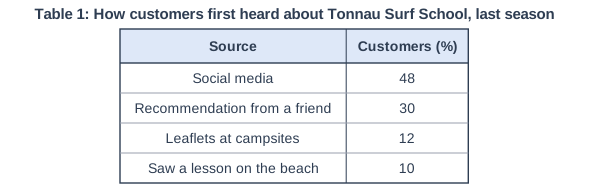
Last season Tonnau had 1 250 customers. Rhian asked every customer how they had first heard about the business. The results are shown in Table 1.

A regional tourist magazine, given free to visitors at campsites, hotels and holiday cottages across Pembrokeshire, has offered Rhian a full-page advert in every issue from April to October for £2 400. The magazine says it is read by 60 000 visitors each season. Rhian estimates that 0.25% of the magazine's readers would become customers.

Rhian made a profit of £21 000 last season and has £3 000 in the business bank account. Two other surf schools have opened on nearby beaches in the last two years, and one of them already advertises in the magazine.

Recommend whether Rhian should pay £2 400 to advertise in the regional tourist magazine.

Give reasons for your recommendation.

Table 1: How customers first heard about Tonnau Surf School, last season. Table with columns "Source", "Customers (%)". Source: Social media; Customers (%): 48 | Source: Recommendation from a friend; Customers (%): 30 | Source: Leaflets at campsites; Customers (%): 12 | Source: Saw a lesson on the beach; Customers (%): 10.

Model answer

I recommend that Rhian should pay for the advert, but she should use it to fill places in the quieter months.

The magazine reaches exactly the right people. It is given free at campsites, hotels and holiday cottages, so its 60 000 readers are visitors to Pembrokeshire, and families on holiday are Rhian's main target market. Leaflets at campsites already brought in 12% of last season's 1 250 customers, which is 150 customers, so there is evidence that holidaymakers respond to printed promotion where they stay.

The advert also looks good value. If 0.25% of readers become customers, that is 150 new customers paying £40, which is £6 000 of extra revenue from an advert costing £2 400, or £16 per new customer. As Rhian teaches the lessons herself, most of this revenue would add to her profit. In addition, one of the new rival surf schools already advertises in the magazine. If Rhian does not, readers will only see her competitor and may book with them instead.

However, there are risks. The advert would use £2 400 of the £3 000 in her bank account, leaving only £600 if equipment needs replacing early in the season before much revenue comes in. Also, lessons are already fully booked in July and August, so new customers wanting lessons in the summer holidays cannot be served; the extra revenue only comes if they book in April, May, September or October. Social media and recommendations already bring in 78% of her customers at very little cost, so she does not depend on the magazine.

Overall, the advert is worth paying for, because £6 000 of potential revenue is much greater than the £2 400 cost, and it stops the rival having the magazine's readers to itself. The decision depends on whether the 0.25% estimate is realistic, so Rhian should include a discount code for spring and autumn lessons in the advert. This would fill her empty places, and the code would show her whether the advert has worked before she pays for it again next year.

Explanation

Top-level answers make a clear recommendation and weigh the cost of the advert against the extra revenue it could bring, using the figures in Item A, such as 150 new customers at £16 each and only £600 left in the bank. Strong answers notice that July and August are already full, so the advert's value depends on filling the quieter months. Answers that list general benefits of magazine advertising without using the case stay in the lower levels.

Mark scheme
  1. 9 marks

    Levels of response (9 marks). AO2 = 3, AO3 = 6.
    Level 3 (7-9 marks): Detailed analysis and evaluation of topics based on the context. Sustained line of reasoning, which is coherent, relevant, substantiated with a focused conclusion that is fully justified. Business areas are fully analysed. Applies knowledge and understanding to the context sufficiently.
    Level 2 (4-6 marks): Sound analysis and evaluation of topics based on the context. A line of reasoning, with a conclusion that has some justification. Business areas are partially analysed. Applies some knowledge and understanding to the context.
    Level 1 (1-3 marks): Basic analysis and evaluation of topics based on the context. Basic line of reasoning with a conclusion. Basic analysis of business areas. Basic knowledge and understanding is applied to the context.
    0 marks: nothing to reward.

    Indicative content (not a checklist; credit other valid points): Application: the advert costs £2 400 and Rhian has £3 000 in the bank, leaving £600; last season's profit was £21 000; the magazine is given free to visitors at campsites, hotels and holiday cottages and is read by 60 000 visitors; Rhian's estimate of 0.25% means 150 new customers, £6 000 of revenue at £40 each and a cost of £16 per new customer; leaflets at campsites already brought in 12% of customers (150), so printed material where visitors stay works; social media brought in 48% (600 customers) but takes eight hours a week; lessons are fully booked in July and August but have empty places in April, May, September and October; one of the two new rival surf schools already advertises in the magazine. Analysis (pay for the advert): the magazine reaches the target market (holiday visitors to Pembrokeshire), so little of the cost is wasted; if the estimate is right, £6 000 of extra revenue is far more than the £2 400 cost, so profit rises; without an advert, readers see only the rival and may book with them, so Rhian could lose customers; it reduces her reliance on social media, which takes up her evenings. Analysis (do not pay): the advert uses most of her £3 000 cash, leaving little to cover problems such as replacing equipment early in the season, before most revenue comes in; social media and recommendations already bring in 78% of customers at little cost; new customers wanting July or August cannot be served because those months are full, so the extra revenue depends on them booking in quieter months; 0.25% is only an estimate and the readership figure comes from the magazine itself. Evaluation (what does it depend on?): whether the 0.25% estimate is realistic; whether new customers book in the months with spare places; whether Rhian could pay for spring and autumn issues only, or include a discount code to measure results; how the rival's advert affects her bookings; how much cash she needs at the start of the season. A justified recommendation either way can reach Level 3. Level 3 needs a focused recommendation that weighs the cost against the likely extra revenue, using evidence from Item A on finance, capacity and competition. A generic answer that does not use Item A cannot go above Level 2, however well developed.

Ready to try the rest? Every answer you write is marked against the mark scheme, so you can see exactly where the marks are.

Study Helper Hints first, answers after you try

Stuck on this one? Ask for a hint and I’ll point you in the right direction, without giving the answer away. Once you’ve checked your answer, I’ll show you how the marks are awarded.