Level:
Correct: 0
Incorrect: 0
Marks: 0/0

Business ownership

Practise 17 exam-style questions on Business ownership for AQA GCSE Business (Paper 2). Write your answer as you would in the exam and get it marked in seconds against the mark scheme, point by point, with the Study Helper on hand if you get stuck.

  • 17 questions
  • 1–12 marks each
  • Instant marking
  • No sign-up needed
17 questions, marked as you go

Sample questions with model answers

Here are 4 of the questions in this topic, each with a model answer, an explanation of why it earns the marks and the mark scheme an examiner would use.

Question 1

1 mark

Which one of the following best describes a not-for-profit organisation?

Choose your answer.

  • An organisation that is making a loss
  • An organisation that spends any surplus on its aims instead of paying it to owners
  • An organisation that gives all of its products away free
  • An organisation that is owned and run by the government

Model answer

An organisation that spends any surplus on its aims instead of paying it to owners

Explanation

A not-for-profit organisation, such as a charity, can make a surplus, but it puts the money back into its aims, for example helping people or protecting the environment, rather than paying it to owners. It is not the same as a business making a loss, and many not-for-profit organisations charge for what they sell. Being owned by the government does not make an organisation not-for-profit.

Mark scheme
  1. 1 mark

    An organisation that spends any surplus on its aims instead of paying it to owners

    If more than one option is given, 0 marks.

Question 2

2 marks

Explain one reason why the shareholders of a private limited company may not receive a dividend, even in a year when the company makes a profit.

Model answer

The directors may decide to keep the profit in the company as retained profit instead of paying it out as dividends. They could use it to pay for a new marketing campaign or new equipment without borrowing, so the company has no interest to pay and can grow, which may mean higher dividends for shareholders in future.

Explanation

In a company, the profit after tax is shared between dividends to shareholders and retained profit that is kept in the business, and the directors can decide to keep all of it. Retained profit is a cheap internal source of finance, so shareholders may go without a dividend now in return for growth and higher profits later. Answers saying the company made a loss ignore the question, and partnership agreements do not apply to a company.

Mark scheme
  1. 1 mark

    Identifies a reason: the directors decide to keep the profit in the company as retained profit / the profit is needed to pay for growth, eg new equipment, a new shop or a marketing campaign / the profit is used to repay loans or other debts / the company wants to build up cash reserves for the future / the company is short of cash and needs it to pay its bills

    Credit one reason only; if several are given, mark the first. Do not accept 'the company made a loss' or 'sales were too low' - the question says the company made a profit. Do not accept answers about partners or a partnership agreement, which do not apply to a company. Do not accept 'the profit is paid as tax' on its own.

  2. 1 mark

    Explains why keeping the profit helps the company or its shareholders: retained profit is an internal source of finance, so the company does not have to borrow and pay interest / investing the profit can help the company grow and make more profit, so shareholders may receive higher dividends in future / cash reserves help the company survive if sales fall

    Examples of developed answers: The directors may decide to keep the profit as retained profit (1) so that they can pay for a new website and advertising without taking out a loan, which means no interest to pay (1). The company may need the profit to repay a bank loan (1), which cuts its interest costs, so its future profit and dividends could be higher (1). A reason repeated in different words, eg 'the profit is kept' and 'the profit is not paid out', earns 1 mark only.

Question 3

4 marks

Item C
Hartburn Reuse Project

Hartburn Reuse Project is a charity in Stockton-on-Tees. It collects unwanted sofas, beds, tables and washing machines from local households, repairs and safety-tests them, and sells them in its warehouse shop. Its aims are to help families on low incomes to furnish their homes, to reduce the amount of furniture sent to landfill and to train unemployed young people in repair skills.

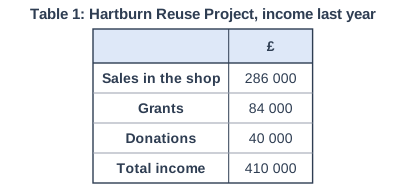
As a not-for-profit organisation, Hartburn has no shareholders. Any surplus it makes is spent on its aims, such as paying for more training places. Last year its income was £410 000 and its costs were £396 000, so it made a surplus of £14 000. Table 1 shows where its income came from.

A sofa that would cost £400 new is usually priced at £90 in Hartburn's shop, and families referred by the local council or a food bank pay half price. Many customers say they could not otherwise afford to furnish their homes. The charity's electricity and van fuel costs have risen sharply this year, and a large furniture retailer has opened a store nearby that sells cheap new furniture.

Explain one way being a not-for-profit organisation affects the prices Hartburn Reuse Project charges. You should use the information in Item C in your answer.

Table 1: Hartburn Reuse Project, income last year. Table with columns (row headings), "£". Sales in the shop; £: 286 000 | Grants; £: 84 000 | Donations; £: 40 000 | Total income; £: 410 000.

Model answer

Because Hartburn Reuse Project is a not-for-profit organisation, it has no shareholders who expect dividends, so it does not need to make a large profit. It only needs to cover its costs, which were £396 000 last year, and it made a small surplus of just £14 000, which it spends on its aims. This allows it to charge very low prices, such as £90 for a sofa that would cost £400 new, and half price for families referred by the council or a food bank. Its grants and donations of £124 000 also pay for part of its costs, so low prices help it achieve its aim of helping families on low incomes.

Explanation

Level 2 answers link the feature of a not-for-profit organisation - no owners taking a share of the profit - to Hartburn's prices, using evidence such as the £90 sofa, the half-price offer, the £14 000 surplus or the grants and donations in Table 1. Saying only that charities charge low prices, without using Item C, stays in Level 1. Good answers may also note that Hartburn must still cover its rising costs.

Mark scheme
  1. 4 marks

    Levels of response (4 marks). AO1 = 2, AO2 = 2.
    Level 2 (3-4 marks): Sound understanding and application of the topics. Applies knowledge and understanding to the context sufficiently. A sound understanding of one or more business concepts and issues.
    Level 1 (1-2 marks): Basic understanding and application of the topics. Applies basic knowledge and understanding to the context. A basic understanding of one or more business concepts.
    0 marks: nothing to reward.

    Indicative content (not a checklist; credit other valid points): Application (evidence from Item C and Table 1):
    - No shareholders; any surplus is spent on its aims; last year's surplus was only £14 000 on income of £410 000 and costs of £396 000.
    - Aim: to help families on low incomes furnish their homes; a sofa costing £400 new is priced at £90; referred families pay half price.
    - Grants (£84 000) and donations (£40 000), £124 000 in total, cover part of its costs; shop sales are £286 000.
    - Rising electricity and van fuel costs; a cheap furniture retailer has opened nearby.
    Analysis (examples): with no shareholders expecting dividends, Hartburn only needs to cover its costs rather than maximise profit, so it can set very low prices that meet its aim of helping low-income families; grants and donations pay for part of its costs, so prices can be lower than its costs alone would require; however, it must still cover its costs, so rising electricity and fuel costs may force it to raise prices slightly or find more grants.
    Level 2 (3-4 marks): a clear explanation of how its not-for-profit status affects its prices, applied to Hartburn using evidence from Item C or Table 1. Level 1 (1-2 marks): a basic or generic point about not-for-profit organisations. An answer not applied to Hartburn cannot go above Level 1.

Question 4

9 marks

Item A
Cadno Leather

Ffion has run Cadno Leather as a sole trader for five years from a small unit in Aberystwyth. She makes handmade leather dog collars and leads, which she sells through her website and at country shows. Customers like the fact that every collar can be personalised with the dog's name, and her sales have grown every year.

A chain of 30 pet shops has offered Ffion a contract to stock her products. To supply the chain she needs £40 000 to move into a larger workshop, buy a leather-cutting machine and employ two workers. She would have to sign a five-year lease on the workshop. Her bank has offered her a loan for the full £40 000, but only if she uses her house as security.

Ffion's accountant has suggested that she turns the business into a private limited company. Ffion's parents have offered to invest £25 000 in return for 25% of the shares, and Ffion would own the other 75%. She would then only need to borrow £15 000. Ffion would be a director and take a salary, and the company would pay dividends to its shareholders out of its profit. The company's accounts would have to be published, so anyone could see them. Ffion is also worried about sharing decisions with her parents, who think she should stop selling at country shows.

Ffion expects that next year, with the pet shop contract, the business would have sales revenue of £180 000 and total costs of £126 000, including her salary. She plans to pay half of the profit to the shareholders as dividends and keep the rest in the business.

Recommend whether Ffion should turn Cadno Leather into a private limited company.

Give reasons for your recommendation.

Model answer

I recommend that Ffion should turn Cadno Leather into a private limited company.

The main reason is limited liability. To supply the pet shop chain, Ffion must sign a five-year lease on a larger workshop and borrow money. As a sole trader she has unlimited liability, and the bank will only lend her the full £40 000 if she uses her house as security. If the pet shop contract ended early and the business could not pay its debts, she could lose her home. As a private limited company, debts such as the lease would belong to the company, so Ffion's personal losses would be limited to the money she had invested.

Becoming a company would also make the finance easier. Her parents would invest £25 000 by buying shares, so she would only need to borrow £15 000. This means smaller loan repayments and less interest, leaving more cash to pay the two new workers and buy the cutting machine.

However, there are drawbacks. Ffion would no longer receive all of the profit. If next year's profit is £54 000 and half is paid as dividends, her parents would receive £6 750, money she would keep as a sole trader. Her parents would also have a say in decisions, and they already want her to stop selling at country shows, which may be an important way of meeting customers and taking personalised orders. The company's accounts would be published, so rivals could see how well she is doing.

On balance, the benefits outweigh the drawbacks. Ffion would keep 75% of the shares, so she could still outvote her parents on any major decision, and protecting her house from the risks of a five-year lease and a large new contract matters more than £6 750 of dividends. The decision depends on how reliable the pet shop contract is: if it were small or short-term, she could stay a sole trader and grow more slowly with less risk.

Explanation

Level 3 answers apply the features of a private limited company to Ffion's situation - limited liability against the five-year lease and the house used as security, the £25 000 from shares, the loss of £6 750 in dividends and her parents' influence - and reach a justified recommendation. Recognising that Ffion keeps 75% of the shares, and so majority control, is a mark of a strong answer. A list of the features of limited companies without reference to Cadno Leather cannot go above Level 2.

Mark scheme
  1. 9 marks

    Levels of response (9 marks). AO2 = 3, AO3 = 6.
    Level 3 (7-9 marks): Detailed analysis and evaluation of topics based on the context. Sustained line of reasoning, which is coherent, relevant, substantiated with a focused conclusion that is fully justified. Business areas are fully analysed. Applies knowledge and understanding to the context sufficiently.
    Level 2 (4-6 marks): Sound analysis and evaluation of topics based on the context. A line of reasoning, with a conclusion that has some justification. Business areas are partially analysed. Applies some knowledge and understanding to the context.
    Level 1 (1-3 marks): Basic analysis and evaluation of topics based on the context. Basic line of reasoning with a conclusion. Basic analysis of business areas. Basic knowledge and understanding is applied to the context.
    0 marks: nothing to reward.

    Indicative content (not a checklist; credit other valid points): Application (evidence from Item A):
    - The pet shop contract needs £40 000; a five-year workshop lease; as a sole trader the bank would lend £40 000 only with her house as security.
    - As a Ltd: her parents invest £25 000 for 25% of the shares, so she borrows only £15 000; Ffion keeps 75% and becomes a director with a salary.
    - Expected profit next year: £180 000 - £126 000 = £54 000; half paid as dividends (£27 000), so her parents would receive £6 750 and Ffion £20 250.
    - Accounts would be published; her parents want her to stop selling at country shows.
    Analysis - for becoming a Ltd: limited liability - the company's debts, such as the lease, belong to the company, so Ffion's personal losses are limited to her investment, whereas as a sole trader her house could be lost if the contract failed; selling shares raises £25 000 without interest, so the smaller loan means lower repayments and interest; she keeps majority control (75%).
    Analysis - against: she would no longer keep all of the profit (£6 750 to her parents next year); her parents would have a say, and stopping country shows could lose personalised orders and contact with customers; published accounts let rivals see her profits; more paperwork. Staying a sole trader keeps all the profit and control but puts her house at risk.
    Evaluation - what does it depend on? how reliable the pet shop contract is; how much her parents would try to interfere (they cannot outvote her 75%); whether the bank would still want security for £15 000; how much Ffion values control compared with protecting her home.
    Level 3 (7-9 marks) needs a recommendation that is fully justified using evidence from Item A, weighing both sides. Accept either recommendation if it is justified. A generic answer about limited companies that does not use the case cannot go above Level 2, however well developed.

Ready to try the rest? Every answer you write is marked against the mark scheme, so you can see exactly where the marks are.

Study Helper Hints first, answers after you try

Stuck on this one? Ask for a hint and I’ll point you in the right direction, without giving the answer away. Once you’ve checked your answer, I’ll show you how the marks are awarded.