Level:
Correct: 0
Incorrect: 0
Marks: 0/0

Identifying and understanding customers

Practise 22 exam-style questions on Identifying and understanding customers for AQA GCSE Business (Paper 2). Write your answer as you would in the exam and get it marked in seconds against the mark scheme, point by point, with the Study Helper on hand if you get stuck.

  • 22 questions
  • 1–12 marks each
  • Instant marking
  • No sign-up needed
20 questions, marked as you go

Sample questions with model answers

Here are 4 of the questions in this topic, each with a model answer, an explanation of why it earns the marks and the mark scheme an examiner would use.

Question 1

1 mark

Which functional area of a business is mainly responsible for identifying the needs of customers?

Choose your answer.

  • Finance
  • Human resources
  • Marketing
  • Operations

Model answer

Marketing

Explanation

The marketing function finds out what customers need, for example through market research, and plans the product, price, promotion and place to meet those needs. Operations then produces the goods or services, human resources provides the right staff and finance provides and controls the money. All four functions work together to satisfy customers, but identifying their needs is mainly the job of marketing.

Mark scheme
  1. 1 mark

    Marketing

    If more than one option is given, 0 marks.

Question 2

2 marks

Explain one reason why a business needs to understand its customers' needs before deciding on its marketing mix.

Model answer

A business needs to know how much its customers are willing to pay. This means it can set a price that is not so high that customers buy from rivals instead, but not so low that it gives away profit.

Explanation

The marketing mix (product, price, promotion and place) only works if each part suits the customers, so the business must understand their needs first. The best answers pick one element, show what the business needs to know about customers and explain what happens as a result. Listing the four Ps without linking them to customers' needs does not score.

Mark scheme
  1. 1 mark

    Identifies a reason linked to one element of the marketing mix: to give the product the features customers want / to set a price customers are willing and able to pay / to choose promotion that reaches and appeals to its customers / to sell the product in the places where its customers shop

    Credit one reason only; if several are given, mark the first. Accept a general reason such as 'so the whole mix suits the target market' for this mark.

  2. 1 mark

    Explains the consequence: more customers buy / higher sales / less money wasted / it can compete with rivals

    Examples of developed answers: Knowing how much customers are willing to pay (1) means the business can set a price that does not drive customers to rivals but still makes a profit (1). Knowing where its customers shop (1) means the product can be sold in those places, so more customers see it and buy it (1). Knowing which media its customers use (1) means advertising reaches them instead of being wasted (1).

Question 3

4 marks

Item D
Overhang Climbing Ltd

Overhang Climbing Ltd runs an indoor climbing centre in a converted warehouse in Nottingham. It opened in 2017 and is open from 10am to 10pm every day. Members pay £42 a month, and non-members pay £13 for a single session. Until 2024 it was the only climbing centre in the city, but two new centres have since opened within five miles. One charges £35 a month for membership; the other has a large café and runs children's parties.

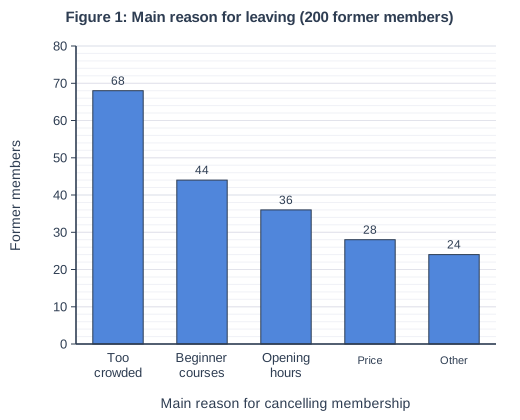
Overhang's membership has fallen from 1 650 in 2024 to 1 400 in 2026. The owners want to understand why members are leaving, so they asked 200 people who had cancelled their membership in the last year for their main reason. Figure 1 shows the results ('Beginner courses' means that there were not enough courses for beginners).

Many former members said that the walls were so busy between 6pm and 9pm that they had to queue for routes, and several said the centre's only beginners' course, on Saturday mornings, was always full. The owners have a budget of £60 000 to spend on improvements this year, and they are considering cutting the membership price to £35 to match their cheaper rival.

Explain one way the survey results in Figure 1 could help Overhang Climbing Ltd to select the correct marketing mix.

You should use the information in Item D in your answer.

Figure 1: Main reason for leaving (200 former members). Bar chart of former members for each main reason for cancelling membership: Too crowded 68, Beginner courses 44, Opening hours 36, Price 28, Other 24.

Model answer

The survey shows that price is not the main reason members are leaving: only 28 of the 200 former members (14%) said the price was too high, while 68 (34%) said the centre was too crowded at peak times. This helps Overhang choose the right price in its marketing mix. Instead of cutting its membership price from £42 to £35 to match its rival, which would cut revenue from its 1 400 members by £9 800 a month, it could keep the price and spend its £60 000 budget on the product, for example more walls or a booking system for the busy 6pm to 9pm period.

Explanation

Level 2 needs one element of the marketing mix linked to specific data from Figure 1, with an explanation of the change Overhang should make and why. Strong answers notice that price was one of the least common reasons for leaving, so a price cut may not be the right response. Simply listing the four Ps, or describing the chart without saying how it helps choose the mix, stays in Level 1.

Mark scheme
  1. 4 marks

    Levels of response (4 marks). AO1 = 2, AO2 = 2.
    Level 2 (3-4 marks): Sound understanding and application of the topics. Applies knowledge and understanding to the context sufficiently. A sound understanding of one or more business concepts and issues.
    Level 1 (1-2 marks): Basic understanding and application of the topics. Applies basic knowledge and understanding to the context. A basic understanding of one or more business concepts.
    0 marks: nothing to reward.

    Indicative content (not a checklist; credit other valid points): Application: Figure 1 shows the main reasons 200 former members cancelled: too crowded 68 (34%), beginner courses (too few) 44 (22%), opening hours 36 (18%), price 28 (14%), other 24 (12%); the walls are so busy from 6pm to 9pm that climbers queue; the only beginners' course is on Saturday mornings and is always full; the centre opens 10am to 10pm; members pay £42 a month and one rival charges £35; the owners are considering cutting the price to £35; budget £60 000. Ways the results help with the mix: product: crowding is the biggest reason, so the £60 000 could go on more walls or a booking system for peak times, and more beginners' courses could be added on weekday evenings; price: only 28 of 200 (14%) left because of price, so cutting the price to £35 may not be needed and would lose £7 a month from each of the 1 400 members; a cheaper off-peak membership could move some climbers away from the busy 6pm to 9pm period; place: opening earlier, for example before work, would suit the 36 who said the hours did not suit them; promotion: advertising beginners' courses and quieter times to the right customers. Level 2 (3-4 marks): one way explained and applied using data from Figure 1 or other evidence from Item D. Level 1 (1-2 marks): a way identified with little explanation, or not applied. An answer not applied to Overhang Climbing cannot go above Level 1. If more than one way is given, credit the best.

Question 4

9 marks

Item C
Thistle & Tide Ltd

Thistle & Tide Ltd makes natural skincare products, such as face creams, cleansers and lip balms, in a small factory in Aberdeen. It sells them through its website and through 85 independent gift shops and chemists across Scotland and the north of England. Almost all of its customers are women aged 25 to 55. Its products are known for their seaweed ingredients and recyclable glass jars, and they sell for £14 to £22 each. Revenue grew from £1.2 million in 2024 to £1.5 million in 2026.

The marketing director, Isla, wants to launch a range of men's skincare products. The UK market for men's skincare is growing quickly, but it is dominated by large brands sold in supermarkets for £5 to £10 a product. Developing the range, designing new packaging and running a launch campaign would cost £38 000.

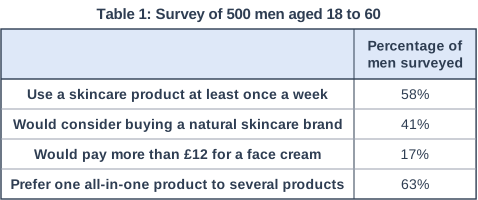
Isla asked a market research agency to survey 500 men aged 18 to 60. Table 1 shows some of the results. The agency also reported that most of the men surveyed bought skincare products in supermarkets or online, not in gift shops, and that many said they did not want products that take a lot of time to use. Isla's first idea was a men's range of five products: a cleanser, a toner, a face cream, an eye cream and a lip balm, each priced at £16.

Recommend whether Thistle & Tide Ltd should launch the men's skincare range.

Give reasons for your recommendation.

Table 1: Survey of 500 men aged 18 to 60. Table with columns (row headings), "Percentage of men surveyed". Use a skincare product at least once a week; Percentage of men surveyed: 58% | Would consider buying a natural skincare brand; Percentage of men surveyed: 41% | Would pay more than £12 for a face cream; Percentage of men surveyed: 17% | Prefer one all-in-one product to several products; Percentage of men surveyed: 63%.

Model answer

There are good reasons to launch a men's range. The market is growing quickly, and Thistle & Tide currently sells almost only to women, so a men's range would give it a new source of revenue and spread its risk. The survey shows that 41% of men would consider buying a natural skincare brand, so its seaweed ingredients and recyclable jars could make it stand out from the large supermarket brands. With revenue of £1.5 million, growing by 25% in two years, the £38 000 launch cost is affordable.

However, Isla's first idea does not meet men's needs. She plans five products at £16 each, but 63% of men prefer one all-in-one product and only 17% would pay more than £12 for a face cream. Many men want skincare that is quick to use, and most buy it in supermarkets or online, not in the gift shops where Thistle & Tide sells most of its products. Large brands are sold for £5 to £10 in supermarkets, so a £16 product in gift shops would be competing in the wrong place at the wrong price. If the range did not sell, most of the £38 000 would be wasted.

I recommend that Thistle & Tide should launch a men's range, but not the one Isla first planned. It should use the research to change the marketing mix: a single all-in-one natural product, priced as close to £12 as its costs allow, sold through its website first. This targets the 41% who like natural brands without taking on the supermarket brands head-on. Launching online first would also act as a trial: if sales are good, it could add more products or try to sell through supermarkets. The decision depends on whether the business can make a profit at a lower price, so it should check its costs before launching.

Explanation

The best answers use Table 1 on both sides, for example the 41% interested in natural brands against the 63% who want an all-in-one product and the 17% who would pay over £12. A strong recommendation explains how identifying men's needs should change the range, price and place, rather than simply saying yes or no. One-sided answers, or answers that do not use the survey data, cannot reach Level 3.

Mark scheme
  1. 9 marks

    Levels of response (9 marks). AO2 = 3, AO3 = 6.
    Level 3 (7-9 marks): Detailed analysis and evaluation of topics based on the context. Sustained line of reasoning, which is coherent, relevant, substantiated with a focused conclusion that is fully justified. Business areas are fully analysed. Applies knowledge and understanding to the context sufficiently.
    Level 2 (4-6 marks): Sound analysis and evaluation of topics based on the context. A line of reasoning, with a conclusion that has some justification. Business areas are partially analysed. Applies some knowledge and understanding to the context.
    Level 1 (1-3 marks): Basic analysis and evaluation of topics based on the context. Basic line of reasoning with a conclusion. Basic analysis of business areas. Basic knowledge and understanding is applied to the context.
    0 marks: nothing to reward.

    Indicative content (not a checklist; credit other valid points): Application: the men's skincare market is growing quickly but is dominated by large brands sold in supermarkets for £5 to £10; the launch would cost £38 000, about 2.5% of 2026 revenue of £1.5 million; revenue grew by 25% from £1.2 million in 2024; Table 1: 58% of men (290 of 500) use skincare at least weekly, 41% (205) would consider a natural brand, 17% (85) would pay more than £12 for a face cream and 63% (315) prefer an all-in-one product; most men buy in supermarkets or online, not gift shops; many want products that are quick to use; Isla's plan is five products at £16 each; current customers are almost all women aged 25 to 55; the brand is known for seaweed ingredients and recyclable glass jars. Analysis for launching: a growing market offers a new source of revenue and growth; selling to men as well as women spreads risk; 41% would consider a natural brand, so Thistle & Tide's natural ingredients and recyclable jars could be a USP against large brands; it already sells online, where many men buy skincare; existing women customers may buy the range as gifts; the business can afford the £38 000. Analysis against: Isla's plan does not match men's needs (five products at £16, when 63% want one product and only 17% would pay over £12); large brands sell for £5 to £10 in supermarkets, where Thistle & Tide does not sell, so competing on price or place will be hard; most of its retailers are gift shops and chemists, where few men buy skincare; if the range fails, the £38 000 is wasted and the brand may be weakened. Evaluation (what does it depend on?): whether the marketing mix is changed to match the research (e.g. one all-in-one product, a price nearer £12, sold online); whether the business can make a profit at a lower price; whether the survey of 500 men reflects the men most likely to buy a natural brand; whether a small trial launch online could test demand first. Accept either recommendation, or a conditional one, if it is justified. Level 3 (7-9 marks): a sustained, balanced argument using the case and Table 1, with a fully justified recommendation. Level 2 (4-6 marks): sound analysis with some use of the evidence, and a recommendation with some justification. Level 1 (1-3 marks): basic points with an asserted recommendation. A generic answer that does not use the case cannot go above Level 2, however well developed.

Ready to try the rest? Every answer you write is marked against the mark scheme, so you can see exactly where the marks are.

Study Helper Hints first, answers after you try

Stuck on this one? Ask for a hint and I’ll point you in the right direction, without giving the answer away. Once you’ve checked your answer, I’ll show you how the marks are awarded.