
Level:
Correct: 0
Incorrect: 0
Marks: 0/0

Analysing the financial performance of a business

Practise 28 exam-style questions on Analysing the financial performance of a business for AQA GCSE Business (Paper 2). Write your answer as you would in the exam and get it marked in seconds against the mark scheme, point by point, with the Study Helper on hand if you get stuck.

  • 28 questions
  • 1–12 marks each
  • Instant marking
  • No sign-up needed
20 questions, marked as you go

Sample questions with model answers

Here are 4 of the questions in this topic, each with a model answer, an explanation of why it earns the marks and the mark scheme an examiner would use.

Question 1

1 mark

Which one of the following best describes a statement of financial position?

Choose your answer.

  • The value of what a business owns and owes on a particular date
  • The revenue, costs and profit of a business over a year
  • The cash flowing into and out of a business each month
  • The profit a business expects to make next year

Model answer

The value of what a business owns and owes on a particular date

Explanation

A statement of financial position (sometimes called a balance sheet) lists a business's assets, liabilities and equity on one date, such as 31 March, so it is a snapshot in time. Revenue, costs and profit over a year are shown on the income statement, and monthly cash in and out is shown on a cash flow forecast. Financial statements record what has already happened, so a forecast of next year's profit is not a statement of financial position.

Mark scheme
  1. 1 mark

    The value of what a business owns and owes on a particular date

    Accept a clear shortened form, e.g. 'what a business owns and owes on a particular date'. If more than one option is given, 0 marks.
Question 2

2 marks

Explain how an asset is different from a liability.

Model answer

An asset is something the business owns that has value, such as its machinery or the cash in its bank account. A liability is something the business owes to someone else, such as a bank loan or money owed to suppliers.

Explanation

Assets are what a business owns (or is owed) and liabilities are what it owes, and both are shown on the statement of financial position. Total assets minus total liabilities gives the business's net assets. Do not confuse a liability with limited or unlimited liability, which is about how much the owners could lose.

Mark scheme
  1. 1 mark

    An asset is something a business owns (or is owed) that has value / will benefit the business, e.g. machinery, inventories, cash

    Accept an example only if it is linked to the idea of ownership or value, e.g. 'an asset is something the business owns, such as its delivery van'. An example alone with no description does not score.

  2. 1 mark

    A liability is something a business owes / a debt it must repay to someone else, e.g. a bank loan, trade payables, an overdraft

    Accept 'whereas a liability is money the business owes to others'. Do not accept 'a liability is a cost', 'a liability is a risk' or answers about limited or unlimited liability. Examples of developed answers: 'An asset is something the business owns, such as machinery (1), whereas a liability is money it owes, such as a bank loan (1).' 'Assets are items of value that belong to the business (1); liabilities are debts it has to pay back (1).'

Question 3

4 marks

Item A
The Long Table Café

The Long Table Café is a community interest company (CIC), a type of social enterprise, in east Belfast. It sells breakfasts, lunches and cakes, and uses the café to train young people aged 16 to 24 who have been out of work or education. Each trainee spends six months working in the kitchen and serving customers, while a full-time trainer helps them gain food hygiene and customer service qualifications. Trainees are paid for the hours they work.

As a social enterprise, the café reinvests its profits in the business and the local community rather than paying them to owners. It buys most of its ingredients from local bakers and growers, even though some cost more than supermarket prices.

In 2025, 16 young people completed the training and 11 of them went on to a job or a college course. The café's net profit margin was 3%, which is low compared with most cafés in Belfast, because training and supporting the trainees adds to its expenses.

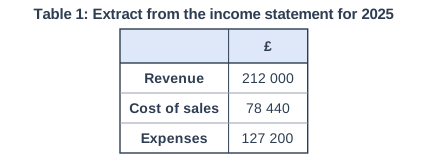
Table 1 shows an extract from the café's income statement for 2025. The directors are applying to a charity for a grant to train more young people next year, and the charity has asked to see the café's financial statements.

Explain one reason why the directors of The Long Table Café should not judge its performance only by its net profit margin.

You should use the information in Item A in your answer.

Table 1: Extract from the income statement for 2025. Table with columns (row headings), "£". Revenue; £: 212 000 | Cost of sales; £: 78 440 | Expenses; £: 127 200.

Model answer

The Long Table Café is a community interest company, so its main aim is to help young people into work rather than to make a large profit. Its net profit margin of 3% is low compared with other Belfast cafés, but this is because it pays its trainees and a full-time trainer and buys from local suppliers, which add to its costs. In 2025, 11 of its 16 trainees went on to a job or college course, which shows it is meeting its social aim. If the directors only looked at the net profit margin they might wrongly think the café is failing, when the charity offering the grant is more likely to judge it on how many young people it helps.

Explanation

Social enterprises measure success against social as well as financial objectives, so a low profit margin can be the price of achieving their aims. Level 2 answers use the case evidence, such as the 11 trainees who found jobs or college places and the reasons for the high expenses. An answer that simply says 'profit is not everything' without using Item A stays in Level 1.

Mark scheme
  1. 4 marks

    Levels of response (4 marks). AO1 = 2, AO2 = 2.
    Level 2 (3-4 marks): Sound understanding and application of the topics. Applies knowledge and understanding to the context sufficiently. A sound understanding of one or more business concepts and issues.
    Level 1 (1-2 marks): Basic understanding and application of the topics. Applies basic knowledge and understanding to the context. A basic understanding of one or more business concepts.
    0 marks: nothing to reward.

    Indicative content (not a checklist; credit other valid points): Knowledge and application: The Long Table Café is a community interest company (a social enterprise) whose main aim is to train young people aged 16 to 24, not to make profit for owners; it reinvests its profits in the business and the community; in 2025, 16 trainees completed the training and 11 of them (about 69%) went on to a job or college course; its net profit margin of 3% is low because paying trainees and a full-time trainer adds to expenses, and buying from local suppliers costs more; the charity deciding on the grant will want evidence of social impact as well as financial information; stakeholders such as the trainees, the local community and funders judge success by social results. Example of a developed point: judging the café only by its 3% net profit margin would make it look less successful than other Belfast cafés, but the low margin is the result of choices made to meet its social aims, such as paying trainees and a trainer, so the number of trainees getting jobs is a better measure of whether it is succeeding. Level 2 needs a sound reason applied to the café using the case, e.g. its trainees' results or why its expenses are high. An answer not applied to the business in the case cannot go above Level 1.

Question 4

9 marks

Item A
Hedley & Daughters Bakery Ltd

Hedley & Daughters Bakery Ltd is a family-owned private limited company in Newcastle upon Tyne. It bakes bread, cakes and pastries in a central bakery and sells them through its own shops. All of its shares are owned by members of the Hedley family, and the directors usually keep most of the profit in the business to pay for growth.

In February 2025 the company opened its third shop, in Gateshead town centre. The new shop increased sales, but the company had to employ eight more staff and pay a high rent. Expenses in 2025 also included one-off costs of £18 000 for training the new staff and running an opening promotion. The prices of butter and flour rose during the year, but the directors raised some of their own prices to cover this.

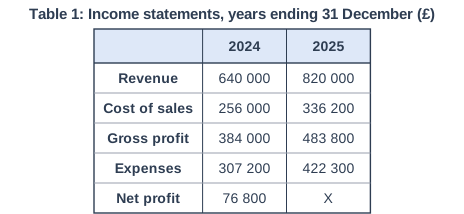
Table 1 shows the company's income statements for 2024 and 2025.

The directors are now considering opening a fourth shop, in Durham, in 2026. Fitting out the shop would cost £95 000 and the rent would be £38 000 a year. The company has £110 000 of retained profit that it could use to pay for the shop. A national bakery chain opened a shop in Durham city centre last year and is popular with students. Hedley & Daughters' Gateshead shop has increased its sales every month since it opened, and customer reviews praise the quality of its products.

In Table 1, X is the net profit for 2025.

Recommend whether Hedley & Daughters should open a fourth shop in Durham in 2026.

Give reasons for your recommendation. Use the financial information in Item A to support your answer.

Table 1: Income statements, years ending 31 December (£). Table with columns (row headings), "2024", "2025". Revenue; 2024: 640 000; 2025: 820 000 | Cost of sales; 2024: 256 000; 2025: 336 200 | Gross profit; 2024: 384 000; 2025: 483 800 | Expenses; 2024: 307 200; 2025: 422 300 | Net profit; 2024: 76 800; 2025: X.

Model answer

I would recommend that Hedley & Daughters waits before opening a fourth shop.

The case for opening is that the company's gross profit margin has held steady at about 60% (60% in 2024 and 59% in 2025), even though butter and flour became dearer. This shows each shop sells its products at a healthy mark-up, so a new shop should add gross profit. Revenue also rose by 28% to £820 000 after the Gateshead shop opened, and that shop's sales have risen every month, which suggests the brand's quality attracts customers in new areas. The company could pay the £95 000 fit-out from its £110 000 of retained profit, so it would not have to pay interest on a loan.

However, net profit fell from £76 800 to £61 500, so the net profit margin fell from 12% to 7.5%. The main reason is that expenses rose by £115 100, or 37%, much faster than revenue, because of eight extra staff and a high rent. Even if the £18 000 of one-off costs are ignored, net profit would only have been £79 500, a margin of about 9.7%, still below the 12% of 2024. A Durham shop would add £38 000 a year in rent as well as more wages, and it would face a national chain that is already popular with students, so its sales may grow more slowly than Gateshead's and it could cut the margin further. Spending £95 000 would also leave only £15 000 of retained profit to cope with any further rise in ingredient prices.

On balance, a fourth shop depends on whether the Gateshead shop's profits keep improving. Because the company's margin is still recovering from its last expansion and the Durham shop faces strong competition, I recommend it waits a year, until the Gateshead shop has shown it can bring the net profit margin back close to 12%, before risking most of its retained profit.

Explanation

Top-level answers use the figures to judge performance: the steady gross profit margin shows the problem is expenses, not pricing, and the one-off costs explain part of the fall in net profit. They then weigh the risks of the Durham shop (rent, competition, little retained profit left) against the evidence of growth and reach a clear, justified decision. Answers that simply list figures from Table 1 without explaining what they show stay in the lower levels.

Mark scheme
  1. 9 marks

    Levels of response (9 marks). AO2 = 3, AO3 = 6.
    Level 3 (7-9 marks): Detailed analysis and evaluation of topics based on the context. Sustained line of reasoning, which is coherent, relevant, substantiated with a focused conclusion that is fully justified. Business areas are fully analysed. Applies knowledge and understanding to the context sufficiently.
    Level 2 (4-6 marks): Sound analysis and evaluation of topics based on the context. A line of reasoning, with a conclusion that has some justification. Business areas are partially analysed. Applies some knowledge and understanding to the context.
    Level 1 (1-3 marks): Basic analysis and evaluation of topics based on the context. Basic line of reasoning with a conclusion. Basic analysis of business areas. Basic knowledge and understanding is applied to the context.
    0 marks: nothing to reward.

    Indicative content (not a checklist; credit other valid points): Application: revenue rose from £640 000 to £820 000 (about 28%) after the Gateshead shop opened; gross profit rose by £99 800 and the gross profit margin stayed at about 60% (59% in 2025) because price rises covered dearer butter and flour; net profit fell from £76 800 to £61 500 (down £15 300, about 20%) and the net profit margin fell from 12% to 7.5%; expenses rose by £115 100 (about 37%) because of eight extra staff and a high rent; £18 000 of the 2025 expenses were one-off - without them net profit would have been £79 500, a margin of about 9.7%; the Gateshead shop's sales have risen every month and reviews praise quality; the Durham shop would cost £95 000 to fit out, leaving £15 000 of the £110 000 retained profit, plus rent of £38 000 a year; a national chain is already popular in Durham city centre. Analysis (open): the gross profit margin has held up, so each shop sells at a healthy mark-up and a new shop adds gross profit; part of the fall in net profit is one-off and part comes from a new shop that is still building up sales, so a fourth shop could add to profit once established; paying from retained profit means no loan and no interest; more shops spread the cost of the central bakery. Analysis (do not open): the third shop has already cut the net profit margin from 12% to 7.5%, and a fourth shop with £38 000 rent and more wages could cut it further; spending £95 000 of the £110 000 leaves little to cope with further rises in ingredient prices; competition from the national chain may mean sales grow more slowly than in Gateshead; managing four shops may stretch the family directors. Evaluation - what does it depend on?: whether the underlying margin (about 9.7%) keeps improving as the Gateshead shop grows; how many customers a Durham shop could win from the national chain; whether waiting a year to see the Gateshead shop's full-year profit would be wiser; whether ingredient prices keep rising. Any well-argued recommendation can reach Level 3. Level 3 needs a sustained, balanced line of reasoning that uses the figures in Table 1 (ideally with calculations such as the margins or the effect of the one-off costs) and a justified conclusion. A generic answer that does not use the case cannot go above Level 2, however well developed. An answer that only copies figures without explaining what they show is Level 1.

Ready to try the rest? Every answer you write is marked against the mark scheme, so you can see exactly where the marks are.

Study Helper Hints first, answers after you try

Stuck on this one? Ask for a hint and I’ll point you in the right direction, without giving the answer away. Once you’ve checked your answer, I’ll show you how the marks are awarded.