Level:
Correct: 0
Incorrect: 0
Marks: 0/0

Business location

Practise 17 exam-style questions on Business location for AQA GCSE Business (Paper 2). Write your answer as you would in the exam and get it marked in seconds against the mark scheme, point by point, with the Study Helper on hand if you get stuck.

  • 17 questions
  • 1–12 marks each
  • Instant marking
  • No sign-up needed
17 questions, marked as you go

Sample questions with model answers

Here are 4 of the questions in this topic, each with a model answer, an explanation of why it earns the marks and the mark scheme an examiner would use.

Question 1

1 mark

A new shoe shop opens in a shopping centre next to three other shoe shops.

Which one of the following is the most likely reason for choosing this location?

Choose your answer.

  • To pay lower rent than its rivals
  • To attract customers who already visit the area to buy shoes
  • To reduce the cost of its raw materials
  • To face less competition

Model answer

To attract customers who already visit the area to buy shoes

Explanation

Some retailers locate near competitors because shoppers go where they can compare several shops, so a new shop can win some of the customers its rivals already attract. Rent in a busy shopping centre is usually higher, not lower, and a shop does not buy raw materials. Locating next to rivals means more competition, so the shop must stand out on price, range or service.

Mark scheme
  1. 1 mark

    To attract customers who already visit the area to buy shoes

    If more than one option is given, 0 marks.

Question 2

2 marks

Explain one way locating close to its raw materials can help a business to reduce its costs.

Model answer

If its raw materials are heavy and bulky, such as timber, a business that is located close to them only has to transport them a short distance. This cuts its transport costs, so its total costs fall and it can make more profit on each item it sells.

Explanation

Being near raw materials matters most when they are bulky, heavy or perishable, because moving them is expensive or they spoil. The explanation must show how the cost is reduced, eg shorter journeys mean lower transport costs. Simply saying 'it saves money' is too vague for the second mark.

Mark scheme
  1. 1 mark

    Identifies a way: lower transport / delivery costs for raw materials / bulky or heavy raw materials do not have to be moved far / less need to store raw materials (fresh supplies arrive quickly) / less waste of perishable raw materials

    Do not accept 'cheaper raw materials' with no link to distance or transport.

  2. 1 mark

    Explains how this reduces costs: eg moving heavy, bulky materials over long distances is expensive, so being close reduces total costs / less storage space or fewer freezers needed, cutting rent or energy costs / less wasted stock, so materials costs fall

    Examples of developed answers: Raw materials such as stone or timber are heavy and bulky (1), so transporting them a short distance cuts delivery costs, reducing total costs (1). Fresh raw materials can be collected daily (1), so the business needs less storage and fewer freezers, saving on rent and energy (1). Credit a link to profit or lower prices as development if the cost saving is clear.

Question 3

4 marks

Item A
Harbourside Fish & Chips

Harbourside Fish & Chips is owned by Marek, a sole trader, and is on the seafront in Scarborough, North Yorkshire. Each morning Marek buys fish straight from the boats landing at the harbour, 200 metres away, so he does not pay for deliveries or need large freezers. His menu says 'From boat to plate in hours', and many online reviews praise the freshness of the fish.

Scarborough attracts large numbers of tourists in the summer, and from June to August there is often a queue outside the shop. Harbourside's sales average about £28 000 a month in the summer but only about £7 000 a month between November and February. The rent of £32 000 a year and the business rates still have to be paid every month.

There are 14 other fish and chip shops within a mile of the seafront, so prices are very competitive. Harbourside charges £9.50 for fish and chips, the same as most of its rivals, and Marek feels he cannot raise his price even though the cost of fish and cooking oil has risen this year.

Explain one benefit to Harbourside Fish & Chips of being located close to the harbour.

You should use the information in Item A in your answer.

Model answer

Being 200 metres from the harbour means Marek can buy fish straight from the boats each morning. He does not pay for deliveries or need large freezers, so he saves on delivery and energy costs every day. This matters because, with 14 other fish and chip shops within a mile, he cannot raise his £9.50 price even though the cost of fish and cooking oil has risen. Keeping his other costs low therefore protects the profit he makes on each portion.

Explanation

Choose one benefit - lower costs or the freshness USP - and link it to Harbourside's situation using the case facts (200 metres, no deliveries or freezers, a fixed £9.50 price). Level 2 needs the benefit developed into its effect on costs, profit or sales. A general point about being near raw materials, with no use of the case, stays in Level 1.

Mark scheme
  1. 4 marks

    Levels of response (4 marks). AO1 = 2, AO2 = 2.
    Level 2 (3-4 marks): Sound understanding and application of the topics. Applies knowledge and understanding to the context sufficiently. A sound understanding of one or more business concepts and issues.
    Level 1 (1-2 marks): Basic understanding and application of the topics. Applies basic knowledge and understanding to the context. A basic understanding of one or more business concepts.
    0 marks: nothing to reward.

    Indicative content (not a checklist; credit other valid points): Knowledge and application: being close to raw materials can reduce costs and improve quality. Evidence from Item A: fish is bought straight from the boats landing 200 metres away each morning; no delivery costs and no need for large freezers; the menu says 'From boat to plate in hours'; online reviews praise the freshness; 14 rivals within a mile; the price of £9.50 is the same as most rivals and cannot be raised even though fish and oil costs have risen. Developed points: lower costs (no deliveries, less freezer space and energy) protect Harbourside's profit margin when competition stops it raising its price; fresh fish gives Harbourside a USP and good reviews, which help it attract customers in a very competitive market, increasing sales. An answer that is not applied to Harbourside cannot go above Level 1. Level 2 needs a developed explanation of one benefit, using evidence from Item A.

Question 4

9 marks

Item A
Ashbury Bikes

Tom is a sole trader who sells and repairs bicycles from a shop on a busy street in Cambridge city centre. Many of his customers are students and commuters who walk or cycle past the shop every day, and about a third of his sales come from people who drop in after seeing the window display. Two other cycle shops are within half a mile. Last year Ashbury Bikes had sales revenue of £150 000 and made a profit of £24 000.

Tom's landlord has told him that the rent will rise by 20% when his lease ends in three months. Tom has found a larger unit on a retail park on the edge of the city, where the rent would be fixed for five years. The unit has free parking and room for a bigger workshop and a test track, so Tom could sell more electric bikes, which customers like to try before they buy. There are no other cycle shops on the retail park, but a large sports chain nearby sells cheaper bikes. Fewer people would pass the unit on foot or by bike, so Tom thinks he would need to spend more on advertising, including social media adverts and a new website.

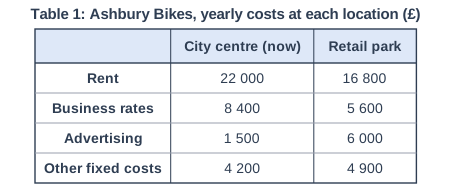
Table 1 shows Tom's yearly costs in the city centre now, and his expected yearly costs at the retail park.

Recommend whether Tom should move Ashbury Bikes to the retail park.

Give reasons for your recommendation.

Table 1: Ashbury Bikes, yearly costs at each location (£). Table with columns (row headings), "City centre (now)", "Retail park". Rent; City centre (now): 22 000; Retail park: 16 800 | Business rates; City centre (now): 8 400; Retail park: 5 600 | Advertising; City centre (now): 1 500; Retail park: 6 000 | Other fixed costs; City centre (now): 4 200; Retail park: 4 900.

Model answer

I recommend that Tom should stay in the city centre, at least for now.

The main argument for moving is cost. After the 20% rent rise, Tom's yearly costs in the city centre would be £40 500, compared with £33 300 at the retail park, a saving of £7 200. That is 30% of last year's profit of £24 000, which is a large gain for a sole trader. The retail park rent is also fixed for five years, so Tom would know his costs and could plan ahead. The bigger unit has room for a larger workshop and a test track, which would help him sell more electric bikes, a higher-value product that customers like to try before buying, and the free parking would suit customers who drive.

However, the city centre location keeps Tom close to his market. Many of his customers are students and commuters who walk or cycle past every day, and about a third of his sales, around £50 000 a year, come from people who drop in after seeing the window display. Customers without cars are less likely to travel to the edge of the city, so many of these sales could be lost. If he lost half of his drop-in sales, that would be £25 000 of revenue a year, and the profit lost on those sales could cancel out much of the £7 200 saving. At the retail park he would also face a large sports chain selling cheaper bikes, and he would have to spend £6 000 a year on advertising instead of £1 500, with no guarantee that it works.

On balance, the saving is not certain to outweigh the lost sales, because Tom's business depends on passing trade from people who do not drive. The decision depends on how many customers would follow him and how quickly electric bike sales would grow. Before deciding, Tom should try to negotiate a smaller rent rise, and could test demand for electric bikes by offering test rides from his current shop.

Explanation

Top answers weigh the £7 200 cost saving (from Table 1 after the rent rise) against the risk of losing drop-in sales from students and commuters who walk or cycle. Show what the decision depends on, such as how many customers would follow Tom. Either recommendation can reach Level 3 if it is justified with the case figures.

Mark scheme
  1. 9 marks

    Levels of response (9 marks). AO2 = 3, AO3 = 6.
    Level 3 (7-9 marks): Detailed analysis and evaluation of topics based on the context. Sustained line of reasoning, which is coherent, relevant, substantiated with a focused conclusion that is fully justified. Business areas are fully analysed. Applies knowledge and understanding to the context sufficiently.
    Level 2 (4-6 marks): Sound analysis and evaluation of topics based on the context. A line of reasoning, with a conclusion that has some justification. Business areas are partially analysed. Applies some knowledge and understanding to the context.
    Level 1 (1-3 marks): Basic analysis and evaluation of topics based on the context. Basic line of reasoning with a conclusion. Basic analysis of business areas. Basic knowledge and understanding is applied to the context.
    0 marks: nothing to reward.

    Indicative content (not a checklist; credit other valid points): Application: after the 20% rent rise, city centre costs are £40 500 a year against £33 300 at the retail park, a saving of £7 200 (30% of last year's profit of £24 000); the retail park rent is fixed for five years; about a third of sales (about £50 000 of £150 000 revenue) come from people who drop in after seeing the window display; many customers are students and commuters who walk or cycle; two other cycle shops are within half a mile in the city; the retail park has free parking, room for a bigger workshop and a test track for electric bikes, no other cycle shops, but a sports chain nearby sells cheaper bikes; advertising rises from 1 500 to 6 000 a year. Analysis (move): lower fixed costs raise profit if sales hold up; fixed rent for five years gives certainty; more space allows more repairs and electric bike sales (a higher-value product customers want to test), so revenue could grow; free parking suits customers who drive; no other cycle shop on the park. Analysis (stay): the city centre is close to the market; students and commuters without cars may not travel to the edge of the city, so many drop-in sales could be lost, and even a small share of about 50 000 could cancel out much of the 7 200 saving; the sports chain sells cheaper bikes, so Tom faces price competition; extra advertising of 4 500 a year may not replace passing trade; moving also has costs not shown in Table 1. Evaluation (what does it depend on?): how many existing customers would follow Tom; how quickly electric bike sales would grow; whether Tom could negotiate a smaller rent rise; how effective social media advertising would be; the profit on the sales that might be lost. Any well-justified recommendation is acceptable. A generic answer that does not use the case cannot go above Level 2, however well developed. Level 3 needs a focused conclusion that weighs the cost saving against the effect on sales of moving away from the market, using Table 1 and Item A.

Ready to try the rest? Every answer you write is marked against the mark scheme, so you can see exactly where the marks are.

Study Helper Hints first, answers after you try

Stuck on this one? Ask for a hint and I’ll point you in the right direction, without giving the answer away. Once you’ve checked your answer, I’ll show you how the marks are awarded.