Item A
Glenarrow Pet Foods Ltd
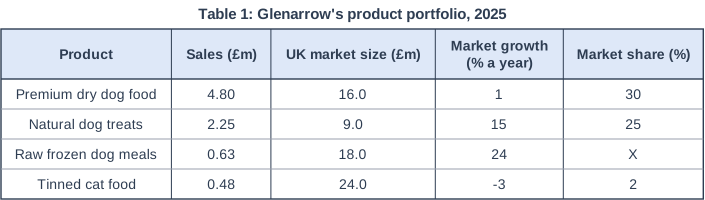
Glenarrow Pet Foods Ltd is a private limited company near Perth in Scotland. It makes pet food from Scottish meat and vegetables and sells it to pet shops, supermarkets and online retailers across the UK. It sells four products, shown in Table 1.
Glenarrow's premium dry dog food has led its market for many years, and it earns most of the company's profit. Its natural dog treats were launched four years ago and have been a great success, but two larger competitors launched similar treats last year and are spending heavily on advertising.
Raw frozen dog meals were launched 18 months ago. Owners who try them often say they are the best they have used, but few shops stock them because they need freezer space, and the frozen delivery vans that Glenarrow hires are expensive. Raw frozen meals are the fastest-growing part of the pet food market.
The tinned cat food was Glenarrow's first product. Its sales have fallen for several years, but some pet shops only stock Glenarrow's dog food because they can buy cat food from the same supplier.
Glenarrow's managers have £400 000 to spend next year on promoting and developing one product. The marketing manager wants to spend it on the natural dog treats to protect their market share. The finance director would prefer to spend it on the raw frozen dog meals, including paying for freezers in 200 pet shops.
Recommend whether Glenarrow should spend the £400 000 on its natural dog treats or on its raw frozen dog meals.
Give reasons for your recommendation. Use the Boston Matrix and the information in Table 1 to support your answer.
Model answer
I recommend that Glenarrow should spend the £400 000 on its raw frozen dog meals.
In the Boston Matrix, the raw frozen meals are a question mark: they have a market share of only 3.5% (£0.63m of an £18.0m market) but are in the fastest-growing part of the pet food market, growing at 24% a year. Their main problem is not the product, as owners who try them say they are the best they have used, but availability: few shops stock them because they need freezer space. Paying for freezers in 200 pet shops would tackle this problem directly, so many more owners could buy the meals. Because the market is large and growing fast, even a small rise in market share would mean a large increase in sales, and the product could become a star.
The natural dog treats are a star, with a 25% share of a market growing at 15% a year. Stars need investment to keep their share, and two larger competitors are now advertising heavily, so the treats could lose share if Glenarrow does nothing. However, the treats already sell well (£2.25 million) and are established in shops, so they may be able to hold their share with a smaller budget.
Glenarrow can afford to take a risk on the question mark because its premium dry dog food is a cash cow: it has a 30% share of a market growing by only 1% a year and earns most of the company's profit. The risk is that the raw frozen meals stay a question mark, or become a dog when the market stops growing, and the expensive frozen delivery vans could keep costs high even if sales rise.
Overall, the raw frozen meals offer the greater growth potential, and the £400 000 targets their biggest barrier. The decision depends on how strongly the competitors attack the treats; if the treats start to lose share quickly, Glenarrow may need to use some of the profit from its cash cow to protect them as well.