Level:
Correct: 0
Incorrect: 0
Marks: 0/0

Break-even

Practise 25 exam-style questions on Break-even for AQA GCSE Business (Paper 2). Write your answer as you would in the exam and get it marked in seconds against the mark scheme, point by point, with the Study Helper on hand if you get stuck.

  • 25 questions
  • 1–12 marks each
  • Instant marking
  • No sign-up needed
20 questions, marked as you go

Sample questions with model answers

Here are 4 of the questions in this topic, each with a model answer, an explanation of why it earns the marks and the mark scheme an examiner would use.

Question 1

1 mark

A business's fixed costs rise, but its selling price and its variable cost per unit stay the same.

Which one of the following will happen?

Choose your answer.

  • Its break-even output will rise
  • Its break-even output will fall
  • Its margin of safety will rise
  • Its total revenue line will become steeper

Model answer

Its break-even output will rise

Explanation

Higher fixed costs move the fixed costs and total costs lines up the chart, so the total costs line meets the total revenue line at a higher output. The business must sell more units to break even, so its margin of safety falls, not rises. The total revenue line depends only on the selling price, which has not changed.

Mark scheme
  1. 1 mark

    Its break-even output will rise

    If more than one option is given, 0 marks.

Question 2

2 marks

Explain the meaning of the term 'margin of safety' using an example.

Model answer

The margin of safety is the amount by which a business's actual sales are above its break-even output, so it shows how far sales could fall before the business makes a loss. For example, if a bakery breaks even at 2 000 loaves a month and sells 2 600 loaves, its margin of safety is 2 600 − 2 000 = 600 loaves.

Explanation

One mark is for describing the margin of safety and one is for an example that shows it being worked out. It is measured in units of output, such as loaves or customers, not in pounds. A bigger margin of safety means the business is less at risk of making a loss if sales fall.

Mark scheme
  1. 1 mark

    A description: the amount by which actual (or planned) output or sales is above the break-even output / how far sales can fall before the business makes a loss / actual output − break-even output

    1 mark for a correct description. Do not accept 'the profit a business makes' or 'how safe a business is' on their own.

  2. 1 mark

    A valid example, e.g. a café that breaks even at 400 meals a week and sells 550 meals a week has a margin of safety of 150 meals

    1 mark for a correct example. The example must be in units of output, not £, and subtract the break-even output from actual output (e.g. 550 − 400 = 150 meals). An example in which the subtraction is the wrong way round, or that uses revenue in £, does not score. The example mark can be given even if the description is weak, as long as the example is correct.

Question 3

4 marks

Item A
Ashgrove Escape Rooms Ltd

Ashgrove Escape Rooms Ltd runs four escape rooms in Leeds. Groups of up to six people pay £100 per booking to solve puzzles and 'escape' within an hour. The Leeds site opened four years ago and now averages about 650 bookings a month. Bookings are highest in the school holidays and in December, and lowest in January.

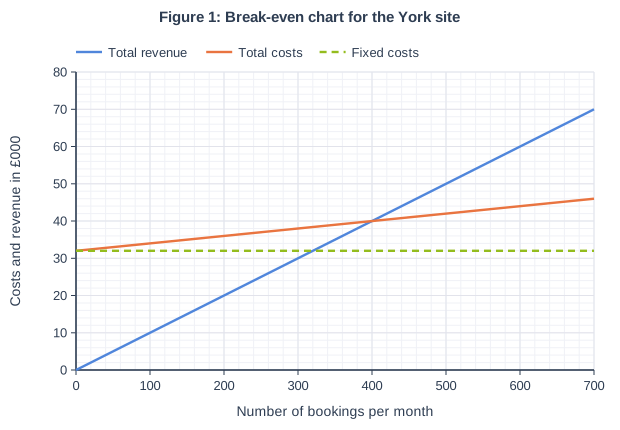
The directors are considering opening a second site, with four new rooms, in York. Fitting out the rooms would cost £180 000, and the building would be rented on a ten-year lease. The directors have drawn the break-even chart in Figure 1 for the York site. Its fixed costs include rent, salaries for the site manager and game hosts, insurance and advertising. Its variable costs include cleaning, replacing broken props and card payment fees.

The directors forecast 600 bookings a month at the York site. The forecast comes from an online survey of 300 of Ashgrove's Leeds customers, about a third of whom live in or near York. One escape room business already operates in York city centre, and its rooms have mixed online reviews. The Leeds site made a profit of £190 000 last year. The directors would pay for the fit-out with £120 000 of retained profit and a bank loan.

Using Figure 1, calculate the margin of safety and the monthly profit for the York site if it has 600 bookings a month.

Show your workings.

Figure 1: Break-even chart for the York site. Line graph of costs and revenue in £000 (y-axis, 0 to 80) against number of bookings per month (x-axis, 0 to 700). "Total revenue" joins the points (0, 0), (700, 70). "Total costs" joins the points (0, 32), (700, 46). "Fixed costs" (dashed) joins the points (0, 32), (700, 32).

Model answer

Break-even output (from Figure 1) = 400 bookings
Margin of safety = 600 − 400 = 200 bookings
At 600 bookings: total revenue = £60 000 and total costs = £44 000 (from Figure 1)
Profit = £60 000 − £44 000 = £16 000 a month

Explanation

The margin of safety is the forecast output minus the break-even output, given in bookings. The profit is the vertical gap between the total revenue and total costs lines at 600 bookings. Remember that the vertical axis is in thousands of pounds, so 60 − 44 = 16 means £16 000, not £16.

Mark scheme
  1. 1 mark

    Break-even output read from Figure 1 = 400 bookings; margin of safety = 600 − 400

    Answers = margin of safety 200 bookings and profit £16 000 a month (4). Correct answers with no working score full marks.

  2. 1 mark

    Margin of safety = 200 bookings

    Accept 200 or 200 bookings; a unit is not required. Do not accept £200 or £20 000 (the margin of safety is a number of bookings, not money). Apply the own figure rule (OFR): if the break-even output is misread, award this mark for subtracting the student's own figure from 600.

  3. 1 mark

    At 600 bookings, total revenue = £60 000 and total costs = £44 000 (read from Figure 1)

    The vertical axis is in £000: accept 60 and 44 here if the profit is then given correctly in pounds.

  4. 1 mark

    Profit = £60 000 − £44 000 = £16 000 a month

    Accept £16 000 or £16k. £16 (not converted from £000) loses this mark. OFR: award this mark for correctly subtracting the student's own readings. An error is penalised once; later steps using the wrong figure correctly earn their marks.

Question 4

9 marks

Item A
Pebblebrook Candle Co.

Sasha set up Pebblebrook Candle Co. as a sole trader two years ago. She makes scented soy candles by hand in a small rented workshop in Harrogate, North Yorkshire, and sells them through her own website and an online marketplace for £12 each. Her fixed costs include the workshop rent, website fees and insurance. Her variable costs are the wax, fragrance oil, glass jar and packaging for each candle.

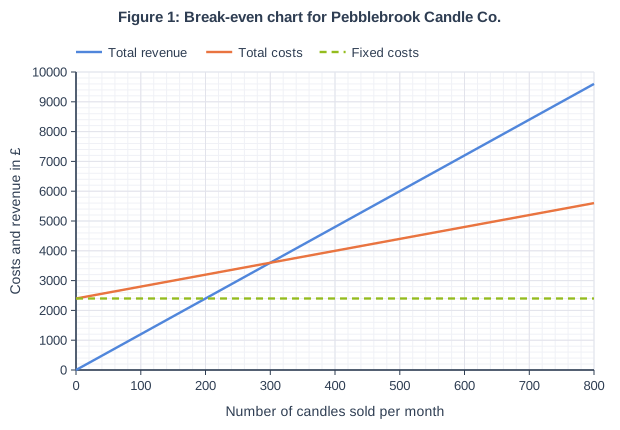
Figure 1 shows Pebblebrook's monthly break-even chart. Sasha currently sells about 500 candles a month. Working alone, she can make at most about 700 candles a month.

Several new candle sellers have appeared on the online marketplace, many charging £9 or £10 for similar candles. Sasha is considering cutting her price to £10. At £10 a candle, Pebblebrook would break even at 400 candles a month. Sasha asked 80 of her regular customers whether they would buy more candles at the lower price, and from their answers she estimates that sales would rise to about 650 candles a month. She calculates that her profit would then be about £1 500 a month.

Pebblebrook's candles have excellent online reviews, and customers often mention that they are hand-poured and sold in plastic-free packaging. Sasha is worried that a lower price might make her candles seem less special.

Sasha wants to compete with the new, cheaper candle sellers.

Recommend whether Sasha should cut the price of her candles from £12 to £10. Give reasons for your recommendation. Use the financial information provided to support your answer.

Figure 1: Break-even chart for Pebblebrook Candle Co.. Line graph of costs and revenue in £ (y-axis, 0 to 10000) against number of candles sold per month (x-axis, 0 to 800). "Total revenue" joins the points (0, 0), (800, 9600). "Total costs" joins the points (0, 2400), (800, 5600). "Fixed costs" (dashed) joins the points (0, 2400), (800, 2400).

Model answer

I recommend that Sasha does not cut her price to £10.

Figure 1 shows that at £12 Pebblebrook breaks even at 300 candles a month. At her current sales of 500 candles, total revenue is £6 000 and total costs are £4 400, so she makes a profit of £1 600 a month, with a margin of safety of 200 candles. If she cut the price to £10, each candle would bring in £2 less, so the total revenue line would be less steep and the break-even output would rise to 400 candles a month.

Sasha estimates that sales would rise to 650 candles at £10, but even then her profit would be about £1 500 a month, £100 less than now. She would have to make 150 more candles every month, which means more hours of work for less profit. Because she can make at most about 700 candles a month, she would be working close to her limit and would struggle to meet extra demand at busy times such as Christmas.

The estimate is also risky. It is based on asking 80 regular customers, who already buy at £12 and may be keener than new customers would be. If sales rose by less than she expects, her profit would be even lower.

There is a case for cutting the price. If her estimate is right, the margin of safety would rise from 200 to 250 candles, and the new sellers charging £9 or £10 could take some of her customers if she stays at £12. However, Pebblebrook's customers praise the hand-poured candles and plastic-free packaging, which suggests that they buy for quality rather than price. A lower price could make the candles seem less special, as Sasha fears.

Overall, Sasha should keep her price at £12 and promote what makes her candles different, such as the plastic-free packaging and her excellent reviews. The price cut would mean more work for less profit, and it would only make sense if her sales at £12 started to fall well below 500 candles a month.

Explanation

A top-level answer reads the chart accurately (break-even at 300 candles, profit of £1 600 at 500 candles) and compares it with the figures for £10 in Item A, showing that the price cut raises the break-even output and does not raise profit. It then weighs this against the threat from cheaper rivals and the reliability of Sasha's estimate before reaching a clear judgement. Answers that say a lower price 'will attract more customers and so more profit' without using the figures stay in the lower levels.

Mark scheme
  1. 9 marks

    Levels of response (9 marks). AO2 = 3, AO3 = 6.
    Level 3 (7-9 marks): Detailed analysis and evaluation of topics based on the context. Sustained line of reasoning, which is coherent, relevant, substantiated with a focused conclusion that is fully justified. Business areas are fully analysed. Applies knowledge and understanding to the context sufficiently.
    Level 2 (4-6 marks): Sound analysis and evaluation of topics based on the context. A line of reasoning, with a conclusion that has some justification. Business areas are partially analysed. Applies some knowledge and understanding to the context.
    Level 1 (1-3 marks): Basic analysis and evaluation of topics based on the context. Basic line of reasoning with a conclusion. Basic analysis of business areas. Basic knowledge and understanding is applied to the context.
    0 marks: nothing to reward.

    Indicative content (not a checklist; credit other valid points): Application: Figure 1 shows that at £12 Pebblebrook breaks even at 300 candles a month; at current sales of 500 candles, total revenue is £6 000 and total costs £4 400, a profit of £1 600 a month, and the margin of safety is 200 candles; at £10 the break-even output rises to 400 candles; Sasha estimates sales of about 650 at £10, a margin of safety of 250 candles and a profit of about £1 500 a month, £100 less than now; she can make at most about 700 candles a month; rivals charge £9 or £10; the estimate comes from asking 80 regular customers; excellent reviews, hand-poured candles and plastic-free packaging; Sasha fears a lower price could make the candles seem less special. Analysis (do not cut): each candle earns £2 less, so the total revenue line is less steep and the break-even output rises from 300 to 400; Sasha must sell about 150 more candles a month for a slightly lower profit, so she works harder for less; 650 candles is close to her limit of 700, leaving little spare capacity for busy periods; regular customers who already pay £12 may not be typical, so the estimate may be too high, and if sales rose by less, profit would fall further; customers seem to buy for quality, so a lower price could damage the brand. Analysis (cut): if the estimate is right, the margin of safety rises from 200 to 250 candles; keeping £12 may lose customers to cheaper rivals, so sales of 500 may not last; more customers could lead to more reviews and repeat sales. Evaluation (what does it depend on?): whether sales at £12 will fall as rivals grow; how reliable an estimate based on 80 regular customers is; whether Sasha can make 650 candles a month; whether she could compete on quality instead, or cut the price of only some candles. Accept a justified recommendation either way. Because the question asks students to use the financial information, Level 3 needs figures from Figure 1 and Item A (e.g. break-even rising from 300 to 400, the £1 600 and £1 500 profits, or the margins of safety of 200 and 250) and a judgement on the risk in the estimate. A generic answer that does not use the case cannot go above Level 2, however well developed.

Ready to try the rest? Every answer you write is marked against the mark scheme, so you can see exactly where the marks are.

Study Helper Hints first, answers after you try

Stuck on this one? Ask for a hint and I’ll point you in the right direction, without giving the answer away. Once you’ve checked your answer, I’ll show you how the marks are awarded.