Level:
Correct: 0
Incorrect: 0
Marks: 0/0

Globalisation

Practise 17 exam-style questions on Globalisation for AQA GCSE Business (Paper 2). Write your answer as you would in the exam and get it marked in seconds against the mark scheme, point by point, with the Study Helper on hand if you get stuck.

  • 17 questions
  • 1–12 marks each
  • Instant marking
  • No sign-up needed
17 questions, marked as you go

Sample questions with model answers

Here are 4 of the questions in this topic, each with a model answer, an explanation of why it earns the marks and the mark scheme an examiner would use.

Question 1

1 mark

A UK retailer imports all of its stock from Japan and pays for it in Japanese yen.

Which one of the following is most likely to increase the retailer's profit margins?

Choose your answer.

  • A rise in the value of the pound against the yen
  • A fall in the value of the pound against the yen
  • A rise in the cost of shipping from Japan
  • A fall in the retailer's UK selling prices

Model answer

A rise in the value of the pound against the yen

Explanation

If the pound rises against the yen, each pound buys more yen, so stock from Japan costs the retailer fewer pounds and its profit margin rises if it keeps its prices the same. A fall in the pound would make its imports dearer, and higher shipping costs or lower selling prices would both cut its margins.

Mark scheme
  1. 1 mark

    A rise in the value of the pound against the yen

    If more than one option is given, 0 marks.

Question 2

2 marks

Explain one drawback of globalisation for a UK business.

Model answer

Globalisation means more foreign businesses can sell in the UK, often at lower prices. This increases competition, so a UK business may lose sales or have to cut its prices, which reduces its profit.

Explanation

The main drawbacks of globalisation for UK businesses are tougher competition, uncertainty from exchange rates and the cost of adapting to other countries' customers. The second mark needs a consequence for the business, such as lost sales, lower prices or higher costs. A drawback for consumers or the government does not answer the question.

Mark scheme
  1. 1 mark

    Identifies a drawback: more competition from foreign businesses (in the UK and abroad) / changes in exchange rates / need to adapt products, labels or promotion for other countries / language or cultural differences / higher transport costs or delivery delays

    1 mark for identifying a drawback linked to globalisation.

  2. 1 mark

    Explains the drawback: so it may lose sales / market share / have to cut prices, reducing profit / so its revenue or costs in pounds become uncertain / so its marketing costs rise / so customers abroad may not buy its products

    1 mark for explaining the consequence of the drawback. Examples of developed answers: Foreign businesses can sell more easily in the UK, often at lower prices (1), so the UK business may lose customers and have to cut its prices, reducing its profit (1). Exchange rates change (1), so the pounds it receives from sales abroad can fall, making its profit uncertain (1).

Question 3

4 marks

State and explain two ways a UK business could compete with foreign businesses in international markets.

Model answer

Way 1: Offer better designs than foreign rivals, such as a more stylish or award-winning product. This gives the business a USP, so customers abroad are willing to choose it even if it is not the cheapest.
Way 2: Offer lower prices, for example by buying materials in bulk to cut costs. This makes its products more attractive than foreign rivals' products to price-conscious customers, increasing its sales.

Explanation

UK businesses compete internationally by offering better designs, higher quality or lower prices, often supported by a strong brand. Each explanation must show how the way helps the business win customers from foreign rivals. Make sure the two ways are genuinely different.

Mark scheme
  1. 1 mark

    States a first way: better designs / higher quality / lower prices / a strong brand or USP (eg 'Made in Britain') / adapting products or promotion to local customers / selling online to reach customers abroad / better customer service

    Max 4: 1 mark for stating each way and 1 mark for explaining it (× 2).

  2. 1 mark

    Explains the first way (how it helps the business compete)

    Example of a developed answer: It could offer a better design than its rivals (1), giving it a USP, so customers abroad choose it even if it is not the cheapest (1).

  3. 1 mark

    States a second, different way

    The two ways must be different; 'better quality' and 'higher quality materials' count as one way.

  4. 1 mark

    Explains the second way (how it helps the business compete)

    Example of a developed answer: It could cut its prices by buying materials in bulk (1), which makes its products more attractive to price-conscious customers abroad and increases its sales (1).

Question 4

9 marks

Item A
Kittiwake Chocolate Ltd

Kittiwake Chocolate Ltd makes handmade chocolates in Alnwick, Northumberland. Its chocolate bars and gift boxes, decorated with drawings of seabirds, are sold in its own shop, in 40 UK gift shops and through its website. Sales in the UK have grown slowly over the last two years, and the UK market for luxury chocolate is very competitive.

A chain of 25 delicatessens in Germany has offered to stock Kittiwake's gift boxes. Its buyer was impressed by the quality and designs, but wants the packaging printed in German. The chain would pay Kittiwake in euros, at a price in euros that would be fixed for the first year.

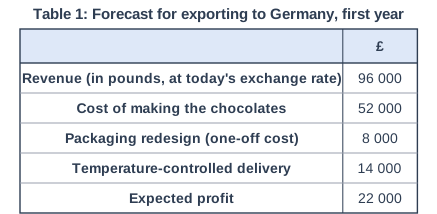
To export to Germany, Kittiwake would need to redesign its packaging and pay for temperature-controlled delivery. Table 1 shows the managing director's forecast for the first year.

Over the last two years the value of the pound against the euro has changed by up to 5% in either direction. Kittiwake's finance manager is worried that, because the price in euros would be fixed, a rise in the value of the pound would mean Kittiwake receives fewer pounds for each box. Kittiwake has never exported before, and its small office team would need to spend time on the paperwork for exporting.

Recommend whether Kittiwake should accept the offer to sell its gift boxes in Germany.

Give reasons for your recommendation.

Table 1: Forecast for exporting to Germany, first year. Table with columns (row headings), "£". Revenue (in pounds, at today's exchange rate); £: 96 000 | Cost of making the chocolates; £: 52 000 | Packaging redesign (one-off cost); £: 8 000 | Temperature-controlled delivery; £: 14 000 | Expected profit; £: 22 000.

Model answer

I recommend that Kittiwake should accept the offer from the German chain.

The offer gives Kittiwake access to a new market at a time when its UK sales are growing only slowly and the UK luxury chocolate market is very competitive. Selling in 25 delicatessens in Germany would spread its risk across two markets, and the buyer already values its quality and designs, so the boxes are likely to sell. Table 1 forecasts revenue of £96 000 and a profit of £22 000 in the first year, a margin of about 23%. The £8 000 packaging redesign is a one-off cost, so if sales continue at the same level, profit in the second year could be about £30 000.

However, there are risks. The price in euros would be fixed for a year, so if the value of the pound rose by 5%, as it has done in the past, Kittiwake would receive about 5% fewer pounds, roughly £4 500 less revenue. As its costs are in pounds, this would cut the expected profit by about a fifth. Exporting is also new to Kittiwake: the paperwork will take up the time of its small office team, and temperature-controlled delivery costs £14 000. If the forecast is too optimistic, the profit could be much smaller than £22 000.

On balance, the benefits outweigh the risks. Even with a 5% rise in the pound, Kittiwake would still expect a profit of over £17 000 in the first year, and the exchange rate could just as easily move in its favour. The decision depends on how accurate the sales forecast is and how much time exporting takes, so Kittiwake should check that the chain plans to order regularly and agree the euro price carefully before signing.

Explanation

The best answers use Table 1 and the exchange rate information together, for example working out roughly how a 5% rise in the pound would reduce the pounds received and so the £22 000 profit. They weigh the benefits of a new market against the risks of a fixed euro price and a lack of exporting experience, and reach a justified decision. Remember that a rise in the pound reduces the pounds a UK exporter receives when its foreign price is fixed.

Mark scheme
  1. 9 marks

    Levels of response (9 marks). AO2 = 3, AO3 = 6.
    Level 3 (7-9 marks): Detailed analysis and evaluation of topics based on the context. Sustained line of reasoning, which is coherent, relevant, substantiated with a focused conclusion that is fully justified. Business areas are fully analysed. Applies knowledge and understanding to the context sufficiently.
    Level 2 (4-6 marks): Sound analysis and evaluation of topics based on the context. A line of reasoning, with a conclusion that has some justification. Business areas are partially analysed. Applies some knowledge and understanding to the context.
    Level 1 (1-3 marks): Basic analysis and evaluation of topics based on the context. Basic line of reasoning with a conclusion. Basic analysis of business areas. Basic knowledge and understanding is applied to the context.
    0 marks: nothing to reward.

    Indicative content (not a checklist; credit other valid points): Application: UK sales growing slowly in a very competitive market; offer from 25 German delicatessens whose buyer was impressed by the quality and designs; paid in euros at a price fixed for the first year; packaging must be printed in German; Table 1: revenue £96 000, cost of making £52 000, packaging redesign £8 000 (one-off), delivery £14 000, expected profit £22 000 (a margin of about 23%); the pound has moved by up to 5% either way against the euro; no exporting experience; small office team and export paperwork.
    Analysis for: a new, large market and more sales when UK growth is slow; spreads risk across two countries; profit of £22 000 in the first year, which could rise to about £30 000 a year once the one-off £8 000 redesign is paid for; the buyer already values Kittiwake's quality and designs, so its USP works abroad; a fall in the pound would increase the pounds received.
    Analysis against: with a fixed euro price, a 5% rise in the pound would cut the pounds received by about 5% (roughly £4 500 to £4 800), about a fifth of the expected profit, because costs are in pounds; delivery and redesign costs are high; paperwork takes the small team's time away from UK sales; the forecast may be optimistic.
    Evaluation: depends on how the exchange rate moves; how reliable the forecast is; whether the chain will keep ordering after the first year; whether Kittiwake can cope with the extra workload. Either recommendation can reach Level 3.
    Level 3 needs a justified recommendation using Table 1 and the exchange rate information, with the effect of exchange rate changes explained correctly. A generic answer that does not use the case cannot go above Level 2, however well developed.

Ready to try the rest? Every answer you write is marked against the mark scheme, so you can see exactly where the marks are.

Study Helper Hints first, answers after you try

Stuck on this one? Ask for a hint and I’ll point you in the right direction, without giving the answer away. Once you’ve checked your answer, I’ll show you how the marks are awarded.