Level:
Correct: 0
Incorrect: 0
Marks: 0/0

The economic climate on businesses

Practise 17 exam-style questions on The economic climate on businesses for AQA GCSE Business (Paper 2). Write your answer as you would in the exam and get it marked in seconds against the mark scheme, point by point, with the Study Helper on hand if you get stuck.

  • 17 questions
  • 1–12 marks each
  • Instant marking
  • No sign-up needed
17 questions, marked as you go

Sample questions with model answers

Here are 4 of the questions in this topic, each with a model answer, an explanation of why it earns the marks and the mark scheme an examiner would use.

Question 1

1 mark

Which one of the following is the most likely reason why a fall in interest rates increases consumer spending?

Choose your answer.

  • Borrowing becomes cheaper
  • Saving becomes more rewarding
  • Unemployment rises
  • Businesses must cut their prices

Model answer

Borrowing becomes cheaper

Explanation

When interest rates fall, loans, credit cards and finance deals cost less, so consumers are more willing to borrow and spend. Lower rates make saving less rewarding, not more, which also encourages people to spend rather than save.

Mark scheme
  1. 1 mark

    Borrowing becomes cheaper

    If more than one option is given, 0 marks.

Question 2

2 marks

Explain one reason why a rise in interest rates may reduce consumer spending.

Model answer

When interest rates rise, the interest on loans and credit cards goes up. This means consumers are less willing to borrow to buy expensive items such as cars or furniture, so their spending falls.

Explanation

Higher interest rates affect consumers in three main ways: borrowing costs more, variable mortgage payments rise and saving pays more. Each of these leads to less spending, especially on items bought on credit. To gain the second mark, link the reason to spending rather than just stating a second reason.

Mark scheme
  1. 1 mark

    Identifies a way higher interest rates affect consumers: loans / credit cards / finance deals cost more to borrow / (variable) mortgage repayments rise / saving becomes more rewarding

    1 mark for identifying the effect on consumers. Do not credit 'prices go up' unless it is linked to the cost of borrowing.

  2. 1 mark

    Explains how this reduces spending: so consumers borrow less to buy goods (especially expensive items bought on credit) / so they have less disposable income left to spend / so they save more of their income instead of spending it

    1 mark for explaining the consequence for spending. The second mark cannot be given for a second, unlinked reason. Examples of developed answers: Loans and credit cards become more expensive (1) so consumers borrow less to buy expensive items such as cars and furniture (1). Homeowners' mortgage payments rise (1), leaving them less disposable income to spend on other goods (1). Saving becomes more rewarding (1), so people put money into savings rather than spending it (1).

Question 3

4 marks

Item A
Moorland Hot Tubs

Moorland Hot Tubs is owned by Gareth, a sole trader. He has a showroom near Harrogate in North Yorkshire, where he sells hot tubs priced between £4 000 and £9 000 and offers a delivery and installation service. His main target market is homeowners aged 35 to 60.

About two-thirds of Moorland's customers pay for their hot tub with a personal loan that Gareth arranges through a finance company. Over the past year, the interest rate on these loans has risen from 7% to 11% a year. Many of Gareth's customers also have mortgages, and several have told him that their monthly mortgage payments have gone up.

Gareth spends £1 200 a month on online advertising and has just ordered £30 000 of extra stock for the spring, which is usually his busiest season. He has noticed that more people are visiting the showroom 'just to look', and that he took fewer orders in the last three months than in the same three months last year.

Explain how the rise in interest rates may affect the demand for Moorland's hot tubs.

You should use the information in Item A in your answer.

Model answer

About two-thirds of Moorland's customers buy their hot tub with a personal loan, and the rate on these loans has risen from 7% to 11% a year. This makes each monthly repayment bigger, so a £4 000 to £9 000 hot tub now costs customers more in total and some will delay or cancel their purchase. At the same time, many customers' mortgage payments have risen, leaving them less disposable income. A hot tub is a luxury, not an essential, so it is one of the first purchases people give up. This explains why more people are 'just looking' and Gareth is taking fewer orders, so demand for his hot tubs is likely to fall.

Explanation

Level 2 answers explain how the interest rate rise works through to demand and use the case, for example the two-thirds of customers who use loans or the rise from 7% to 11%. A hot tub is an expensive luxury bought on credit, so its demand is especially sensitive to the cost of borrowing. Answers that simply state 'demand will fall', without explaining why or using Moorland's information, stay in Level 1.

Mark scheme
  1. 4 marks

    Levels of response (4 marks). AO1 = 2, AO2 = 2.
    Level 2 (3-4 marks): Sound understanding and application of the topics. Applies knowledge and understanding to the context sufficiently. A sound understanding of one or more business concepts and issues.
    Level 1 (1-2 marks): Basic understanding and application of the topics. Applies basic knowledge and understanding to the context. A basic understanding of one or more business concepts.
    0 marks: nothing to reward.

    Indicative content (not a checklist; credit other valid points): Knowledge and application: about two-thirds of customers buy with a personal loan, and the loan rate has risen from 7% to 11% - repayments are higher, so a hot tub costing £4 000 to £9 000 costs more in total and some customers delay or cancel; many customers' mortgage payments have gone up - less disposable income to spend on non-essential items; a hot tub is an expensive luxury, so it is one of the first purchases to be cut; more people are 'just looking' and orders are lower than last year - evidence that demand is falling; target market of homeowners aged 35 to 60 is likely to have mortgages, so it is directly affected.
    Level 2 needs a sound explanation of how higher interest rates reduce demand, applied to Moorland (eg the two-thirds of customers using loans, the rise from 7% to 11% or the price of a hot tub). An answer that is not applied to Moorland cannot go above Level 1.

Question 4

9 marks

Item A
Tala Jewellery

Tala is a sole trader who makes handmade silver jewellery in a small workshop in Cardiff. She sells through her own website and at craft markets. Her rings, earrings and necklaces sell for £35 to £90, and her customers are mainly people aged 18 to 30 buying gifts.

Over the past two years, unemployment in the area where most of her customers live has fallen and many local employers have raised wages. Tala's sales have grown by 20% in that time.

Tala is considering launching a range of gold engagement and wedding rings priced from £450 to £1 200. To do this she would need to spend £9 000 on gold, tools and marketing. She would use £5 000 of her savings and take out a bank loan for the rest, at a fixed interest rate of 8% a year. A gold ring takes three times as long to make as a silver piece, so she would make fewer silver items.

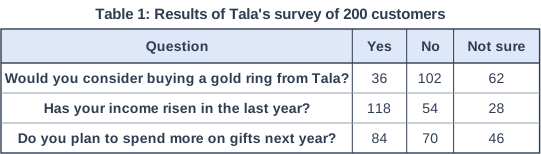
Tala carried out a survey of 200 of her customers. The results are shown in Table 1.

A friend who runs a gift shop has warned her: 'If the economy slows down, expensive items like gold rings are the first things people stop buying.'

Recommend whether Tala should launch the range of gold rings.

Give reasons for your recommendation.

Table 1: Results of Tala's survey of 200 customers. Table with columns "Question", "Yes", "No", "Not sure". Question: Would you consider buying a gold ring from Tala?; Yes: 36; No: 102; Not sure: 62 | Question: Has your income risen in the last year?; Yes: 118; No: 54; Not sure: 28 | Question: Do you plan to spend more on gifts next year?; Yes: 84; No: 70; Not sure: 46.

Model answer

I recommend that Tala should launch the gold ring range, but carefully.

The economic climate supports the launch. Unemployment in the area where most of her customers live has fallen and many employers have raised wages, so customers have more disposable income. Her sales have grown by 20% in two years, and 59% of the customers she surveyed (118 out of 200) say their income has risen, while 42% plan to spend more on gifts next year. Gold engagement and wedding rings at £450 to £1 200 are luxury purchases, and demand for luxuries rises most when incomes rise. Her £4 000 loan is at a fixed 8%, so the interest is only about £320 a year and will not rise.

However, there are risks. Only 36 of the 200 customers (18%) would consider buying a gold ring from her, and 102 (51%) said no. Her customers are mainly 18 to 30 year olds buying gifts at £35 to £90, so the gold range is a big jump in price. As her friend warns, if the economy slows and unemployment rises, expensive items such as gold rings are the first purchases people cut, which would leave Tala with £9 000 spent on gold, tools and marketing and a loan to repay. Gold rings also take three times as long to make, so she would make fewer silver pieces, which are her proven sellers.

On balance, she should launch the range because incomes are rising now, and even a small number of sales at £450 to £1 200 would bring in far more than the same number of silver pieces. The decision depends on how long the good economic conditions last, so she should start with a small range, make rings to order where possible and keep making silver pieces, so that she does not rely too heavily on a luxury product.

Explanation

Top answers link the economic climate to demand: rising employment and wages increase disposable income, and demand for luxury items such as gold rings rises most. They use the survey data, such as the 18% who are interested and the 59% whose incomes have risen, and weigh the risk that an economic slowdown would hit expensive items first. A recommendation either way can reach Level 3 if it is justified with Tala's information.

Mark scheme
  1. 9 marks

    Levels of response (9 marks). AO2 = 3, AO3 = 6.
    Level 3 (7-9 marks): Detailed analysis and evaluation of topics based on the context. Sustained line of reasoning, which is coherent, relevant, substantiated with a focused conclusion that is fully justified. Business areas are fully analysed. Applies knowledge and understanding to the context sufficiently.
    Level 2 (4-6 marks): Sound analysis and evaluation of topics based on the context. A line of reasoning, with a conclusion that has some justification. Business areas are partially analysed. Applies some knowledge and understanding to the context.
    Level 1 (1-3 marks): Basic analysis and evaluation of topics based on the context. Basic line of reasoning with a conclusion. Basic analysis of business areas. Basic knowledge and understanding is applied to the context.
    0 marks: nothing to reward.

    Indicative content (not a checklist; credit other valid points): Application: unemployment in her customers' area has fallen and many employers have raised wages; sales up 20% in two years; gold rings £450 to £1 200 compared with silver pieces at £35 to £90; customers mainly aged 18 to 30 buying gifts; £9 000 needed (£5 000 savings, £4 000 loan at a fixed 8%, about £320 interest a year); gold rings take three times as long to make; survey: 36 of 200 (18%) would consider a gold ring, 102 (51%) would not, 62 (31%) not sure; 118 (59%) say their income has risen; 84 (42%) plan to spend more on gifts; friend's warning about an economic slowdown.
    Analysis for: rising employment and wages increase disposable income, and demand for luxuries such as gold rings rises most when incomes rise; a 59% share of customers with rising incomes and 42% planning to spend more suggest demand is there; each gold ring sells for many times the price of a silver piece, so a few sales could add a lot of revenue; the fixed-rate loan means interest costs will not rise.
    Analysis against: only 18% would consider buying, and the range is a big step up from her £35 to £90 gift market; if the economy slows and unemployment rises, expensive non-essential items are cut first, leaving Tala with money tied up and a loan to repay; she would make fewer silver pieces, her proven sellers, so she could lose silver sales (opportunity cost); she would be risking her own savings.
    Evaluation: depends on how long the strong economic conditions last; whether the 'not sure' customers would buy; whether she could start small or make rings to order; whether she could reach a new target market such as couples planning weddings. Either recommendation can reach Level 3.
    Level 3 needs a justified recommendation that links the economic climate (incomes and employment) to demand for gold rings, using the survey data or other case evidence. A generic answer that does not use the case cannot go above Level 2, however well developed.

Ready to try the rest? Every answer you write is marked against the mark scheme, so you can see exactly where the marks are.

Study Helper Hints first, answers after you try

Stuck on this one? Ask for a hint and I’ll point you in the right direction, without giving the answer away. Once you’ve checked your answer, I’ll show you how the marks are awarded.