Level:
Correct: 0
Incorrect: 0
Marks: 0/0

Stakeholders

Practise 17 exam-style questions on Stakeholders for AQA GCSE Business (Paper 2). Write your answer as you would in the exam and get it marked in seconds against the mark scheme, point by point, with the Study Helper on hand if you get stuck.

  • 17 questions
  • 1–12 marks each
  • Instant marking
  • No sign-up needed
17 questions, marked as you go

Sample questions with model answers

Here are 4 of the questions in this topic, each with a model answer, an explanation of why it earns the marks and the mark scheme an examiner would use.

Question 1

1 mark

A fast-food takeaway plans to stay open until 2am at weekends to increase its sales.

Which one of the following stakeholder groups is most likely to object to this plan?

Choose your answer.

  • Its owners
  • Its suppliers
  • Its customers
  • The local community

Model answer

The local community

Explanation

Local residents are likely to object because late opening may bring noise, litter and traffic late at night, which goes against their objective of the business having little impact on the area. The owners want the extra sales and profit, suppliers will receive bigger orders, and customers gain more choice of when to buy. A single business decision often benefits some stakeholders and harms others, which is why conflict between stakeholders arises.

Mark scheme
  1. 1 mark

    The local community

    Accept 'local residents' / 'people living nearby' as identifying this option. If more than one option is given, 0 marks.

Question 2

2 marks

A bank that lends money to a business is one of the business's stakeholders.

Explain one way a bank can influence the decisions of a business it lends to.

Model answer

The bank may refuse to increase the business's overdraft limit. The business would then have less cash available, so it might have to delay its plan to open a new shop or cut its spending on promotion until its cash flow improves.

Explanation

Lenders such as banks are stakeholders because they want their loans repaid with interest, and they influence a business through whether they lend, how much interest they charge and the conditions they set. The first mark is for the way the bank influences the business and the second for the effect on the business's decisions, such as delaying expansion or raising prices. Saying only that the bank lends money does not explain any influence.

Mark scheme
  1. 1 mark

    Identifies a way the bank can influence the business: refusing to lend more or to increase the overdraft limit / raising the interest rate it charges / asking for security (eg the business's premises or the owner's home) / asking to see a business plan or cash-flow forecast before it lends / setting conditions on a loan / asking for an overdraft to be repaid

    Do not accept 'the bank lends money' with no link to influence. Do not accept answers about the business's own bank account or savings.

  2. 1 mark

    Explains how this affects the business's decisions: eg it has to delay or cancel plans such as expansion or a marketing campaign / it must find another source of finance, eg retained profit or selling shares / it must cut costs or improve its cash flow / higher interest costs reduce its profit, so it may raise its prices or cut spending / it has to plan its finances more carefully

    Examples of developed answers: The bank may refuse to increase the business's overdraft limit (1), so the business may have to delay its plan to expand or cut its spending on promotion (1). The bank may raise the interest rate on a loan (1), so interest costs rise and profit falls, and the business may decide to raise its prices (1). The bank may ask to see a business plan before lending (1), so the owners must set objectives and forecast their cash flow before they can go ahead (1). Do not award the second mark for a vague consequence such as 'the business will lose out'.

Question 3

4 marks

Item A
Lumen Cosmetics Ltd

Lumen Cosmetics Ltd is a private limited company in Manchester that makes vegan skincare products. It sells online through its own website and social media, mainly to customers aged 18-30 who care about the environment. Lumen has three shareholders: its founder, Priya, and two friends who each invested £20 000 in the business in 2022. Last year Lumen made a net profit of £52 000 and paid its first dividend.

In March, Lumen changed the packaging of its best-selling moisturiser from glass jars to plastic tubes, saving 45p per item. Within weeks, hundreds of customers posted complaints on social media saying that the change went against Lumen's eco-friendly brand image. A beauty blogger with 250 000 followers posted a video criticising the change. Lumen's average customer rating fell from 4.8 to 3.9 stars, and its monthly online sales fell from £38 000 to £31 500.

Priya now wants to move all of Lumen's products into refillable glass jars. Customers would buy a jar once and then buy refill pouches, which would be cheaper than buying a new product each time. The change would cost £14 000 to set up and would add 60p to the cost of each item. A rival brand that offers refills has seen its sales grow by 30% this year.

The other two shareholders are against the idea. They think that customers will soon forget the complaints, and that the £14 000 should be paid out as dividends instead.

Explain one way Lumen's customers have influenced the business.

You should use the information in Item A in your answer.

Model answer

Lumen's customers have influenced the business by complaining publicly about its packaging. When the moisturiser moved from glass to plastic, hundreds of customers posted complaints on social media and a blogger with 250 000 followers criticised the change. This damaged Lumen's eco-friendly brand image, and its rating fell from 4.8 to 3.9 stars, which puts off new online customers. As a result, monthly sales fell from £38 000 to £31 500, a fall of £6 500. This pressure has forced Priya to rethink the decision, and she now wants to spend £14 000 moving all products into refillable glass jars.

Explanation

The top level needs a clear chain from the customers' action (complaints, reviews, buying less) to its effect on Lumen (a lower rating, sales down £6 500 a month, a possible change of packaging). Quoting the case figures shows application. Describing what customers want without showing how they changed Lumen's decisions or performance stays in Level 1.

Mark scheme
  1. 4 marks

    Levels of response (4 marks). AO1 = 2, AO2 = 2.
    Level 2 (3-4 marks): Sound understanding and application of the topics. Applies knowledge and understanding to the context sufficiently. A sound understanding of one or more business concepts and issues.
    Level 1 (1-2 marks): Basic understanding and application of the topics. Applies basic knowledge and understanding to the context. A basic understanding of one or more business concepts.
    0 marks: nothing to reward.

    Indicative content (not a checklist; credit other valid points): Knowledge and application: customers influence a business through what they buy, complaints, reviews and social media. Evidence from Item A: hundreds of complaints on social media after the switch to plastic tubes; a beauty blogger with 250 000 followers criticised the change; the average rating fell from 4.8 to 3.9 stars; monthly online sales fell from £38 000 to £31 500 (a fall of £6 500, about 17.1%); Priya now wants to spend £14 000 moving all products into refillable glass jars; customers are aged 18-30 and care about the environment. Developed points: complaints damaged the eco-friendly brand image, and the lower rating puts off new online customers, so sales fell, forcing Priya to rethink the packaging decision; customers' reaction has also caused a disagreement between the shareholders about whether to spend £14 000 on refills or pay dividends. An answer that is not applied to Lumen cannot go above Level 1. Level 2 needs a developed explanation of one way, using evidence from Item A.

Question 4

9 marks

Item A
Brackenridge Outdoor plc

Brackenridge Outdoor plc sells walking boots, waterproof clothing and camping equipment through 140 stores across the UK and an online shop. Its shares are traded on the stock exchange and it has about 9 000 shareholders. Many of them are retired people who rely on the dividend they receive each year as part of their income.

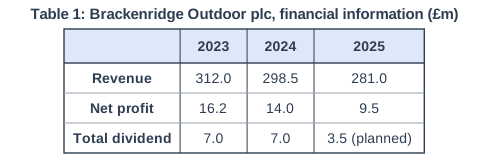
Online-only retailers with lower prices have taken many of Brackenridge's younger customers. Table 1 shows that revenue and net profit have fallen for two years in a row, and the share price has dropped by 18% in the last twelve months.

The directors want to spend £6.0m of the 2025 net profit on a two-year marketing campaign, including television adverts and a new loyalty app aimed at customers aged 18-30. They forecast that the campaign could increase revenue by 5% in each of the next two years, although a similar campaign by a rival last year had little effect on its sales. To afford the campaign, the directors plan to cut the total dividend from £7.0m to £3.5m.

Several large investors have said that they will vote against the directors at the annual general meeting, and may sell their shares, if the dividend is cut. Brackenridge may also need to issue new shares within the next three years to pay for upgrading its online shop.

Recommend whether Brackenridge Outdoor plc should cut its dividend to pay for the marketing campaign.

Give reasons for your recommendation.

Table 1: Brackenridge Outdoor plc, financial information (£m). Table with columns (row headings), "2023", "2024", "2025". Revenue; 2023: 312.0; 2024: 298.5; 2025: 281.0 | Net profit; 2023: 16.2; 2024: 14.0; 2025: 9.5 | Total dividend; 2023: 7.0; 2024: 7.0; 2025: 3.5 (planned).

Model answer

I recommend that Brackenridge should cut the dividend to pay for the campaign, but explain the reasons clearly to its shareholders.

Brackenridge's performance is getting worse. Net profit has fallen from £16.2m in 2023 to £9.5m in 2025, a fall of 32.1% in the last year alone, and revenue has fallen from £312.0m to £281.0m because online rivals are taking its younger customers. If nothing changes, profit is likely to keep falling, and the business cannot keep paying £7.0m of dividends out of a shrinking profit - in 2025 that would be almost three-quarters of net profit. A campaign aimed at 18-30 year olds tackles the cause of the problem. If revenue rises by 5% a year, that is about £14m of extra sales in the first year, which should raise profit and allow the dividend to rise again in future. Using £6.0m of retained profit also means no interest has to be paid, unlike a loan.

However, the cut has real costs for shareholders. Many are retired and rely on the dividend as income, so halving it from £7.0m to £3.5m directly reduces their income. Large investors have threatened to sell their shares, and with the share price already down 18%, more selling would push it lower still. That would make it harder to raise money when Brackenridge needs to issue new shares for its online shop. There is also a risk that the campaign fails, as a rival's similar campaign did, so shareholders could lose income for no gain.

On balance, the cut is justified because the shareholders' long-term interest is a business that survives and grows; falling profits and a falling share price will hurt them more than one lower dividend. The decision depends on whether the 5% forecast is realistic, so the directors should test the adverts and loyalty app before spending the full £6.0m, and explain to shareholders how the campaign is expected to protect future dividends.

Explanation

Top answers use the figures - profit down 32.1%, the dividend halved and the share price down 18% - and weigh the shareholders' need for income now against the growth the campaign could bring. Consider how shareholders could influence the business, eg by selling shares or voting against the directors. A conclusion that ignores one side, or does not say what the decision depends on, stays in Level 2.

Mark scheme
  1. 9 marks

    Levels of response (9 marks). AO2 = 3, AO3 = 6.
    Level 3 (7-9 marks): Detailed analysis and evaluation of topics based on the context. Sustained line of reasoning, which is coherent, relevant, substantiated with a focused conclusion that is fully justified. Business areas are fully analysed. Applies knowledge and understanding to the context sufficiently.
    Level 2 (4-6 marks): Sound analysis and evaluation of topics based on the context. A line of reasoning, with a conclusion that has some justification. Business areas are partially analysed. Applies some knowledge and understanding to the context.
    Level 1 (1-3 marks): Basic analysis and evaluation of topics based on the context. Basic line of reasoning with a conclusion. Basic analysis of business areas. Basic knowledge and understanding is applied to the context.
    0 marks: nothing to reward.

    Indicative content (not a checklist; credit other valid points): Application: about 9 000 shareholders, many retired and relying on the dividend for income; the total dividend would be halved from £7.0m to £3.5m; net profit fell from 16.2m (2023) to 14.0m (2024) to 9.5m (2025), a fall of 32.1% in the last year; revenue fell from 312.0m to 281.0m; the share price is down 18% in twelve months; the campaign costs £6.0m over two years and is aimed at 18-30 year olds (TV adverts and a loyalty app); forecast revenue growth of 5% a year (about 14m on 2025 revenue); a rival's similar campaign had little effect; large investors may vote against the directors and sell their shares; new shares may be needed within three years for the online shop. Analysis (cut the dividend): revenue and profit are falling because online rivals are taking younger customers, so without action future profits, and so future dividends, are likely to keep falling; paying 7.0m out of 9.5m profit (about 74%) leaves little to invest; the campaign could win back younger customers and raise revenue and profit, allowing higher dividends later; retained profit is internal finance with no interest to pay; long-term survival protects the shareholders' investment and employees' jobs. Analysis (do not cut): halving the dividend reduces the income of retired shareholders who rely on it; large investors may sell, pushing the share price down further, so a future share issue for the online shop would raise less; a vote against the directors creates conflict and could lead to them being replaced; the campaign may fail, as the rival's did, so shareholders could lose income for little gain. Evaluation (what does it depend on?): how likely the 5% revenue growth is and how much extra profit it brings; whether most shareholders want income now or growth in the value of their shares; whether a smaller cut, a cheaper online-only campaign or another source of finance would work; how far the share price might fall. Any well-justified recommendation is acceptable, including a compromise such as a smaller cut. A generic answer that does not use the case cannot go above Level 2, however well developed. Level 3 needs a focused conclusion that weighs the shareholders' objective of dividends against the long-term benefit of the campaign, using evidence from Item A and Table 1.

Ready to try the rest? Every answer you write is marked against the mark scheme, so you can see exactly where the marks are.

Study Helper Hints first, answers after you try

Stuck on this one? Ask for a hint and I’ll point you in the right direction, without giving the answer away. Once you’ve checked your answer, I’ll show you how the marks are awarded.