Level:
Correct: 0
Incorrect: 0
Marks: 0/0

Segmentation

Practise 22 exam-style questions on Segmentation for AQA GCSE Business (Paper 2). Write your answer as you would in the exam and get it marked in seconds against the mark scheme, point by point, with the Study Helper on hand if you get stuck.

  • 22 questions
  • 1–12 marks each
  • Instant marking
  • No sign-up needed
20 questions, marked as you go

Sample questions with model answers

Here are 4 of the questions in this topic, each with a model answer, an explanation of why it earns the marks and the mark scheme an examiner would use.

Question 1

1 mark

Which one of the following is the main reason why businesses segment their markets?

Choose your answer.

  • To target the needs of different groups of customers more precisely
  • To sell exactly the same product to every customer in the same way
  • To reduce the number of competitors in the market
  • To avoid the need to carry out market research

Model answer

To target the needs of different groups of customers more precisely

Explanation

Segmentation divides a market into groups with similar characteristics so that a business can design products, prices and promotion that meet each group's needs more precisely. It does not reduce the number of competitors, and it is the opposite of selling the same product to everyone in the same way. Businesses usually need market research to find out which segments exist, so segmentation does not remove the need for it.

Mark scheme
  1. 1 mark

    To target the needs of different groups of customers more precisely

    Accept a clear shortened form, eg 'to target the needs of different groups'. If more than one option is given, 0 marks.

Question 2

2 marks

Explain the meaning of the term 'market segmentation'. Use an example in your answer.

Model answer

Market segmentation means dividing a market into groups of customers who share similar characteristics, such as age, gender, location or income, so that each group can be targeted. For example, a magazine publisher might produce one magazine for teenagers and a different one for retired people.

Explanation

One mark is for an accurate description (dividing customers into groups with similar characteristics) and one is for an example showing a business targeting one of those groups. Vague answers such as 'aiming at customers' miss the idea of dividing the market into groups. Make the example specific by naming the product and the group it is aimed at.

Mark scheme
  1. 1 mark

    Dividing a market (potential customers) into groups (segments) of customers with similar characteristics or needs

    Accept splitting customers into groups by age, gender, location or income so that each group can be targeted. Do not accept 'targeting customers' or 'finding out about customers' on their own (the second describes market research).

  2. 1 mark

    A valid example of a business targeting a segment, eg a toy company making games for children under five / a clothing shop with separate men's and women's ranges / a supermarket stocking different products in different regions / a car maker designing a luxury model for people on high incomes

    The example must show a particular group of customers being targeted. The example mark can be awarded even if the description mark is not.

Question 3

4 marks

Item A
Wearbrook Bakery

Wearbrook Bakery is a family business in County Durham. It is a partnership run by Gareth and his sister Nia, and it has six shops: two in town centres, two at out-of-town retail parks and two in villages. All the bread, cakes and pastries are baked early each morning at a central bakery and delivered to the shops by van.

The partners have noticed that each type of location attracts different customers. In the town centres, most sales are sandwiches and drinks bought by office workers at lunchtime. However, many offices now let their staff work from home for part of the week. The retail park shops are busiest at weekends, when families and shoppers who arrive by car buy pasties, sausage rolls and cakes. Both retail park shops have space for extra tables and chairs. In the villages, most customers are older residents who buy fresh bread and cakes in the morning, and several of them have asked whether they could order celebration cakes for birthdays and anniversaries.

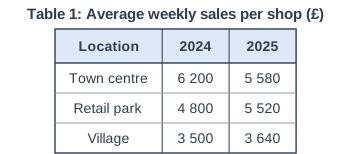
At the moment, every shop sells the same range of products at the same prices and opens from 8am to 5pm. Gareth thinks the business should tailor what each shop offers to the customers in its location. Table 1 shows the average weekly sales per shop for each type of location.

Explain one way Wearbrook Bakery could use segmentation by location to increase its sales. You should use the information in Item A in your answer.

Table 1: Average weekly sales per shop (£). Table with columns "Location", "2024", "2025". Location: Town centre; 2024: 6 200; 2025: 5 580 | Location: Retail park; 2024: 4 800; 2025: 5 520 | Location: Village; 2024: 3 500; 2025: 3 640.

Model answer

Wearbrook Bakery could change the products offered in each type of location to suit the customers who shop there. In its two village shops, most customers are older residents, and several have asked whether they could order celebration cakes for birthdays and anniversaries. If the village shops took orders for celebration cakes, Wearbrook would be meeting a need that its customers have already told it about, so these customers would spend more with Wearbrook instead of buying cakes elsewhere. This matters because the village shops have the lowest sales, only £3 640 a week each in 2025, so adding a higher-priced product would raise sales where they are weakest.

Explanation

Level 2 answers pick one way of using location segmentation and apply it to one of Wearbrook's types of location, using evidence such as the village customers' requests or the falling town-centre sales in Table 1, and then explain how it raises sales. Answers that only say 'sell different things in different places' without using Item A stay in Level 1.

Mark scheme
  1. 4 marks

    Levels of response (4 marks). AO1 = 2, AO2 = 2.
    Level 2 (3-4 marks): Sound understanding and application of the topics. Applies knowledge and understanding to the context sufficiently. A sound understanding of one or more business concepts and issues.
    Level 1 (1-2 marks): Basic understanding and application of the topics. Applies basic knowledge and understanding to the context. A basic understanding of one or more business concepts.
    0 marks: nothing to reward.

    Indicative content (not a checklist; credit other valid points): Application: six shops, two in each of town centres, retail parks and villages; every shop sells the same range at the same prices and opens from 8am to 5pm; town centres: sandwiches and drinks bought by office workers at lunchtime, many of whom now work from home for part of the week, and average weekly sales per shop fell from £6 200 to £5 580 (-10%); retail parks: busiest at weekends, families and shoppers who arrive by car buy pasties, sausage rolls and cakes, space for extra tables and chairs, sales rose from £4 800 to £5 520 (+15%); villages: older residents buy fresh bread and cakes in the morning, several have asked to order celebration cakes, sales rose from £3 500 to £3 640 (+4%). Possible ways: offer celebration cakes to order in the village shops; add seating, hot food or family meal deals at the retail parks, perhaps with longer weekend opening; in the town centres offer lunchtime deals on busy office days or reduce the range on quiet days to cut waste; change opening hours to match when each location's customers shop; target promotion locally, eg leaflets in the villages. Level 2: one way is explained and applied to Wearbrook's customers in a particular type of location, with a consequence for sales. Level 1: a basic way of using segmentation with little use of the case. An answer not applied to Wearbrook Bakery cannot go above Level 1.

Question 4

9 marks

Item C
Wrenmere Cottages Ltd

Wrenmere Cottages Ltd owns 12 holiday cottages near the north Norfolk coast, which it lets to holidaymakers by the week. The cottages are comfortable but simply furnished, and they are mainly booked by families on middle incomes. The average price is £950 per week, and each cottage is booked for an average of 38 weeks a year. The company has a good reputation and many families return every summer.

The managing director, Priya, wants to increase profit. She is considering converting four of the cottages into luxury cottages aimed at customers on high incomes. Each would have a hot tub, designer furniture and the option of a private chef. The price would be £2 200 per week.

Priya has found the following information:
- converting the four cottages would cost £180 000, which would be paid for with a bank loan
- running a luxury cottage costs about £10 000 a year more than running a standard cottage, mainly for extra cleaning and hot tub maintenance
- luxury holiday cottages in the area are booked for an average of 34 weeks a year
- spending on holidays by people on high incomes has stayed steady over the past two years, while many families on middle incomes have cut back
- there are already six luxury cottages within five miles, owned by two other businesses.

Some regular customers have told Priya that they would be disappointed if fewer standard cottages were available during the school summer holidays.

Recommend whether Wrenmere Cottages Ltd should convert four of its cottages to target customers on high incomes.

Give reasons for your recommendation. Use the information in Item C to support your answer.

Model answer

I recommend that Wrenmere Cottages Ltd should convert the four cottages to target customers on high incomes.

The figures suggest the luxury cottages would earn much more. A standard cottage earns 38 weeks × £950 = £36 100 a year, but a luxury cottage booked for the local average of 34 weeks at £2 200 would earn £74 800. That is £38 700 more per cottage, or £28 700 after the extra £10 000 running costs. Across four cottages this is about £114 800 extra a year, so the £180 000 conversion could be paid back in less than two years, even before allowing for loan interest. High-income customers are also a more reliable segment at present: their holiday spending has stayed steady, while many families on middle incomes have cut back, so the change would make Wrenmere less dependent on a group whose spending is falling.

There are risks. The £180 000 would be borrowed, so Wrenmere must pay interest and repay the loan even if bookings are poor. There are already six luxury cottages within five miles, and Wrenmere's reputation is for simple family cottages, so it may not reach 34 weeks of bookings at first. Some regular families would be disappointed by fewer standard cottages in the summer holidays, and losing these loyal customers could damage the good reputation that brings them back every year.

On balance, the benefits outweigh the risks. Even if each luxury cottage were booked for only 25 weeks, it would earn £55 000, which is still £8 900 more than a standard cottage after the extra running costs. Wrenmere would also keep eight standard cottages for its regular families. The decision depends on how quickly the new cottages can build a reputation against the six existing rivals, so Priya could reduce the risk by converting two cottages first and converting the others if bookings reach the local average.

Explanation

The strongest answers use the figures in Item C, such as comparing a standard cottage's £36 100 a year with £74 800 for a luxury cottage, and then weigh this against the bank loan, the six rival luxury cottages and the risk of upsetting loyal families. Any recommendation can reach Level 3 if it is justified with the case evidence and the conclusion says what the decision depends on. Answers that simply say 'rich customers spend more' without using Wrenmere's data cannot go above Level 2.

Mark scheme
  1. 9 marks

    Levels of response (9 marks). AO2 = 3, AO3 = 6.
    Level 3 (7-9 marks): Detailed analysis and evaluation of topics based on the context. Sustained line of reasoning, which is coherent, relevant, substantiated with a focused conclusion that is fully justified. Business areas are fully analysed. Applies knowledge and understanding to the context sufficiently.
    Level 2 (4-6 marks): Sound analysis and evaluation of topics based on the context. A line of reasoning, with a conclusion that has some justification. Business areas are partially analysed. Applies some knowledge and understanding to the context.
    Level 1 (1-3 marks): Basic analysis and evaluation of topics based on the context. Basic line of reasoning with a conclusion. Basic analysis of business areas. Basic knowledge and understanding is applied to the context.
    0 marks: nothing to reward.

    Indicative content (not a checklist; credit other valid points): Application - for: luxury price £2 200 a week compared with £950; a standard cottage earns 38 × £950 = £36 100 a year, while a luxury cottage booked for the local average of 34 weeks would earn 34 × £2 200 = £74 800; that is £38 700 more per cottage, or £28 700 after the extra £10 000 running costs, about £114 800 a year for four cottages; the £180 000 cost could be paid back in under two years (before interest); holiday spending by people on high incomes has stayed steady while many middle-income families have cut back; eight standard cottages would remain for families. Application - against: the £180 000 bank loan means interest and repayments even if bookings are poor; six luxury cottages already within five miles, owned by two other businesses; Wrenmere's reputation is for simple family cottages, so it may not reach 34 weeks of bookings at first; regular families would be disappointed by fewer standard cottages in the summer holidays, risking their loyalty and the company's good reputation; a private chef service needs new skills or suppliers. Analysis: eg targeting a high-income segment raises revenue per week and makes income less dependent on families who are cutting back, but the business takes on debt and enters a segment where rivals are already established. Evaluation - what does it depend on? whether the luxury cottages can achieve close to 34 weeks of bookings; the interest rate on the loan; how loyal families react; whether Wrenmere could convert one or two cottages first as a trial. Any justified recommendation can be credited. Credit correct calculations used to support the answer. Level 3 needs a sustained line of reasoning using the case evidence and a focused, fully justified conclusion. A generic answer that does not use the case cannot go above Level 2, however well developed.

Ready to try the rest? Every answer you write is marked against the mark scheme, so you can see exactly where the marks are.

Study Helper Hints first, answers after you try

Stuck on this one? Ask for a hint and I’ll point you in the right direction, without giving the answer away. Once you’ve checked your answer, I’ll show you how the marks are awarded.