Level:
Correct: 0
Incorrect: 0
Marks: 0/0

Setting business aims and objectives

Practise 17 exam-style questions on Setting business aims and objectives for AQA GCSE Business (Paper 2). Write your answer as you would in the exam and get it marked in seconds against the mark scheme, point by point, with the Study Helper on hand if you get stuck.

  • 17 questions
  • 1–12 marks each
  • Instant marking
  • No sign-up needed
17 questions, marked as you go

Sample questions with model answers

Here are 4 of the questions in this topic, each with a model answer, an explanation of why it earns the marks and the mark scheme an examiner would use.

Question 1

1 mark

Which one of the following is an ethical objective for a business?

Choose your answer.

  • To pay suppliers in poorer countries a fair price
  • To increase market share to 20%
  • To open five new stores abroad
  • To increase the dividend paid to shareholders

Model answer

To pay suppliers in poorer countries a fair price

Explanation

An ethical objective is about acting in a way that stakeholders see as fair and honest, such as paying suppliers a fair price even if it costs more. The other options are a market share objective, an international growth objective and a shareholder value objective. Ethical objectives may reduce profit in the short term, which is why they can conflict with other objectives.

Mark scheme
  1. 1 mark

    To pay suppliers in poorer countries a fair price

    If more than one option is given, 0 marks.

Question 2

2 marks

Explain one reason why a business that faces a lot of competition may set survival as its main objective.

Model answer

When there is a lot of competition, rivals may cut their prices to win customers. The business may have to lower its own prices too, so its revenue may not cover its costs, and it must focus on staying in business before it can aim for growth or higher profit.

Explanation

The level of competition is one reason objectives differ between businesses. Strong competition reduces a business's sales or the prices it can charge, so it may struggle to cover its costs, which makes survival the priority. Saying only that every business wants to survive does not explain the link with competition.

Mark scheme
  1. 1 mark

    Identifies a reason linked to competition: rivals may take its customers / rivals may cut their prices, forcing it to cut its own prices / it is hard for the business to attract enough customers when there are many alternatives

    The reason must be linked to competition. Do not accept 'all businesses want to survive' on its own.

  2. 1 mark

    Explains the consequence: so its sales revenue and profit may be low, so it may struggle to cover its costs or run out of cash, which means staying in business has to come first

    Examples of developed answers: Competitors may cut their prices to win customers (1), so the business has to lower its own prices and may struggle to cover its costs, making survival the priority (1). With many rivals, customers have plenty of choice (1), so the business may not make enough sales to cover its costs and could be forced to close (1).

Question 3

4 marks

Item A
Mend & Go Phones

Aisha opened Mend & Go Phones, a kiosk that repairs mobile phone screens and batteries, in a shopping centre in Aberdeen in 2023. She used £12 000 of her savings and a £10 000 bank loan to pay for equipment, a stock of parts and fitting out the kiosk. In her first year there were three other phone repair businesses in the same shopping centre, and her rent of £1 500 a month had to be paid whatever her sales were.

During 2023 Aisha's main objective was survival. She set her prices slightly below her rivals' prices, gave a free screen protector with every repair and spent very little on promotion. In some months the business made a loss and Aisha did not pay herself anything.

By 2025 the business was profitable. Online reviews praised its 30-minute repairs, and one of the rival kiosks had closed. Aisha has repaid half of the bank loan and has set two new objectives for 2026: to increase sales revenue by 25% and to open a second kiosk in another shopping centre in the city. She is also thinking about selling refurbished phones.

Explain one reason why survival was Aisha's main objective when Mend & Go Phones started trading. You should use the information in Item A in your answer.

Model answer

Survival was Aisha's main objective because Mend & Go Phones faced high risks when it started. There were already three other phone repair businesses in the same shopping centre, so customers had plenty of choice and she had no reputation yet. At the same time, she had to pay rent of £1 500 a month whatever her sales were, as well as repaying a £10 000 loan. In quiet months the business made a loss, and if this had continued she could have run out of cash and lost her £12 000 of savings. So her priority had to be covering her costs and staying open.

Explanation

Level 2 answers link the reason for a survival objective - high fixed costs and strong competition at the start - to the evidence in Item A, such as the three rival kiosks, the £1 500 monthly rent and the loan. Generic statements that new businesses need to survive stay in Level 1. One well-explained reason is enough for full marks.

Mark scheme
  1. 4 marks

    Levels of response (4 marks). AO1 = 2, AO2 = 2.
    Level 2 (3-4 marks): Sound understanding and application of the topics. Applies knowledge and understanding to the context sufficiently. A sound understanding of one or more business concepts and issues.
    Level 1 (1-2 marks): Basic understanding and application of the topics. Applies basic knowledge and understanding to the context. A basic understanding of one or more business concepts.
    0 marks: nothing to reward.

    Indicative content (not a checklist; credit other valid points): Application (evidence from Item A):
    - Three other phone repair businesses in the same shopping centre; a new business with no reputation.
    - Rent of £1 500 a month, paid whatever her sales; a £10 000 bank loan to repay; £12 000 of her own savings at risk.
    - Losses in some months; Aisha did not pay herself.
    Analysis (examples): with three rivals and no reputation, Aisha would struggle to attract enough customers at first, while her fixed rent and loan repayments still had to be paid; if sales did not cover these costs she could run out of cash and lose her savings, so staying in business had to come before growth or profit; this is why she set prices below her rivals' and kept promotion spending low.
    Level 2 (3-4 marks): a clear reason, explained and applied to Mend & Go Phones using evidence from Item A. Level 1 (1-2 marks): a basic or generic reason why new businesses aim to survive. An answer not applied to Mend & Go Phones cannot go above Level 1.

Question 4

9 marks

Item C
Bramblewick Garden Centre

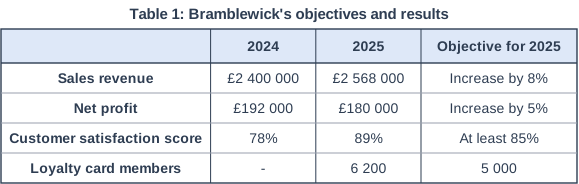
Bramblewick Garden Centre Ltd is a family-owned garden centre near Lincoln. It sells plants, garden furniture and tools, and has a café. At the start of 2025 its directors set four objectives for the year. Table 1 shows these objectives and the garden centre's results.

In March 2025 Bramblewick launched a loyalty card, which gives members 10% off plants and a free hot drink each month. Launching and running the scheme cost £30 000 in 2025, including the discounts. The managers believe the card has encouraged many regular customers to visit more often, and the café now has a waiting list for tables at weekends.

The year was difficult in other ways. A very wet spring meant fewer visitors in April and May, which are usually the busiest months for plant sales. In the summer two large DIY stores nearby cut the price of garden furniture by up to 30%, and Bramblewick's furniture sales fell. Its costs also rose, because the price of energy for its heated greenhouses increased.

The directors must now decide whether 2025 was a successful year.

Evaluate whether 2025 was a successful year for Bramblewick Garden Centre. Use the information in Item C to support your answer.

Table 1: Bramblewick's objectives and results. Table with columns (row headings), "2024", "2025", "Objective for 2025". Sales revenue; 2024: £2 400 000; 2025: £2 568 000; Objective for 2025: Increase by 8% | Net profit; 2024: £192 000; 2025: £180 000; Objective for 2025: Increase by 5% | Customer satisfaction score; 2024: 78%; 2025: 89%; Objective for 2025: At least 85% | Loyalty card members; 2024: -; 2025: 6 200; Objective for 2025: 5 000.

Model answer

Overall, I think 2025 was a successful year for Bramblewick, even though it missed both of its financial objectives.

Judged on its financial objectives, Bramblewick was not successful. Table 1 shows that sales revenue rose from £2 400 000 to £2 568 000, an increase of 7%, just below its objective of 8%. Net profit fell from £192 000 to £180 000, a fall of 6.25%, when the objective was a 5% increase. However, many of the reasons were outside the directors' control. A very wet spring kept visitors away in April and May, the busiest months for plant sales, two large DIY stores cut the price of garden furniture by up to 30%, and energy prices for the heated greenhouses rose. Raising revenue by 7% despite these problems suggests the business performed well.

Bramblewick met both of its other objectives, which shows that success can be measured in other ways than profit. The customer satisfaction score rose from 78% to 89%, above the target of at least 85%, and 6 200 customers joined the loyalty card scheme, beating the target of 5 000. Customers seem happier and more loyal: regular customers are visiting more often and the café has a waiting list at weekends.

The loyalty card also explains much of the fall in profit, because it cost £30 000 in 2025. Without this cost, net profit would have been £210 000, more than 9% higher than in 2024 and above the 5% target. So the lower profit partly reflects an investment that should bring repeat sales in future years.

How successful 2025 really was depends on whether the loyalty members keep spending in 2026 and whether the DIY stores keep their prices low. On balance, because Bramblewick grew its sales and its customers' loyalty in a difficult year, it was successful, but the directors should watch profit closely.

Explanation

Level 3 answers judge success against all four objectives in Table 1, recognising that success can be measured in other ways than profit, and explain the results using the case, such as the weather, the DIY stores' price cuts and the £30 000 loyalty card cost. Working out the 7% revenue increase and the 6.25% fall in profit shows good use of the data. Accept either judgement, but it must be justified rather than just stated.

Mark scheme
  1. 9 marks

    Levels of response (9 marks). AO2 = 3, AO3 = 6.
    Level 3 (7-9 marks): Detailed analysis and evaluation of topics based on the context. Sustained line of reasoning, which is coherent, relevant, substantiated with a focused conclusion that is fully justified. Business areas are fully analysed. Applies knowledge and understanding to the context sufficiently.
    Level 2 (4-6 marks): Sound analysis and evaluation of topics based on the context. A line of reasoning, with a conclusion that has some justification. Business areas are partially analysed. Applies some knowledge and understanding to the context.
    Level 1 (1-3 marks): Basic analysis and evaluation of topics based on the context. Basic line of reasoning with a conclusion. Basic analysis of business areas. Basic knowledge and understanding is applied to the context.
    0 marks: nothing to reward.

    Indicative content (not a checklist; credit other valid points): Application (evidence from Item C and Table 1):
    - Sales revenue rose from £2 400 000 to £2 568 000, an increase of 7% (objective 8%: missed by one percentage point).
    - Net profit fell from £192 000 to £180 000, a fall of 6.25% (objective: increase by 5%: missed).
    - Customer satisfaction rose from 78% to 89% (objective at least 85%: met); 6 200 loyalty card members (objective 5 000: met).
    - The loyalty card cost £30 000 in 2025; excluding this cost, net profit would have been £210 000, about 9.4% higher than in 2024.
    - Outside factors: very wet spring in the busiest months; DIY stores cut garden furniture prices by up to 30%; higher energy prices; the café has a weekend waiting list; regular customers visit more often.
    Analysis - not successful: both financial objectives were missed and profit fell, so there is less to reinvest or pay to the owners; furniture sales are under threat from the DIY stores.
    Analysis - successful: success can be measured in other ways than profit; both customer objectives were beaten, showing more loyal and satisfied customers, which should bring repeat sales; revenue still grew by 7% despite the weather and price competition; the fall in profit is largely explained by the £30 000 investment in the loyalty card.
    Evaluation - what does it depend on? which objectives the directors see as most important; whether loyalty members keep spending in 2026; whether the DIY stores keep prices low; whether 2025 was a one-off because of the weather.
    Level 3 (7-9 marks) needs a fully justified judgement that uses the data in Table 1 and the case, weighing financial against non-financial measures of success. Accept any well-argued judgement. A generic answer that does not use the case cannot go above Level 2, however well developed.

Ready to try the rest? Every answer you write is marked against the mark scheme, so you can see exactly where the marks are.

Study Helper Hints first, answers after you try

Stuck on this one? Ask for a hint and I’ll point you in the right direction, without giving the answer away. Once you’ve checked your answer, I’ll show you how the marks are awarded.