Level:
Correct: 0
Incorrect: 0
Marks: 0/0

Cash flow

Practise 28 exam-style questions on Cash flow for AQA GCSE Business (Paper 2). Write your answer as you would in the exam and get it marked in seconds against the mark scheme, point by point, with the Study Helper on hand if you get stuck.

  • 28 questions
  • 1–12 marks each
  • Instant marking
  • No sign-up needed
20 questions, marked as you go

Sample questions with model answers

Here are 4 of the questions in this topic, each with a model answer, an explanation of why it earns the marks and the mark scheme an examiner would use.

Question 1

1 mark

Which one of the following would improve a business's cash flow by delaying its cash outflows?

Choose your answer.

  • Asking suppliers for longer to pay
  • Giving customers longer to pay
  • Buying more stock in advance
  • Repaying the overdraft early

Model answer

Asking suppliers for longer to pay

Explanation

Asking suppliers for longer to pay re-schedules payments: the money leaves the business later, so more cash is available now. Giving customers longer to pay delays inflows, buying stock in advance brings outflows forward, and repaying the overdraft early is an extra outflow now, so all three would make cash flow worse in the short term.

Mark scheme
  1. 1 mark

    Asking suppliers for longer to pay

    If more than one option is given, 0 marks.

Question 2

2 marks

Explain one reason why cash is important to a business.

Model answer

A business needs cash to pay its suppliers on time. If it cannot pay them, they may stop delivering materials, so the business would not be able to make its products or serve its customers.

Explanation

Cash is needed to pay bills as they fall due, so the first mark is for a use of cash and the second for what happens if the business has or lacks it. Many businesses that fail are profitable on paper but run out of cash to pay their debts. Simply saying 'cash is needed to run the business' is too vague for the first mark.

Mark scheme
  1. 1 mark

    Identifies a reason: to pay suppliers / to pay wages / to pay bills such as rent or loan repayments when they are due / to survive (avoid insolvency) / to deal with emergencies or unexpected costs / to take advantage of opportunities such as bulk-buying discounts

    Answers may include any of the reasons listed. Do not accept 'to make a profit' on its own.

  2. 1 mark

    Explains the consequence: so suppliers keep delivering and production can continue / so staff are paid on time and stay motivated / otherwise creditors could take legal action and the business could be forced to close, even if it is profitable / so it can buy stock cheaply or invest without borrowing

    Examples of developed answers: 'A business needs cash to pay its suppliers (1), otherwise they may stop delivering and it would not be able to make its products (1).' 'Without enough cash a business cannot pay its debts when they are due (1), so it could be forced to close even if it is making a profit (1).'

Question 3

4 marks

State and explain two ways a business could improve its cash flow.

Model answer

Way 1: Ask suppliers for longer to pay, for example 60 days instead of 30. This delays the cash outflow, so the business keeps its cash for longer and can pay other bills first.

Way 2: Offer customers a small discount if they pay within 14 days. This encourages them to pay sooner, so cash inflows arrive earlier and the business is less likely to be short of cash.

Explanation

The ways to improve cash flow are to bring cash in sooner or in larger amounts, to delay or reduce cash going out, or to find finance to cover a gap. Each way needs a short explanation of how it changes the timing or size of cash flows. Make sure the two ways are genuinely different, not the same idea in different words.

Mark scheme
  1. 1 mark

    First way: re-schedule payments (ask suppliers for longer to pay / delay a large purchase) / arrange an overdraft / reduce cash outflows (for example cut costs, hold less stock, lease equipment instead of buying it) / increase cash inflows (for example ask customers to pay sooner, offer a discount for prompt payment, ask for deposits, sell unwanted assets) / find a new source of finance (for example a loan, a share issue or more capital from the owners)

    Max 4: 1 mark for stating each way and 1 mark for explaining how it improves cash flow, for two different ways. 'Cut costs' and 'spend less' count as the same way.

  2. 1 mark

    Explanation of the first way: how it brings cash in sooner, delays or reduces cash going out, or covers a shortfall

    Example of a developed answer: 'Ask suppliers for 60 days to pay instead of 30 (1), so the cash stays in the business for longer and can be used to pay other bills first (1).'

  3. 1 mark

    Second, different way from the list above

    Do not credit a second way that repeats the first in different words.

  4. 1 mark

    Explanation of the second way

    Example of a developed answer: 'Sell equipment the business no longer uses (1), which brings in a one-off cash inflow that can cover a shortfall without borrowing (1).'

Question 4

9 marks

Item A
Willowmere Landscapes

Ravi runs Willowmere Landscapes, a garden design and landscaping business near Norwich, as a sole trader. He employs two staff and builds patios, ponds and new gardens for homeowners. Customers pay in full when a job is finished.

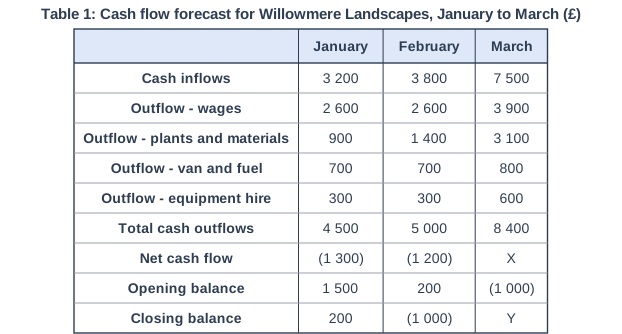
The business is very seasonal. Most gardens are built between April and September, and winter work is mostly small repairs. Last year the business made a net profit of £34 000, but Ravi's bank balance always falls in the early part of the year, when he still has to pay his staff and buy plants and materials for the spring jobs. Table 1 shows his cash flow forecast for January to March. Figures in brackets are negative.

Ravi already has jobs worth £18 000 booked for April and May. He does not currently have an overdraft. His bank has offered him one with a limit of £2 500. Interest would be charged at 19% a year on the amount overdrawn, and there is an arrangement fee of £60. The bank can reduce or cancel the overdraft at any time.

Ravi's brother has suggested that, instead, Ravi should ask customers to pay a deposit of 20% when they book a job. None of the other landscapers in the area asks for a deposit. Ravi could also ask his plant nursery to give him 60 days to pay instead of 30, although it has refused to do this in the past. A wet spring could delay the start of the jobs booked for April.

In Table 1, X is the net cash flow for March and Y is the closing balance for March.

Recommend whether Ravi should arrange the overdraft to deal with the cash flow problem shown in Table 1.

Give reasons for your recommendation.

Table 1: Cash flow forecast for Willowmere Landscapes, January to March (£). Table with columns (row headings), "January", "February", "March". Cash inflows; January: 3 200; February: 3 800; March: 7 500 | Outflow - wages; January: 2 600; February: 2 600; March: 3 900 | Outflow - plants and materials; January: 900; February: 1 400; March: 3 100 | Outflow - van and fuel; January: 700; February: 700; March: 800 | Outflow - equipment hire; January: 300; February: 300; March: 600 | Total cash outflows; January: 4 500; February: 5 000; March: 8 400 | Net cash flow; January: (1 300); February: (1 200); March: X | Opening balance; January: 1 500; February: 200; March: (1 000) | Closing balance; January: 200; February: (1 000); March: Y.

Model answer

I recommend that Ravi arranges the overdraft.

Table 1 shows that the bank balance is forecast to fall from £1 500 at the start of January to (£1 000) at the end of February and (£1 900) at the end of March. This is because Ravi still has to pay his staff and buy plants and materials for the spring, while customers only pay when a job is finished. Without finance he could not pay his staff or suppliers in February and March.

The overdraft limit of £2 500 covers the largest shortfall of £1 900. The problem is short-term and seasonal: most gardens are built between April and September, Ravi already has £18 000 of jobs booked for April and May, and the business made a net profit of £34 000 last year. As interest is only charged on the amount overdrawn, the cost is small: one month overdrawn by £1 900 at 19% a year costs about £30, plus the £60 fee. Once customers pay in April and May, Ravi can repay the overdraft quickly.

There are risks. The limit leaves only £600 to spare in March, and if a wet spring delays the April jobs, the balance could fall below (£2 500). The bank could also reduce or cancel the overdraft at any time. Asking customers for a 20% deposit would bring in £3 600 on the jobs already booked, more than the shortfall, with no interest. However, no other landscaper asks for a deposit, so some customers might go to competitors, which would reduce Ravi's cash inflows in his busiest months. The nursery has also refused longer credit before, so that option is uncertain.

Overall, the overdraft is the best choice because it is cheap, flexible and covers the forecast shortfall without risking customers. It depends on the spring jobs starting on time, so Ravi should also ask the nursery again for 60 days' credit, to give himself more room if the weather delays his work.

Explanation

Top-level answers use Table 1 to show the size and timing of the problem (a shortfall of up to £1 900, within the £2 500 limit) and weigh the overdraft against the alternatives in Item A, such as deposits and longer supplier credit. They reach a clear recommendation and say what it depends on, such as the weather delaying jobs. Describing overdrafts in general without using the forecast cannot go above Level 2.

Mark scheme
  1. 9 marks

    Levels of response (9 marks). AO2 = 3, AO3 = 6.
    Level 3 (7-9 marks): Detailed analysis and evaluation of topics based on the context. Sustained line of reasoning, which is coherent, relevant, substantiated with a focused conclusion that is fully justified. Business areas are fully analysed. Applies knowledge and understanding to the context sufficiently.
    Level 2 (4-6 marks): Sound analysis and evaluation of topics based on the context. A line of reasoning, with a conclusion that has some justification. Business areas are partially analysed. Applies some knowledge and understanding to the context.
    Level 1 (1-3 marks): Basic analysis and evaluation of topics based on the context. Basic line of reasoning with a conclusion. Basic analysis of business areas. Basic knowledge and understanding is applied to the context.
    0 marks: nothing to reward.

    Indicative content (not a checklist; credit other valid points): Application - Yes, arrange the overdraft: the forecast closing balance is (£1 000) in February and (£1 900) in March, both within the £2 500 limit; the shortfall is short-term and seasonal, as most gardens are built from April to September and £18 000 of jobs are already booked for April and May; the business made a net profit of £34 000 last year; interest is only charged on the amount overdrawn, so the cost is small (about £30 for a month overdrawn by £1 900, plus the £60 fee); the alternatives are uncertain, as the nursery has refused longer credit before and no other landscaper asks for deposits. Analysis - Yes: the overdraft lets Ravi keep paying his two staff and buying plants for the spring jobs, so the jobs start on time and bring in cash from April; because it is flexible he can repay it as soon as customers pay, keeping the cost low; it avoids putting customers off with deposits, which could send them to competitors. Application - No: the £2 500 limit leaves only £600 to spare in March; a wet spring could delay the April jobs, so the balance could fall further and break the limit; interest is 19% a year and the bank can reduce or cancel the overdraft at any time; a 20% deposit on the £18 000 of booked jobs would bring in £3 600, more than the £1 900 shortfall, with no interest; 60 days' credit from the nursery would delay the payments for plants and materials (£1 400 in February and £3 100 in March) and reduce the shortfall. Analysis - No: relying on an overdraft that can be withdrawn is risky if jobs are delayed, because Ravi might be unable to pay wages; deposits bring cash in before the costs of a job are paid, tackling the cause of the problem every year rather than borrowing to cover it; but deposits might put customers off when no competitor asks for one. Evaluation - what does it depend on? How likely the April jobs are to be delayed; whether customers would accept a deposit; whether the nursery would agree to 60 days; whether Ravi could combine solutions, for example an overdraft as a safety net plus deposits on new bookings. Level 3 (7-9) needs a clear recommendation, either way, justified with evidence from Item A and Table 1 (for example the shortfall against the £2 500 limit, the low interest cost or the booked jobs) and weighed against the alternatives. An answer that does not use the information about Willowmere Landscapes cannot go above Level 2, however well developed. Accept any well-argued recommendation.

Ready to try the rest? Every answer you write is marked against the mark scheme, so you can see exactly where the marks are.

Study Helper Hints first, answers after you try

Stuck on this one? Ask for a hint and I’ll point you in the right direction, without giving the answer away. Once you’ve checked your answer, I’ll show you how the marks are awarded.