
Level:
Correct: 0
Incorrect: 0
Marks: 0/0
Exam Practice
Course:
Topics:
Edexcel GCSE Combined Science (Foundation Biology Paper 2) Smart practice A mixed round aimed at your weak spots
Avg
score:
–
Topics
done:
0/28

Type 1 and type 2 diabetes

Practise 15 exam-style questions on Type 1 and type 2 diabetes for Edexcel GCSE Combined Science (Foundation Biology Paper 2). Write your answer as you would in the exam and get it marked in seconds against the mark scheme, point by point, with the Study Helper on hand if you get stuck.

  • 15 questions
  • 1–6 marks each
  • Instant marking
  • No sign-up needed
15 questions, marked as you go

Sample questions with model answers

Here are 4 of the questions in this topic, each with a model answer, an explanation of why it earns the marks and the mark scheme an examiner would use.

Question 1

1 mark

Joe is 58 and has type 2 diabetes. His doctor advises him to lose body mass.

Which statement explains how losing body mass helps Joe to control his blood glucose concentration?

Choose your answer.

  • A his body cells respond better to insulin, so they take up more glucose from the blood
  • B his immune system stops destroying the cells in his pancreas that make insulin
  • C his liver starts to make insulin instead of his pancreas
  • D glucose from his food is no longer absorbed into his blood

Model answer

A - his body cells respond better to insulin, so they take up more glucose from the blood.

Explanation

Type 2 diabetes is caused by body cells no longer responding properly to insulin; the pancreas usually still makes insulin. Losing body mass, eating less sugar and exercising more help many people to control type 2 diabetes, because their cells respond better to insulin and take up more glucose from the blood. A common error is to mix up the causes of type 1 and type 2 diabetes.

Mark scheme
  1. 1 mark

    A / his body cells respond better to insulin, so they take up more glucose from the blood

    The only correct answer is A: in type 2 diabetes the body cells do not respond properly to insulin, and losing body mass (especially fat around the waist) helps the cells to respond to insulin again, so they take up more glucose from the blood. B is not correct because the immune system destroying the cells that make insulin is the cause of type 1 diabetes, not type 2 diabetes; C is not correct because insulin is made by the pancreas, not the liver; D is not correct because glucose from digested food is still absorbed into the blood, whatever a person's body mass. Accept the letter or the option. If more than one option is given, do not award the mark.
Question 2

2 marks

Some people think that type 1 diabetes is caused by eating too much sugar.

Explain why this idea is wrong.

Model answer

Type 1 diabetes is caused by the pancreas producing little or no insulin, because the cells in the pancreas that make insulin have been destroyed by the body's immune system. This is not caused by what a person eats, so eating less sugar would not prevent it; it often starts in children who have a healthy diet and mass.

Explanation

This idea confuses type 1 diabetes with type 2 diabetes, whose risk is increased by being overweight. Type 1 diabetes is caused by a lack of insulin from the pancreas, not by diet. A full answer gives the real cause and says why diet is not the cause.

Mark scheme
  1. 1 mark

    type 1 diabetes is caused by the pancreas producing little or no insulin / by the (immune system destroying the) cells in the pancreas that make insulin

    Accept 'the pancreas does not make (enough) insulin'. Do not accept 'body cells do not respond to insulin' (this is type 2).

  2. 1 mark

    this is not caused by diet / eating sugar / lifestyle, so eating less sugar would not prevent it

    Accept 'it often starts in children who have a healthy diet and body mass' or 'it is not linked to body mass'. Accept 'it is not caused by eating sugar' when it is given with the correct cause (marking point 1); on its own it only repeats the question and scores 0.

Question 3

3 marks

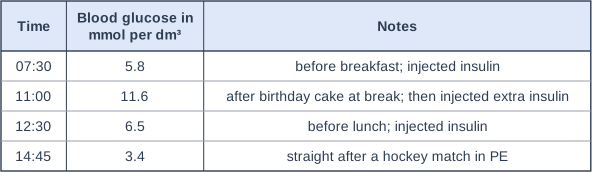
Jade is in Year 9 at school and has type 1 diabetes. Her diabetes nurse has asked her to keep her blood glucose concentration between 4.0 and 9.0 mmol per dm³ during the day.

The table shows Jade's readings and notes on one school day.

Explain why her blood glucose concentration was outside this range at 11:00 and at 14:45.

Table with columns "Time", "Blood glucose in mmol per dm³", "Notes". Time: 07:30; Blood glucose in mmol per dm³: 5.8; Notes: before breakfast; injected insulin | Time: 11:00; Blood glucose in mmol per dm³: 11.6; Notes: after birthday cake at break; then injected extra insulin | Time: 12:30; Blood glucose in mmol per dm³: 6.5; Notes: before lunch; injected insulin | Time: 14:45; Blood glucose in mmol per dm³: 3.4; Notes: straight after a hockey match in PE.

Model answer

At 11:00 her blood glucose was above 9.0 because the sugar in the cake was absorbed into her blood. Her pancreas produces little or no insulin, so her body could not bring the concentration down until she injected extra insulin.

At 14:45 it was below 4.0 because during the hockey match her muscles respired faster and used more glucose from the blood, while the insulin she had injected at lunch was still making her cells take up glucose.

Explanation

Use the notes in the table to find the cause of each reading. Eating sugar raises blood glucose, and a person with type 1 diabetes cannot release insulin to bring it down. Exercise uses glucose in respiration, so after an insulin injection the concentration can fall too low; people with type 1 diabetes often eat extra carbohydrate or inject less insulin before exercise.

Mark scheme
  1. 1 mark

    (11:00) sugar / carbohydrate in the cake was digested and absorbed into her blood, so her blood glucose concentration rose (above 9.0)

    An explanation including three from the four points; max 3. Max 2 if only one of the two readings is explained.

  2. 1 mark

    her pancreas produces little or no insulin, so her body could not bring the concentration down by itself / she needed to inject (extra) insulin

    Accept 'she had not injected enough insulin for the cake'.

  3. 1 mark

    (14:45) during the hockey match her muscles respired faster and used more glucose (from the blood)

    Accept 'exercise uses up glucose'.

  4. 1 mark

    the insulin she injected at lunch was still causing cells to take up glucose, so her blood glucose fell (below 4.0)

    Accept 'she had injected her usual dose of insulin but then exercised'.

Question 4

4 marks

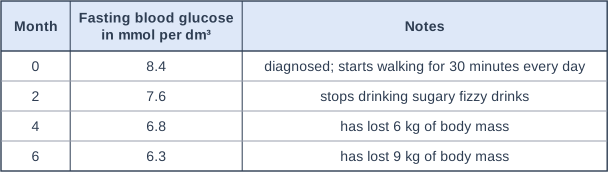
Rajesh was diagnosed with type 2 diabetes. Over the next six months he made some changes to his lifestyle. His doctor measured his fasting blood glucose concentration every two months.

The table shows the results.

percentage decrease = (decrease ÷ starting value) × 100

Calculate the percentage decrease in Rajesh's fasting blood glucose concentration from month 0 to month 6.

Explain how two of the changes in the table helped to lower Rajesh's blood glucose concentration.

Table with columns "Month", "Fasting blood glucose in mmol per dm³", "Notes". Month: 0; Fasting blood glucose in mmol per dm³: 8.4; Notes: diagnosed; starts walking for 30 minutes every day | Month: 2; Fasting blood glucose in mmol per dm³: 7.6; Notes: stops drinking sugary fizzy drinks | Month: 4; Fasting blood glucose in mmol per dm³: 6.8; Notes: has lost 6 kg of body mass | Month: 6; Fasting blood glucose in mmol per dm³: 6.3; Notes: has lost 9 kg of body mass.

Model answer

Decrease = 8.4 − 6.3 = 2.1
Percentage decrease = 2.1 ÷ 8.4 × 100 = 25 %

Walking every day makes Rajesh's muscles respire faster, so they use more glucose from his blood. Stopping sugary drinks means that less glucose is absorbed into his blood after he eats and drinks.

Explanation

For a percentage change, divide the change by the starting value (8.4), not the final value. The explanations must say how each change affects the glucose in the blood: exercise uses glucose in respiration, less sugar means less glucose absorbed, and losing body fat helps cells respond to insulin. 'It is healthier' is not enough.

Mark scheme
  1. 1 mark

    (decrease =) 8.4 − 6.3 = 2.1; or a correct final answer of 25 % with no working

    An answer of 25 % with no working scores marking points 1 and 2. Also accept 6.3 ÷ 8.4 × 100 = 75 % followed by 100 − 75 = 25 % for marking points 1 and 2. 2.1 ÷ 6.3 × 100 = 33 % (wrong starting value) scores marking point 1 only. 75 % as the final answer scores 0. Marking points 3, 4 and 5: any two, max 2.

  2. 1 mark

    (2.1 ÷ 8.4 × 100 =) 25 (%)

    Ignore units.

  3. 1 mark

    walking (exercise) makes his muscles respire faster, so they use more glucose from the blood

    The change and its effect on glucose are both needed. Accept 'exercise uses up glucose'.

  4. 1 mark

    stopping sugary drinks means less sugar / glucose is absorbed into his blood

    Accept 'he takes in less glucose'. Ignore 'it is healthier'.

  5. 1 mark

    losing body mass (fat) helps his body cells respond better to insulin, so they take up more glucose

    Accept 'losing weight makes his cells more sensitive to insulin'. Ignore 'losing weight is healthier'.

Ready to try the rest? Every answer you write is marked against the mark scheme, so you can see exactly where the marks are.

Study Helper Hints first, answers after you try

Stuck on this one? Ask for a hint and I’ll point you in the right direction, without giving the answer away. Once you’ve checked your answer, I’ll show you how the marks are awarded.