
Level:
Correct: 0
Incorrect: 0
Marks: 0/0
Exam Practice
Course:
Topics:
Edexcel GCSE Combined Science (Foundation Biology Paper 2) Smart practice A mixed round aimed at your weak spots
Avg
score:
–
Topics
done:
0/28

Hormonal and barrier contraception

Practise 13 exam-style questions on Hormonal and barrier contraception for Edexcel GCSE Combined Science (Foundation Biology Paper 2). Write your answer as you would in the exam and get it marked in seconds against the mark scheme, point by point, with the Study Helper on hand if you get stuck.

  • 13 questions
  • 1–6 marks each
  • Instant marking
  • No sign-up needed
13 questions, marked as you go

Sample questions with model answers

Here are 4 of the questions in this topic, each with a model answer, an explanation of why it earns the marks and the mark scheme an examiner would use.

Question 1

1 mark

A diaphragm is a soft, dome-shaped barrier method of contraception. It is put into the vagina before sex.

Where is a diaphragm placed?

Choose your answer.

  • A over the cervix
  • B inside an oviduct
  • C under the skin of the upper arm
  • D around an ovary

Model answer

A - over the cervix.

Explanation

Barrier methods stop sperm reaching the egg. A diaphragm fits over the cervix, so sperm in the vagina cannot pass into the uterus. It is used with a spermicide, which kills any sperm that get past its edge.

Mark scheme
  1. 1 mark

    A / over the cervix

    The only correct answer is A: the diaphragm covers the cervix (the entrance to the uterus), so sperm cannot get into the uterus to reach an egg. B is not correct because a diaphragm is placed in the vagina and cannot reach the oviducts; C is not correct because a device placed under the skin of the upper arm is the contraceptive implant, a hormonal method; D is not correct because the ovaries are inside the body and cannot be reached through the vagina. Accept the letter or the option. If more than one option is given, do not award the mark.
Question 2

2 marks

The hormonal IUS is a small T-shaped device that a doctor or nurse places inside the uterus. It slowly releases a hormone similar to progesterone.

The hormone makes the mucus in the cervix thicker. It also makes the lining of the uterus thinner.

Explain how each of these effects helps to prevent pregnancy.

Model answer

Thicker mucus in the cervix stops sperm swimming through into the uterus, so sperm cannot reach an egg to fertilise it.
A thinner lining in the uterus means that, if an egg were fertilised, the embryo would be unlikely to implant in the lining, so a pregnancy could not develop.

Explanation

Each effect needs its own explanation. Thick mucus at the cervix acts as a barrier to sperm. A thin uterus lining is not suitable for an embryo to implant, because an embryo needs a thick lining with a good blood supply. These are two of the ways that progesterone-like hormones prevent pregnancy.

Mark scheme
  1. 1 mark

    thicker mucus: sperm cannot swim / get through the cervix, so they cannot reach an egg (to fertilise it)

    accept sperm cannot enter the uterus / are blocked (by the mucus). Do not accept 'the mucus kills the sperm'.

  2. 1 mark

    thinner lining: a fertilised egg / embryo cannot implant (attach) in the lining / is less likely to implant

    accept the embryo cannot attach to the uterus / cannot develop there. Ignore 'the egg cannot be released' (this does not explain the effect of a thinner lining).

Question 3

3 marks

The contraceptive injection contains a hormone similar to progesterone. After the injection into a muscle, the hormone passes slowly into the blood. The NHS advises women who use the most common type of injection to have a new injection every 13 weeks.

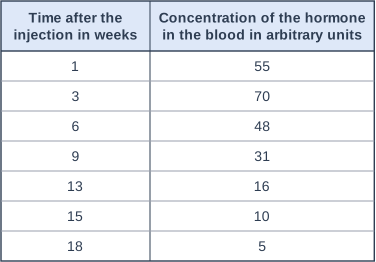
The table shows a simplified model of how the concentration of the hormone in a woman's blood changes after one injection. In this model, ovulation can start again if the concentration of the hormone falls below 12 arbitrary units.

Use the table to explain why a woman using this method of contraception needs a new injection every 13 weeks.

Table with columns "Time after the injection in weeks", "Concentration of the hormone in the blood in arbitrary units". Time after the injection in weeks: 1; Concentration of the hormone in the blood in arbitrary units: 55 | Time after the injection in weeks: 3; Concentration of the hormone in the blood in arbitrary units: 70 | Time after the injection in weeks: 6; Concentration of the hormone in the blood in arbitrary units: 48 | Time after the injection in weeks: 9; Concentration of the hormone in the blood in arbitrary units: 31 | Time after the injection in weeks: 13; Concentration of the hormone in the blood in arbitrary units: 16 | Time after the injection in weeks: 15; Concentration of the hormone in the blood in arbitrary units: 10 | Time after the injection in weeks: 18; Concentration of the hormone in the blood in arbitrary units: 5.

Model answer

The hormone stops ovulation, so no egg is released and there is no egg to be fertilised.
After about 3 weeks the concentration of the hormone in the blood starts to fall, from 70 arbitrary units at 3 weeks to 16 arbitrary units at 13 weeks. Between 13 and 15 weeks it falls below 12 arbitrary units (it is 10 at 15 weeks). Then ovulation could start again and she could become pregnant, so she needs a new injection by 13 weeks to keep the concentration high enough.

Explanation

First say how the hormone prevents pregnancy (it stops ovulation and thickens the mucus in the cervix). Then use the table: the concentration falls over time and drops below the level that stops ovulation soon after 13 weeks, so a new injection is needed before then. Quote values from the table; a common error is to describe the trend without saying when the concentration becomes too low.

Mark scheme
  1. 1 mark

    the hormone prevents ovulation / stops eggs being released (from the ovaries), so there is no egg to be fertilised

    An explanation linking three points. Max 2 if no data from the table are used. accept the hormone thickens the mucus in the cervix, so sperm cannot reach an egg / makes the uterus lining thinner, so an embryo is less likely to implant. Do not accept 'the hormone kills the egg' or 'kills sperm'.

  2. 1 mark

    the concentration of the hormone (in the blood) falls after about 3 weeks / falls from 70 arbitrary units at 3 weeks to 16 arbitrary units at 13 weeks

    accept the concentration goes down as time passes, with any correct data from the table. accept the hormone is used up / removed from the blood over time.

  3. 1 mark

    the concentration falls below 12 arbitrary units between 13 and 15 weeks / is only 10 arbitrary units at 15 weeks, so ovulation could start again (and she could become pregnant) unless she has a new injection by 13 weeks

    accept a new injection at 13 weeks keeps the concentration above 12 arbitrary units / stops it falling too low. accept any time between 13 and 15 weeks for when the concentration falls below 12. Do not accept 'at 13 weeks the concentration is below 12'.

Question 4

4 marks

The combined pill and the male condom are both methods of contraception.

Compare how the combined pill and the male condom prevent pregnancy.

Model answer

Both methods stop a sperm fertilising an egg, but they work in different ways. The combined pill contains the hormones oestrogen and progesterone. These stop eggs being released from the ovaries, so there is no egg to fertilise, and they make the mucus in the cervix thicker so sperm cannot get through. The condom contains no hormones. It is a physical barrier that traps the sperm, so sperm cannot enter the vagina and reach an egg. The pill works all the time because it is taken every day, but a condom only works if it is used each time a couple has sex.

Explanation

A comparison needs similarities and differences, not two separate descriptions. Words such as 'but', 'whereas' and 'both' help. The key difference is that hormonal methods change what happens in the woman's body (no ovulation, thick cervical mucus), whereas barrier methods physically stop sperm reaching the egg.

Mark scheme
  1. 1 mark

    the pill contains hormones (oestrogen and progesterone) but the condom contains no hormones / is a physical barrier

    A comparison including four from the seven points; max 4. Max 3 if only one method is described. accept the pill is a hormonal method and the condom is a barrier method.

  2. 1 mark

    the pill stops eggs being released (prevents ovulation), so there is no egg to fertilise

    accept stops eggs maturing.

  3. 1 mark

    the pill makes the mucus in the cervix thicker, so sperm cannot get through

    accept thickens cervical mucus.

  4. 1 mark

    the pill makes the lining of the uterus thinner, so a fertilised egg / embryo is less likely to implant

    accept the lining is not thick enough for an embryo to attach.

  5. 1 mark

    the condom traps / collects the sperm, so sperm do not enter the vagina / cannot reach an egg

    accept the condom stops sperm getting into the woman's body. Do not accept 'the condom kills sperm'.

  6. 1 mark

    both stop a sperm fertilising an egg / stop a sperm and an egg meeting

    accept both prevent fertilisation (similarity).

  7. 1 mark

    the pill acts all the time (taken every day), but the condom only works at the time of sex / must be used each time

    accept the pill acts inside the woman's body but the condom is used by the man / on the penis.

Ready to try the rest? Every answer you write is marked against the mark scheme, so you can see exactly where the marks are.

Study Helper Hints first, answers after you try

Stuck on this one? Ask for a hint and I’ll point you in the right direction, without giving the answer away. Once you’ve checked your answer, I’ll show you how the marks are awarded.