
Level:
Correct: 0
Incorrect: 0
Marks: 0/0
Exam Practice
Course:
Topics:
Edexcel GCSE Combined Science (Foundation Biology Paper 2) Smart practice A mixed round aimed at your weak spots
Avg
score:
–
Topics
done:
0/28

Core practical: osmosis in potatoes

Practise 14 exam-style questions on Core practical: osmosis in potatoes for Edexcel GCSE Combined Science (Foundation Biology Paper 2). Write your answer as you would in the exam and get it marked in seconds against the mark scheme, point by point, with the Study Helper on hand if you get stuck.

  • 14 questions
  • 1–6 marks each
  • Instant marking
  • No sign-up needed
14 questions, marked as you go

Sample questions with model answers

Here are 4 of the questions in this topic, each with a model answer, an explanation of why it earns the marks and the mark scheme an examiner would use.

Question 1

1 mark

Callum weighed a potato cylinder before and after it spent a night in 0.6 mol/dm³ sucrose solution.

mass before = 2.25 g
mass after = 2.07 g

Which calculation gives the percentage change in mass of the cylinder?

Choose your answer.

  • A (2.07 − 2.25) ÷ 2.25 × 100
  • B (2.07 − 2.25) ÷ 2.07 × 100
  • C 2.07 ÷ 2.25 × 100
  • D (2.25 − 2.07) × 100

Model answer

A ((2.07 − 2.25) ÷ 2.25 × 100, which is −8.0 %)

Explanation

Find the change in mass (final mass − starting mass), divide it by the starting mass and multiply by 100. Here that is −0.18 ÷ 2.25 × 100 = −8.0 %, negative because the cylinder lost mass. Dividing by the final mass is a very common mistake.

Mark scheme
  1. 1 mark

    A / (2.07 − 2.25) ÷ 2.25 × 100

    The only correct answer is A: percentage change in mass = (final mass − starting mass) ÷ starting mass × 100, which gives −8.0 %. B is not correct because it divides by the final mass instead of the starting mass (giving −8.7 %); C is not correct because it gives the final mass as a percentage of the starting mass (92 %), not the change; D is not correct because it does not divide by the starting mass (and gives a positive value for a loss of mass). Accept the letter or the option. If more than one option is given, do not award the mark.
Question 2

2 marks

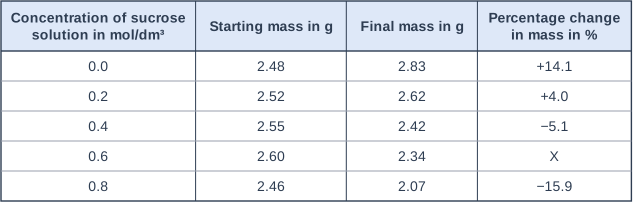
Mia weighed five potato cylinders. She put each one into a sucrose solution of a different concentration. After 24 hours she blotted each cylinder dry and weighed it again.

The table shows her results.

Calculate value X in the table.

Table with columns "Concentration of sucrose solution in mol/dm³", "Starting mass in g", "Final mass in g", "Percentage change in mass in %". Concentration of sucrose solution in mol/dm³: 0.0; Starting mass in g: 2.48; Final mass in g: 2.83; Percentage change in mass in %: +14.1 | Concentration of sucrose solution in mol/dm³: 0.2; Starting mass in g: 2.52; Final mass in g: 2.62; Percentage change in mass in %: +4.0 | Concentration of sucrose solution in mol/dm³: 0.4; Starting mass in g: 2.55; Final mass in g: 2.42; Percentage change in mass in %: −5.1 | Concentration of sucrose solution in mol/dm³: 0.6; Starting mass in g: 2.60; Final mass in g: 2.34; Percentage change in mass in %: X | Concentration of sucrose solution in mol/dm³: 0.8; Starting mass in g: 2.46; Final mass in g: 2.07; Percentage change in mass in %: −15.9.

Model answer

change in mass = 2.34 − 2.60 = −0.26 g
percentage change = −0.26 ÷ 2.60 × 100
= −10.0 %

Explanation

Subtract the starting mass from the final mass to find the change in mass, then divide by the starting mass and multiply by 100. The cylinder lost mass, so the answer is negative, like the other values for the stronger solutions in the table. A common error is to divide by the final mass, which gives −11.1 %.

Mark scheme
  1. 1 mark

    working: (2.34 − 2.60) ÷ 2.60 × 100 / −0.26 ÷ 2.60 × 100; or a correct final answer of −10.0 % with no working

    An answer of −10.0 % (or −10 %) with no working scores 2 marks. The change in mass, −0.26 g, seen on its own scores 1 mark. −0.26 ÷ 2.34 × 100 = −11.1 (divided by the final mass) scores 1 mark only (for the change in mass). 2.34 ÷ 2.60 × 100 = 90 scores 0.

  2. 1 mark

    evaluation: −10.0 (%) / −10 (%)

    accept 10 / 10.0 without the minus sign, or 'a decrease / loss of 10 %'; ignore units

Question 3

2 marks

A student put one potato cylinder into distilled water and another potato cylinder into 0.1 mol/dm³ sucrose solution. Both cylinders were cut from the same potato and left for the same time.

The cylinder in distilled water gained 16 % in mass. The cylinder in 0.1 mol/dm³ sucrose solution gained 7 % in mass.

Explain why the cylinder in distilled water gained a larger percentage of its mass.

Model answer

Distilled water has a higher water concentration than the 0.1 mol/dm³ sucrose solution, so the difference in water concentration between the water and the potato cells is bigger. So more water moved into the potato cells by osmosis in the same time, and the cylinder gained a larger percentage of its mass.

Explanation

Both solutions had a higher water concentration than the potato cells, so both cylinders gained water by osmosis. The bigger the difference in water concentration, the faster the water moves, so the cylinder in distilled water gained more. Make it clear that you are talking about the water concentration.

Mark scheme
  1. 1 mark

    distilled water has a higher water concentration than 0.1 mol/dm³ sucrose solution / there is a bigger difference in water concentration between distilled water and the potato cells

    accept a steeper water concentration gradient between the distilled water and the cells; accept the 0.1 mol/dm³ solution has a water concentration closer to that of the potato cells. Do not accept 'distilled water is less concentrated' unless it is clear that this refers to the solute / sucrose.

  2. 1 mark

    so more water moved into the potato cells by osmosis (in the same time)

    accept water moved into the cells faster by osmosis. 'osmosis' must be linked to water. Do not accept 'sucrose moved out of the potato'.

Question 4

4 marks

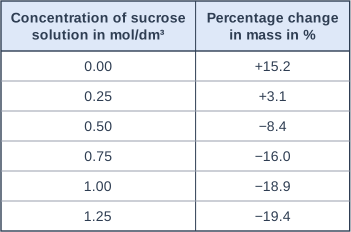
Jordan left one potato cylinder in each of six sucrose solutions for 24 hours. He did not repeat the investigation.

The table shows his results.

Jordan concluded: 'The higher the concentration of the sucrose solution, the more mass the potato cylinders lose.'

Evaluate Jordan's conclusion. Use data from the table in your answer.

Table with columns "Concentration of sucrose solution in mol/dm³", "Percentage change in mass in %". Concentration of sucrose solution in mol/dm³: 0.00; Percentage change in mass in %: +15.2 | Concentration of sucrose solution in mol/dm³: 0.25; Percentage change in mass in %: +3.1 | Concentration of sucrose solution in mol/dm³: 0.50; Percentage change in mass in %: −8.4 | Concentration of sucrose solution in mol/dm³: 0.75; Percentage change in mass in %: −16.0 | Concentration of sucrose solution in mol/dm³: 1.00; Percentage change in mass in %: −18.9 | Concentration of sucrose solution in mol/dm³: 1.25; Percentage change in mass in %: −19.4.

Model answer

The results partly support the conclusion. From 0.50 to 1.00 mol/dm³ the cylinders lost more mass as the concentration increased: −8.4 % at 0.50, −16.0 % at 0.75 and −18.9 % at 1.00 mol/dm³.

However, the cylinders in 0.00 and 0.25 mol/dm³ did not lose mass at all: they gained +15.2 % and +3.1 %. Also, from 1.00 to 1.25 mol/dm³ the loss hardly changed (−18.9 % to −19.4 %). He used only one cylinder at each concentration, so the results may not be repeatable.

So the conclusion is only partly correct. A better conclusion is that the higher the concentration, the lower the percentage change in mass.

Explanation

To evaluate a conclusion, give evidence from the data that supports it and evidence that does not, then make a judgement. Here the cylinders in the weak solutions gained mass, and at the highest concentrations the loss levels off, so the conclusion is only partly right. Also consider how much the results can be trusted: one cylinder per concentration gives no way to check for anomalies.

Mark scheme
  1. 1 mark

    (supports) from 0.50 to 1.00 mol/dm³ the loss in mass increases as the concentration increases, e.g. −8.4 % at 0.50 and −18.9 % at 1.00 mol/dm³

    Max 2 if the answer gives only one side (only evidence that supports or only evidence that does not support the conclusion). An answer including four from the five points; max 4. Max 3 if no data from the table are used.

  2. 1 mark

    (does not support) the cylinders in 0.00 and 0.25 mol/dm³ gained mass (+15.2 % and +3.1 %), so they did not lose mass

    accept the conclusion is only true for the solutions above about 0.3 mol/dm³ / for the solutions that are more concentrated than the potato cells

  3. 1 mark

    (limitation) from 1.00 to 1.25 mol/dm³ the loss in mass hardly increases (−18.9 % to −19.4 %), so the effect levels off / the difference is so small that it may be due to error

    accept above 1.00 mol/dm³ a higher concentration makes very little difference; accept the loss levels off at the highest concentrations. This point counts as evidence that does not fully support the conclusion for the 'Max 2' rule.

  4. 1 mark

    only one cylinder was used at each concentration / there are no repeats, so the results may not be repeatable and anomalies cannot be spotted

    accept he should repeat with more cylinders and calculate a mean before making a conclusion

  5. 1 mark

    a better conclusion: the higher the concentration, the lower the percentage change in mass (a gain turning into a bigger loss) / the conclusion is partly correct

    accept a judgement that the conclusion is true only for the higher concentrations / is only partly correct, with a reason

Ready to try the rest? Every answer you write is marked against the mark scheme, so you can see exactly where the marks are.

Study Helper Hints first, answers after you try

Stuck on this one? Ask for a hint and I’ll point you in the right direction, without giving the answer away. Once you’ve checked your answer, I’ll show you how the marks are awarded.