
Level:
Correct: 0
Incorrect: 0
Marks: 0/0
Exam Practice
Course:
Topics:
Edexcel GCSE Combined Science (Foundation Biology Paper 2) Smart practice A mixed round aimed at your weak spots
Avg
score:
–
Topics
done:
0/28

Enzyme action and factors affecting enzymes

Practise 14 exam-style questions on Enzyme action and factors affecting enzymes for Edexcel GCSE Combined Science (Foundation Biology Paper 2). Write your answer as you would in the exam and get it marked in seconds against the mark scheme, point by point, with the Study Helper on hand if you get stuck.

  • 14 questions
  • 1–6 marks each
  • Instant marking
  • No sign-up needed
14 questions, marked as you go

Sample questions with model answers

Here are 4 of the questions in this topic, each with a model answer, an explanation of why it earns the marks and the mark scheme an examiner would use.

Question 1

1 mark

When an enzyme is heated to a high temperature, the shape of its active site changes permanently and its substrate can no longer fit.

Which word describes the enzyme after this change?

Choose your answer.

  • A denatured
  • B digested
  • C killed
  • D specific

Model answer

A - denatured

Explanation

A high temperature (or a pH far from the optimum) changes the shape of the active site, so the substrate no longer fits: the enzyme is denatured. A common mistake is to say the enzyme is 'killed': enzymes are protein molecules, not living organisms.

Mark scheme
  1. 1 mark

    A / denatured

    The only correct answer is A: an enzyme whose active site has changed shape so that the substrate no longer fits is denatured. B is not correct because digested means broken down into smaller molecules, which is not what happens when an enzyme is heated; C is not correct because enzymes are molecules, not living things, so they cannot be killed; D is not correct because specific describes how an enzyme's active site fits only one substrate, which is lost when it is heated. Accept the letter or the option. If more than one option is given, do not award the mark.
Question 2

2 marks

Meat tenderiser is a powder that contains papain, a protease enzyme from papaya fruit.

A student put a small cube of boiled egg white into a solution of meat tenderiser in a warm water bath. Apart from water, egg white is mostly protein. After one day, the cube of egg white was much smaller.

Explain how the papain made the cube of egg white smaller.

Model answer

The protein in the egg white is the substrate of papain. A protein molecule fits into the active site of papain and an enzyme-substrate complex forms. The papain breaks the protein down into amino acids, which are small molecules that dissolve in the solution, so the cube of egg white gets smaller.

Explanation

A protease breaks proteins down into amino acids. Each protein molecule binds to the active site, forming an enzyme-substrate complex, and the products are released. The amino acids are small enough to dissolve and move out of the cube, so it shrinks. Saying only 'papain digests the egg white' does not explain how.

Mark scheme
  1. 1 mark

    the protein (in the egg white) fits into / binds to the active site of papain / forms an enzyme-substrate complex with papain

    An explanation linking two points. accept the active site of papain is complementary to the protein / the protein is the substrate of papain and binds to it. Ignore 'papain is a protease' or 'papain digests the egg white' on its own for this mark.

  2. 1 mark

    the protein is broken down into amino acids / into small (soluble) molecules, which dissolve / pass into the solution (so the cube gets smaller)

    accept the protein is digested into amino acids. Do not accept broken down into sugars / glucose / fatty acids and glycerol. Do not award this mark for 'papain breaks down the protein' with no reference to amino acids or small molecules. Ignore 'the papain eats the egg white' / 'the egg white melts'.

Question 3

2 marks

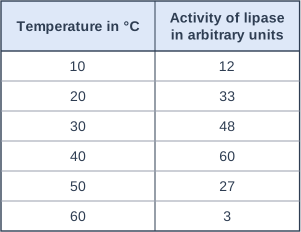
Germinating sunflower seeds contain lipase. Lipase breaks down the oil stored in the seeds.

A scientist measured the activity of lipase from sunflower seedlings at different temperatures. The table shows the results.

Calculate the activity at 20 °C as a percentage of the activity at the optimum temperature.

Table with columns "Temperature in °C", "Activity of lipase in arbitrary units". Temperature in °C: 10; Activity of lipase in arbitrary units: 12 | Temperature in °C: 20; Activity of lipase in arbitrary units: 33 | Temperature in °C: 30; Activity of lipase in arbitrary units: 48 | Temperature in °C: 40; Activity of lipase in arbitrary units: 60 | Temperature in °C: 50; Activity of lipase in arbitrary units: 27 | Temperature in °C: 60; Activity of lipase in arbitrary units: 3.

Model answer

The optimum temperature is 40 °C, where the activity is 60 arbitrary units.
percentage = 33 ÷ 60 × 100
= 55 %

Explanation

First find the optimum temperature: the temperature with the highest activity (60 at 40 °C). Then divide the activity at 20 °C by the highest activity and multiply by 100. Dividing the larger number by the smaller gives an answer over 100 %, which cannot be right here.

Mark scheme
  1. 1 mark

    substitution: 33 ÷ 60 × 100; or a correct final answer of 55 % with no working

    An answer of 55 % with no working scores 2 marks. 60 ÷ 33 × 100 = 182 % (dividing the wrong way round) scores 0. Using a value other than 60 as the activity at the optimum (for example 33 ÷ 48 × 100 = 69 %) scores 0. 33 ÷ 60 = 0.55 with no × 100 scores this mark only.

  2. 1 mark

    evaluation: 55 (%)

    Ignore units.

Question 4

4 marks

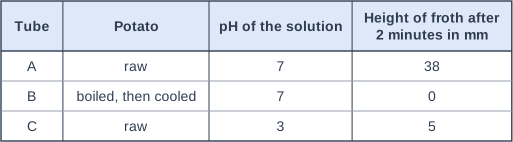
Potato cells contain the enzyme catalase. Catalase releases oxygen gas from hydrogen peroxide, which makes a froth of bubbles.

Ali set up three tubes, A, B and C. Each tube had 10 cm³ of hydrogen peroxide solution and 5 g of potato, and all the tubes were kept at 20 °C. The table shows the potato and the pH used in each tube, and the height of froth after 2 minutes.

Ali concluded: 'Boiling and acid both stop catalase from working completely.'

Use the results to explain how far Ali's conclusion is correct.

Table with columns "Tube", "Potato", "pH of the solution", "Height of froth after 2 minutes in mm". Tube: A; Potato: raw; pH of the solution: 7; Height of froth after 2 minutes in mm: 38 | Tube: B; Potato: boiled, then cooled; pH of the solution: 7; Height of froth after 2 minutes in mm: 0 | Tube: C; Potato: raw; pH of the solution: 3; Height of froth after 2 minutes in mm: 5.

Model answer

Ali is right about boiling. The boiled potato in tube B made no froth at all (0 mm). Boiling denatured the catalase: the high temperature changed the shape of the active site permanently, so even after cooling, hydrogen peroxide could not bind and no enzyme-substrate complexes formed.
Ali is wrong about acid. The raw potato at pH 3 in tube C still made 5 mm of froth, so the catalase still worked a little, although much less than at pH 7 (38 mm). pH 3 is far from the optimum pH, so the shape of the active site changes and fewer substrate molecules can bind. So his conclusion is only partly correct.

Explanation

Check the conclusion against each result in turn. Tube B (0 mm) supports it for boiling, but tube C (5 mm) does not support it for acid: the acid slowed the catalase a lot but did not stop it. Kinetic energy is not relevant here because all three tubes were at the same temperature.

Mark scheme
  1. 1 mark

    (boiling) the boiled potato / tube B made no froth (0 mm), so the conclusion is correct for boiling

    Max 2 if no data from the table are used. accept boiling did stop the catalase working completely (tube B, 0 mm).

  2. 1 mark

    (boiling) the catalase was denatured: the high temperature changed the shape of the active site (permanently, even after cooling), so hydrogen peroxide could no longer bind / no enzyme-substrate complexes formed

    accept the substrate is no longer complementary to the active site. Do not accept 'the enzyme was killed'.

  3. 1 mark

    (acid) tube C / the potato at pH 3 still made some froth (5 mm), so acid did not stop catalase completely / the conclusion is not correct for acid

    accept the acid only slowed the catalase down (5 mm compared with 38 mm at pH 7).

  4. 1 mark

    (acid) pH 3 is far from the optimum pH of catalase, so the shape of the active site changes / some of the catalase is denatured, so fewer substrate molecules bind / fewer enzyme-substrate complexes form

    accept the catalase works more slowly at pH 3 than at pH 7 because the active site is a different shape. Ignore references to kinetic energy (the temperature was the same in every tube).

Ready to try the rest? Every answer you write is marked against the mark scheme, so you can see exactly where the marks are.

Study Helper Hints first, answers after you try

Stuck on this one? Ask for a hint and I’ll point you in the right direction, without giving the answer away. Once you’ve checked your answer, I’ll show you how the marks are awarded.